- 24 Hour Emergency Services
- Servicing Sydney's North Shore
- View On Map

-
Mail Us On
info@lsblocksmiths.com.au
-
Make a Call
0411 700 072
- View On Map
- 24 Hour Emergency Services
- Servicing Sydney's North Shore
- View On Map
-
Mail Us On
info@lsblocksmiths.com.au
-
Make a Call
0411 700 072
- Contact Us
Window Safety Devices NSW: Your 2026 Compliance Guide

Lock, Stock & Barrel Locksmiths
On July 12, 2026
A strata manager in Hornsby gets an AGM agenda with “window safety compliance” buried between gutter repairs and insurance. A family moving into an apartment in Pymble notices the bedroom window opens wide and starts wondering whether that's safe, legal, or both. Window safety devices are often only considered when a notice arrives, a tenant raises it, or a child starts climbing.
That's when the confusion starts. The law uses technical measurements. Buildings have different window types. Strata rules, landlord obligations, and emergency escape all overlap. Standard advice often stops at “fit a lock”, which is exactly where the practical problems begin.
Lock, Stock & Barrel Locksmiths is a father-and-son Master Locksmith business based in Turramurra, working across Sydney's Upper North Shore. This guide cuts through the jargon and focuses on what people in places like Hornsby, Wahroonga and Gordon need to check. It covers how the NSW rules work, which windows are high-risk, what devices are worth fitting, and where responsibility usually lands when strata, owners, landlords and tenants are all involved.
A Practical Guide to NSW Window Safety Laws
Window safety usually becomes urgent all at once. A strata committee gets told several units may need retrofits. A landlord receives a tenant request for child-safe restrictors. A homeowner realises the nursery window sits low enough for a toddler to reach. The issue isn't abstract when the window is already there, opening too far.
Where North Shore properties get caught out
On the North Shore, the common problem isn't just new apartments. Older strata buildings often have aluminium sliders, timber sashes, or awning windows that were installed long before anyone talked about child restrictors in everyday terms. They still need to be assessed properly.
The tricky part is that a window can look harmless and still be classed as high-risk. A low sill height inside the room matters. So does the drop outside. The result is that bedrooms, living rooms, stair landings and common-area windows can all need different treatment, even within the same block.
Practical rule: The right question isn't “does this window have a lock?” It's “does this window open in a way that meets the safety rule without creating another problem?”
What this means in real terms
For homeowners, the job is usually identifying which windows need attention and fitting the right kind of restrictor, lock or guard. For strata managers, it's broader. They need a process that identifies affected windows, records what was installed, and avoids devices that create fresh liability.
For landlords, there's often another layer. A tenant may ask for something more child-specific than the existing window hardware. That's where the legal position can feel less clear than it should be.
This guide keeps the focus on practical decisions. Which windows count. Which products generally suit which window types. What doesn't comply. And why professional installation matters when the device has to restrict opening, hold firm under pressure, and still be workable for an adult in an emergency.
Understanding the NSW Window Safety Legislation
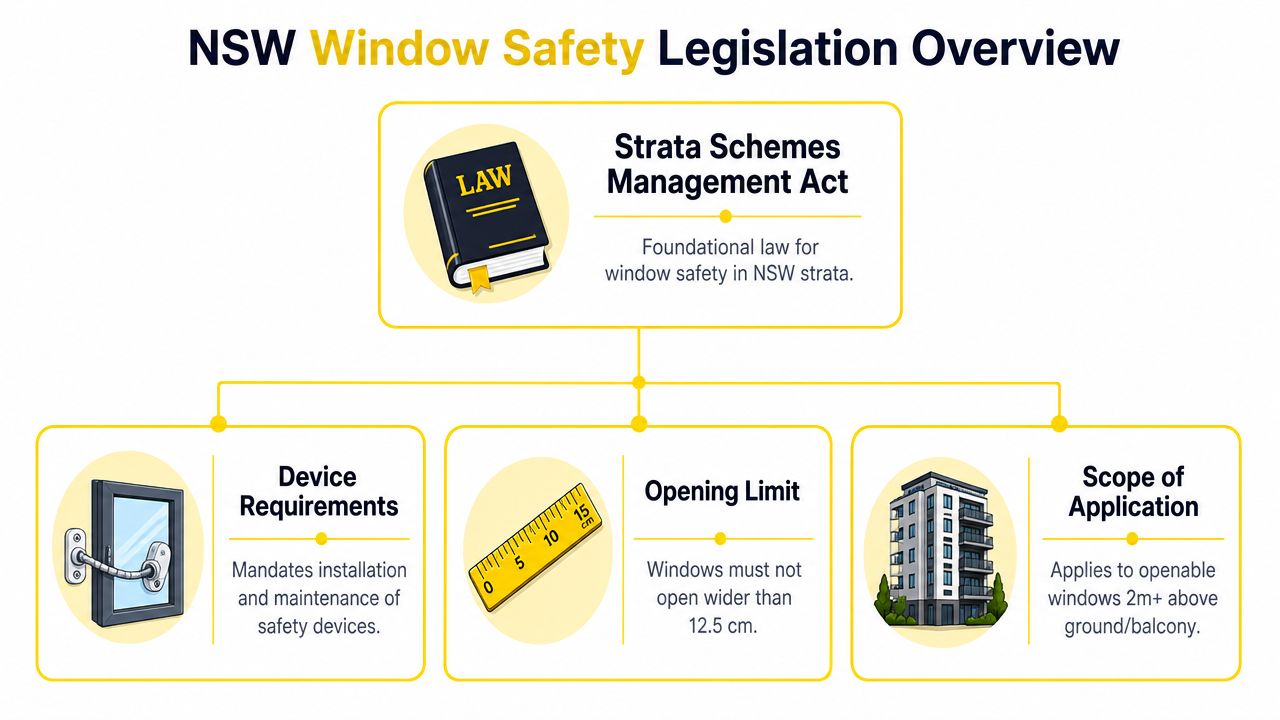
The law is easier to understand once it's stripped back to the measurements that matter. In NSW, a mandatory child window safety law commenced on 13 March 2018, requiring all strata buildings to install compliant safety devices on high-risk windows that open more than 12.5 cm. Those devices must withstand 250 newtons, which is noted as equivalent to 25 kg of force, and responsibility in strata schemes sits with the owners' corporation according to this NSW child window safety legislation summary.
The measurements that matter
The rule is understood faster when it's translated into plain English.
- Opening limit means the window must be restricted so the opening is 125 mm or less where the law applies.
- Strength requirement means the device can't be a flimsy add-on. It must resist 250 newtons of outward or horizontal force.
- Scope means this isn't only about brand-new developments. Existing strata buildings in NSW also fall within the requirement where the window is high-risk.
That last point catches plenty of committees off guard. Older buildings in suburbs like Killara or St Ives don't get a pass just because the windows were installed years ago.
What the legal wording means on site
On site, compliance isn't about ticking a box with any lock from a hardware shelf. The device has to do a specific job. It must physically control how far the sash or panel opens. It also needs to stay secure under force that a child could apply by leaning, pushing, or climbing.
That's where poor product choice shows up quickly. A general security latch may help with basic locking, but that doesn't automatically make it a compliant child safety device. The device has to suit the window's operation, frame material and fixing points.
For strata committees wanting a practical breakdown of that overlap between child safety and building access, this earlier guide on window safety devices and fire safety compliance for Sydney's North Shore strata committees is useful background.
A compliant device isn't just about limiting movement. It has to be installed in a way that makes that limit reliable.
Why this confuses people
The legislation sounds simple on paper, but windows aren't standard. Sliding windows behave differently from double-hungs. An awning window can create a very different opening path from a slider. That's why two neighbouring units in the same block may need different hardware solutions even if the windows look similar from the outside.
Identifying High-Risk Windows in Your Property
The fastest way to assess a window is to stand in front of it and work through three checks. A window is considered high-risk if it can be opened, is less than 1.7 metres above the internal floor, and the floor is 2 metres or more above the ground outside. Standard fly screens don't comply, according to this NSW strata window lock guide.
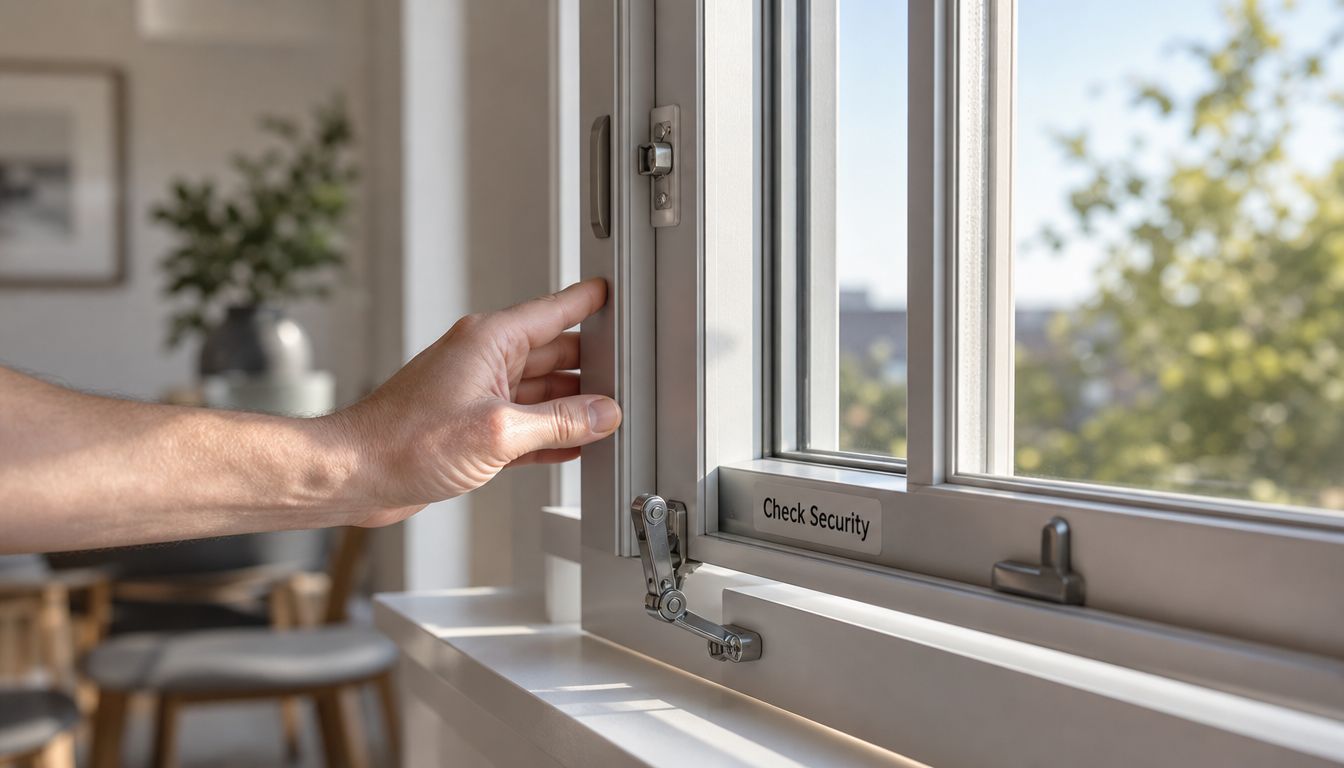
A simple three-check test
Use this checklist room by room.
Can the window open?
Fixed glazing isn't the issue here. Openable windows are.Is the sill under 1.7 metres from the inside floor?
If a child can access a low window, risk rises quickly.Is the outside drop 2 metres or more below the inside floor level?
That could be to ground level, a lower roof, or another external surface below.
If the answer is yes to all three, that window needs close attention.
What owners often miss
The first miss is the outside level. People often judge risk from inside the room and forget the ground outside may fall away. That's common on sloping North Shore sites, where one side of an apartment block sits much higher above the outside surface than the other.
The second miss is assuming an insect screen counts as protection. It doesn't. A fly screen is designed to keep insects out, not to stop a person falling through. That misunderstanding has been behind plenty of false confidence over the years.
Common mistake: If the only thing between a child and the opening is a fly screen, that window hasn't been made safe.
A quick audit approach for homes and strata
For a house or one unit, a notepad and room-by-room check is enough to create a list. For strata, the better method is grouping windows by type and location.
- Bedrooms first because low sills are common.
- Living rooms next because furniture often sits near windows.
- Common property windows such as stairwells and corridors shouldn't be ignored.
- Different elevations matter on split-level or sloping sites.
A useful starting point for committees and owners is this guide on whether windows comply with the new safety rules, especially where there's uncertainty about which openings need devices and which don't.
Types of Compliant Window Safety Devices
Not every compliant solution looks the same, and not every window should be treated with the same hardware. The right choice depends on how the window opens, how often adults need to use it, and whether the frame will take secure fixings without damage or poor alignment.
What tends to be used in practice
The common categories are restrictors, keyed or releasable locking devices, and guards or compliant screen-based solutions. Product names vary by manufacturer, but the core issue isn't brand recognition. It's whether the device suits the window and can be installed so it performs properly.
For example, cable restrictors are often used on certain opening window styles where controlled travel is needed. Sliding window bolts and purpose-made restrictors are more common on aluminium sliders. Guard-style options may suit windows where the opening needs to remain functional but the fall risk has to be physically controlled in another way.
Comparison of Compliant Window Safety Devices
| Device Type | Best For | Pros | Cons |
|---|---|---|---|
| Cable restrictors | Some hinged or projecting windows | Good for controlled opening, can preserve ventilation, often discreet | Must be correctly positioned, not ideal for every frame or opening style |
| Sliding window restrictors or bolts | Aluminium sliding windows | Neat fit on the right slider, simple day-to-day use for adults | Wrong placement can cause misalignment or unreliable restriction |
| Lockable window restrictors | Windows needing controlled opening plus secured release | Useful where adult access needs managing carefully | A poor-quality unit or poor fixing method can undermine compliance |
| Guards or compliant heavy-duty barrier options | Openings where physical barrier control makes more sense | Clear physical protection, useful in some difficult layouts | More visible, can affect appearance and cleaning access |
What works and what usually doesn't
What works is hardware chosen for the actual window. A locksmith looks at travel path, fixing material, sash weight, and whether the release can be operated by an adult without defeating the safety purpose.
What usually doesn't work is retrofitting a generic latch because it was available quickly. That may improve basic security while doing nothing useful for child fall prevention. It can also create a false record of “compliance work” that won't stand up to proper scrutiny.
One practical option for owners and strata managers who want a service built around this kind of assessment is window safety devices installation. The useful part isn't just supply of hardware. It's matching the fitting method to the window so the device functions the way it's meant to.
The best device on the shelf can still be the wrong device once it meets an awkward frame, worn track, or poorly aligned sash.
A tradesperson's selection rule
If the hardware interferes with normal adult operation, people often prop it open, disable it, or stop using it properly. If it's too weak, it fails the reason it was fitted in the first place. Good selection sits in the middle. Safe for children, workable for adults, and durable enough for daily use.
Installation and Maintenance Who Is Responsible
Responsibility is where most arguments start. In strata property, windows often sit in that awkward space where people assume they belong to the lot, but the legal and practical responsibility may point elsewhere.
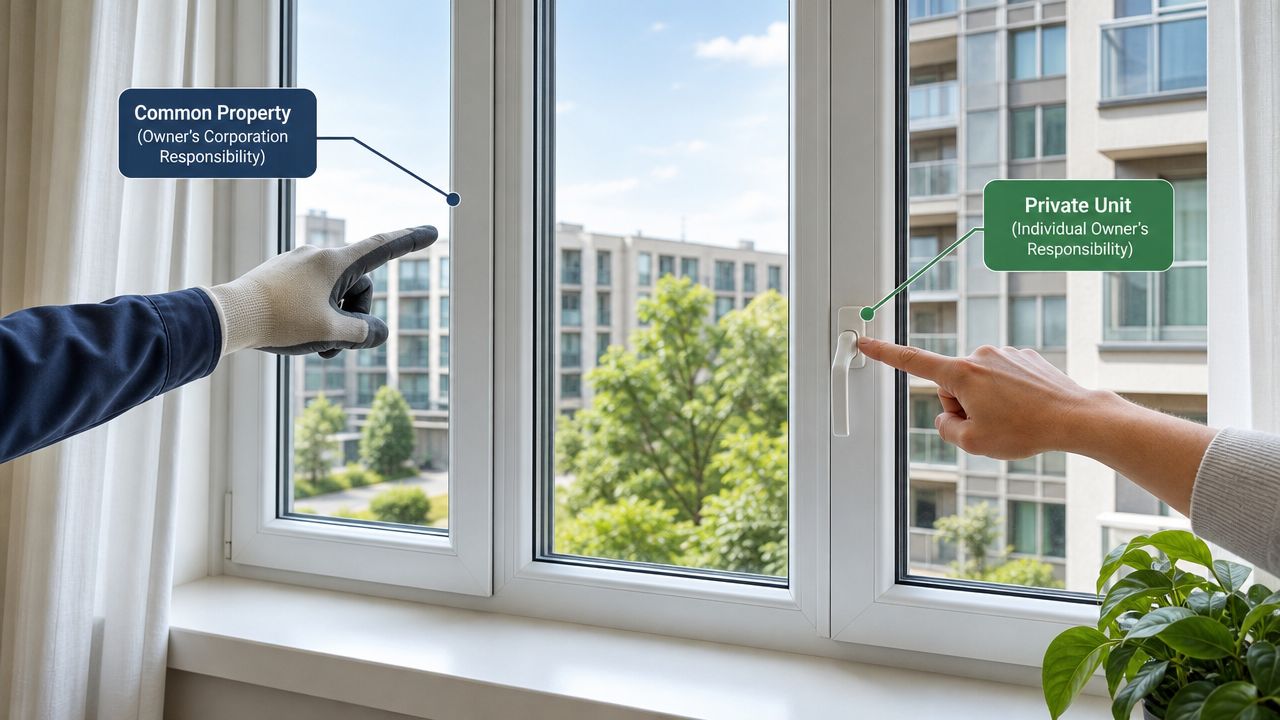
The key point from the NSW position already noted above is that in strata schemes, responsibility for compliance falls on the owners' corporation where the relevant windows are part of common property. The practical issue then becomes identifying which windows are common property under the scheme and who authorises the work.
Strata, owners and landlords
In day-to-day terms, the split often looks like this:
- Owners' corporations usually deal with common property obligations and building-wide compliance processes.
- Lot owners need to know whether the specific window hardware in their unit falls within scheme responsibility or their own.
- Landlords need to respond when a rental property has a window safety issue or when a tenant raises a concern about a specific opening.
That sounds tidy in writing. It rarely feels tidy on site. Some schemes want all devices standardised across the building. Others leave internal lot arrangements partly to owners, subject to by-laws and approvals.
The emergency egress problem
The part many guides skip is the conflict between child safety and emergency escape. Compliant devices must limit openings to 125 mm, withstand 250 newtons of force, and still allow adult override in an emergency such as a fire, as highlighted in this discussion of the emergency escape versus child safety trade-off.
That requirement changes everything about installation. A device fitted too aggressively can turn a window into a trap. A device fitted too lightly can be defeated by force. Either result is a failure.
Life-safety issue: The job isn't finished when the window stops at the right gap. The release method also has to work for an adult when stress is high and time is short.
Why DIY can go wrong
DIY installation usually falls short in one of three ways.
- Bad fixing points where screws are driven into weak material or the wrong section of the frame.
- Poor placement that changes the opening path and makes the restrictor unreliable.
- No thought for release so the device meets the gap requirement but creates a serious egress problem.
Maintenance matters as well. Windows move over time. Tracks wear. Timber shifts. Fasteners loosen. Even a correctly installed device should be checked when windows are replaced, renovated, painted heavily, or start operating differently from before.
Window Safety Devices FAQ for North Shore Residents
Can these devices be installed without a tradesperson
Some hardware can be bought off the shelf, but that doesn't mean every installation will be compliant or safe. The difficulty is rarely the screw gun. It's selecting a device that suits the window and fitting it so it restricts properly without creating an emergency escape problem.
Do the rules apply to ground-floor apartments
Sometimes yes, sometimes no. The deciding factor is the drop outside that window, not the label on the apartment. A ground-floor unit on a sloping site can still present a high-risk opening if the outside level is far enough below the inside floor.
Do fly screens count if they feel sturdy
No. That point has already been dealt with earlier because it's one of the most common misunderstandings. If a resident wants fall protection, the answer is an approved restrictor, lock, guard, or another compliant device suited to that window.
What if a tenant asks for child-specific restrictors
A genuine liability gap exists. According to this PICA Group article on strata window locks, there's ambiguity about who bears the cost when a tenant asks for child-specific restrictors and the existing locks meet basic security needs but not the 125 mm child safety rule. The same source notes that non-compliance fines for owners' corporations can be up to $550.
For landlords, that means “the window already locks” may not be the end of the issue. If a tenant raises a child safety concern, the request should be assessed against the actual risk and the applicable strata arrangements, not brushed aside as a preference upgrade.
How much does professional installation cost
That depends on the window type, the number of windows, access, and whether any existing hardware has to be removed or corrected first. It's better to get the actual windows assessed than rely on broad price talk that may not reflect the job.
What should strata managers in Hornsby do first
Start with an audit list, not a shopping list. Identify the affected windows, confirm responsibility under the scheme, and then get advice on device selection and fitting method. That avoids ordering one product for every unit only to find it suits only part of the building stock.
For local building-specific help, residents and strata managers can view the Hornsby NSW locksmith service area page and then arrange a site assessment for the actual windows involved.
If window safety devices in NSW are on the agenda for a home, rental, or strata building, call Lock, Stock & Barrel Locksmiths or request a quote for a practical assessment. The focus should be on the actual windows in front of the owner, landlord or committee, and on fitting hardware that's safe, workable and appropriate for the building.