- 24 Hour Emergency Services
- Servicing Sydney's North Shore
- View On Map

-
Mail Us On
info@lsblocksmiths.com.au
-
Make a Call
0411 700 072
- View On Map
- 24 Hour Emergency Services
- Servicing Sydney's North Shore
- View On Map
-
Mail Us On
info@lsblocksmiths.com.au
-
Make a Call
0411 700 072
- Contact Us
Garden Shed Lock Guide for St Ives, NSW Homes

Lock, Stock & Barrel Locksmiths
On July 26, 2026
A rusted padlock on a shed door looks harmless until someone notices what's inside, a decent mower, a couple of bikes, ladders, hand tools, seed trays, and everything else a busy household leaves outside the main wall. In Sydney's suburbs, that shed sits inside the home-security perimeter, not outside it. The Australian Bureau of Statistics reported that in 2022–23 there were about 8.2 million households in Australia, and 8.3% experienced at least one break-in or attempted break-in in the previous 12 months, which is roughly 680,000 households; in NSW, the figure was 7.9%, or about 233,000 households. Those numbers are a blunt reminder that a garden shed lock is part of real property security, not a decorative extra, and the same logic applies whether the property is in St Ives or anywhere else on the Upper North Shore.
Why Your Garden Shed Needs More Than a Basic Padlock
A lot of shed security fails because the owner looks at the padlock first and the structure second. That's backwards. If the door flexes, the frame splits, or the hinges are held on with flimsy fixings, even a decent lock is only securing weak timber.
The shed is part of the house perimeter
Outbuildings attract attention for the same reason the main house does, they hold portable items that can be moved quickly. In practical terms, that means tools, bikes, ladders, and garden equipment should be treated as part of the property's protected zone, not as spare items in a backyard corner. The ABS break-in figures above matter because they show the risk is not theoretical.
A homeowner in St Ives might see a small timber shed and assume the problem is minor. In the field, that assumption usually costs more later. Once the lock is defeated, or the door is forced, the thief doesn't need much time to carry off items one by one.
Practical rule: if the door or frame is the weak point, the padlock is doing all the work and that's rarely enough.
That's why a proper garden shed lock setup starts with the shed itself. A lock should slow a thief down, create noise, and force tools or time. It should not be the only thing standing between the yard and the contents inside. For a basic hardware upgrade path, a local service page such as padlock installation and supply is a sensible starting point, but only if the door and fittings are sound enough to hold it.
Why the structure matters as much as the lock
Outdoor security also runs into weather, movement, and age. Timber swells and shrinks, screws loosen, and old sheds often have soft spots near the door edge. A shed lock that feels solid in summer can bind, misalign, or rip out if the frame has already started to move.
That's the reason professional locksmiths look at the complete opening, the door leaf, the jamb, the hinges, and the strike area. A good lock on a weak frame is just a delay. A good lock on a reinforced frame is a barrier.
Selecting the Best Lock and Hasp for Your Shed
The right hardware depends on the shed, not the other way round. Timber sheds usually give more room for reinforcement, while metal sheds often need compact, corrosion-aware hardware that matches the existing fixing points. In both cases, a hasp and staple plus padlock is a stronger approach than relying on a simple door lock, and the hasp should be fitted so it conceals the fixings when closed to reduce tampering, using coach bolts rather than screws where possible (security for garden outbuildings).
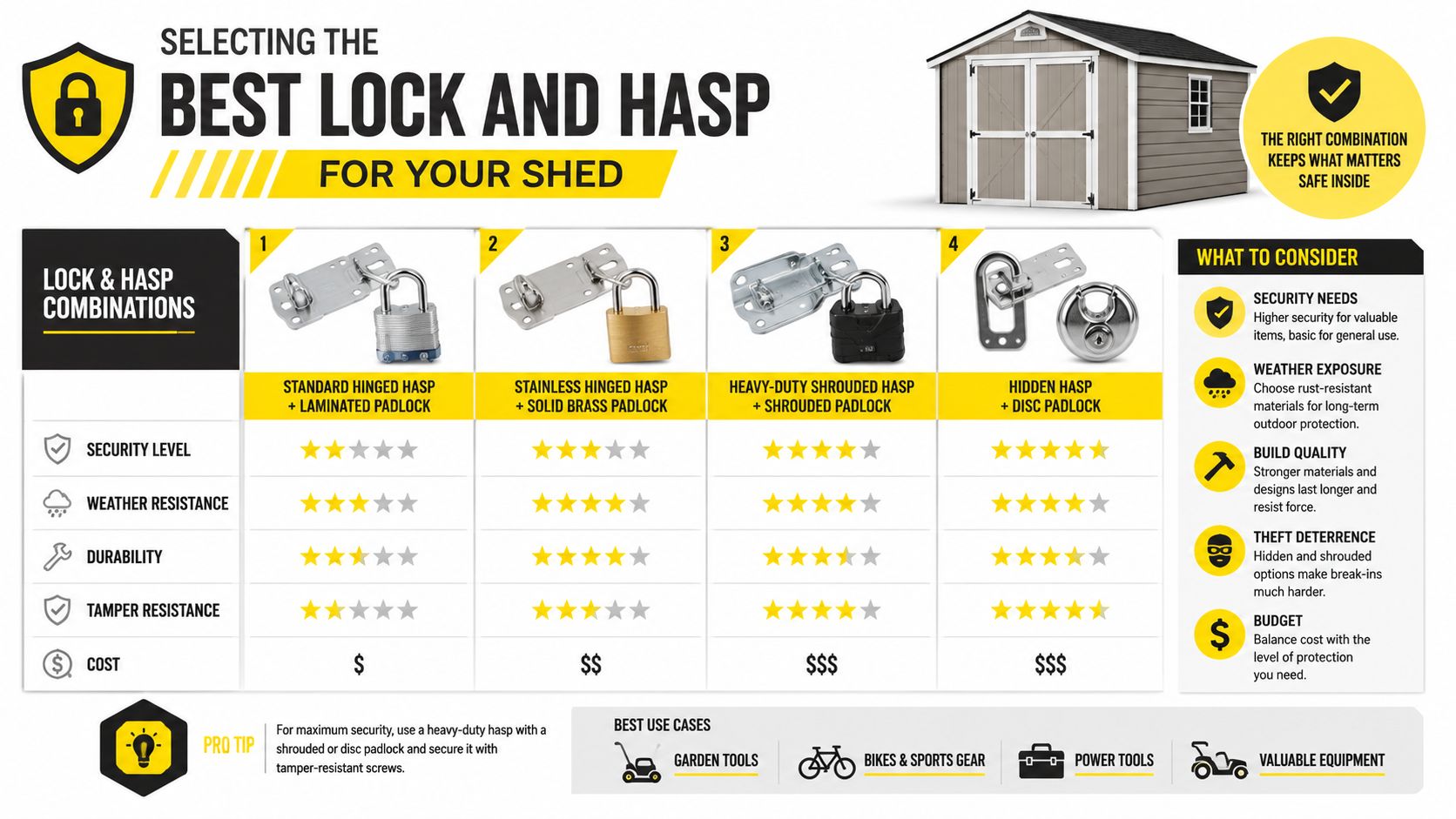
How the common options compare
Shrouded or closed-shackle padlocks suit outdoor sheds because the protected shackle is harder to crop and the exposed body can be easier to weatherproof. They work best on properly sized hasps with enough clearance for the shackle, and they're a poor choice if the hasp is undersized or the body sits too close to the wood to close cleanly.
Deadbolts can work on heavier doors, especially where the door construction and frame are already solid. They're not the answer for every shed, though, because they depend on correct alignment and a solid strike area. If the door twists or the frame moves, the bolt can start catching.
Mortice locks are more relevant where the shed door is built like a proper external door, with enough thickness and structure to take the hardware. On light garden sheds, they're often overkill or impractical. The lock looks neat, but if the door is thin, the fixing strength is still the limiting factor.
Garden Shed Lock Comparison
| Lock Type | Best For | Security Level | Weather Resistance |
|---|---|---|---|
| Shrouded padlock with hasp and staple | Timber sheds, general outdoor storage | Strong when fitted to reinforced timber | Good with weather-resistant hardware |
| Closed-shackle padlock with hardened hasp | Higher-value contents, exposed positions | Stronger against cutting and prying | Good if the body and fixings are protected |
| Deadbolt | Heavier shed doors with solid frames | Good on stiff, well-aligned doors | Moderate, depends on exposure and corrosion control |
| Mortice lock | Substantial doors that accept proper lock bodies | Good when fitted to a strong door | Moderate, needs careful maintenance |
What not to buy
A light-duty padlock on a thin hasp usually looks better than it performs. The weak point is often the fixing, not the lock body. If the hasp tears away or the screws back out, the lock hasn't failed on its own, the installation has.
A hardened steel hasp, proper bolt-through fixing, and enough space for the shackle are the details that matter. The cheapest setup is rarely the one that saves money, because the shed's structure ends up paying for the shortcut.
A Locksmith's Guide to Installing Your Shed Lock
The first job is not drilling. It's checking whether the door and frame can hold the hardware. A sturdy lock on rotting timber is a false economy, because a thief will attack the wood around the lock or the hinges if the frame gives way first.
Start with the timber, not the hardware
The door edge, the latch area, and the jamb deserve a close look. Soft spots, splits, and loose joints mean the surrounding timber needs attention before the lock goes on. If the fitting sits on thin cladding instead of the structural frame, the fasteners will only be as strong as that cladding.
That's why the hasp and staple should be fixed through the timber frame, not just the tongue-and-groove boards. The frame is the part designed to carry force. The boards are the skin.
A shed lock should bite into the structure, not just the surface.
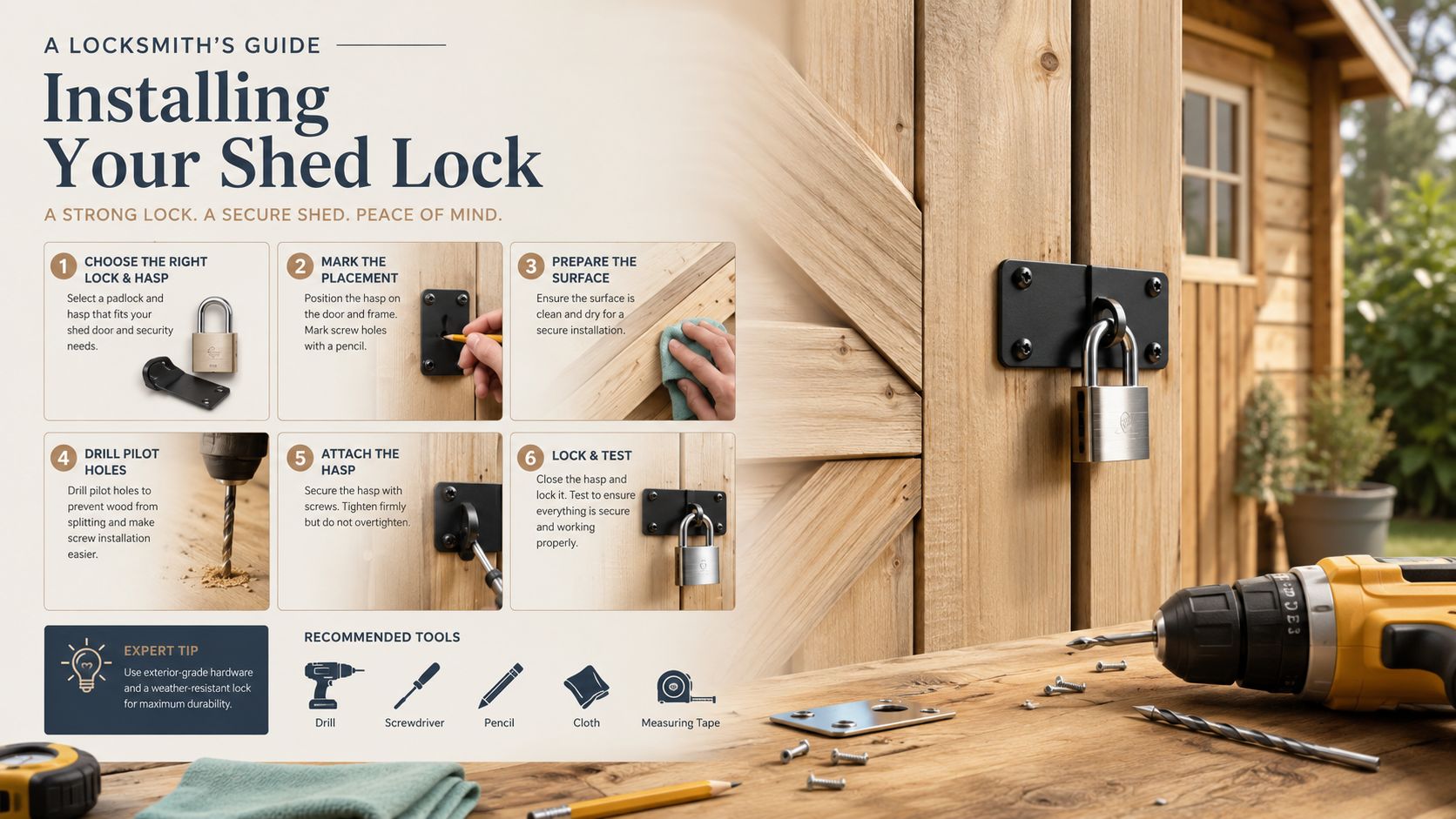
The source guidance on installation is straightforward, measure and mark the lock position, drill to manufacturer dimensions, mount the mechanism and strike or hasp, then test engagement and re-adjust before commissioning (installation tips). That sequence matters because a lock that binds or misaligns won't last long outdoors.
Fixings decide whether the lock survives attack
For timber sheds, coach bolts are far better than ordinary screws. Screws can loosen, strip, or be undone from the outside if the head remains accessible. Coach bolts pass through the timber and clamp the fitting with a nut and washer on the inside, which makes removal much harder.
The hasp should be positioned so the closed cover hides the fixings. That reduces the chance of someone attacking the screws or bolts directly. It also makes the fitting look cleaner, which usually means it was thought through properly.
A practical fitting sequence looks like this:
- Mark the exact centre line: Keep the lock aligned with the door closing path so the latch doesn't fight the frame.
- Drill to the manufacturer's dimensions: Oversized holes create movement, and movement creates wear.
- Bolt through the structural timber: Use coach bolts with washers and internal nuts rather than surface screws.
- Fit the hasp so the fixings are covered: The closed hasp should sit over the vulnerable points.
- Test the engagement several times: Open, close, lock, then check for rubbing or misalignment.
- Re-adjust before calling it done: Outdoor hardware drifts if the fit is only “close enough”.
Why the door needs reinforcing first
A lot of DIY installs fail because the owner assumes the lock itself carries the load. It doesn't. The hasp, staple, and the timber around them absorb the force, then the padlock resists the opening motion. If the door flexes too much, even a decent lock can be levered against weak wood.
For that reason, reinforcing the door edge or adding a metal back plate can be the difference between a workable installation and a quick defeat. The hardware is only one part of the system. The carpentry matters just as much.
Advanced Security Measures to Protect Your Shed's Contents
A locked door still leaves another problem, the thief may not need to steal the whole shed, only the contents. That's where internal anchoring comes in. The Secured by Design guidance recommends chaining garden tools, lawnmowers, and bicycles together and securing the chain to a purpose-made shed shackle, a ground anchor, or an anchor plate fixed to the floor, so the offender has to defeat multiple items at once (secure sheds and outbuildings).
Make the contents awkward to move
This is a simple but effective idea. A thief wants separate, carryable items. A chained bundle forces the offender to spend more time, make more noise, and use more tools. Heavy-duty chains can also be threaded through the handles of spades, shovels, and forks, which keeps the easy-to-grab gear from becoming easy-to-carry loot.
The same principle applies to lawn equipment and bikes. If the mower, the bike frame, and the anchor are all linked, the thief can't just pick off the lightest item and leave. That added friction is the point.
Protect more than the door
Windows are a weak point because they let a thief see what's worth taking and give a quicker entry route if they're broken. Hinges matter too, especially on older timber sheds where exposed fixings can be attacked from outside. If the hinge pin is vulnerable or the screw heads are open, the door becomes easier to remove than to force.
Useful habit: when a shed has a window, treat the window as an access point, not a light source with glass in it.
A layered shed setup often includes the following:
- Internal chain points: Keep the chain fixed low enough to anchor items, but high enough that it's not dragging on the floor.
- Window restriction or bars: Stop casual viewing and reduce the chance of a smash-and-grab entry.
- Concealed hinge fixings: Keep external fixings to a minimum where the door design allows it.
- Reinforced wall sections: Add support where the frame is weakest, especially around the opening.
The key trade-off is simple. More visible hardware can deter theft, but it can also advertise that something valuable sits inside. Internal restraint gives protection without turning the shed into a billboard.
Keeping Your Shed Lock Working Through Rain and Shine
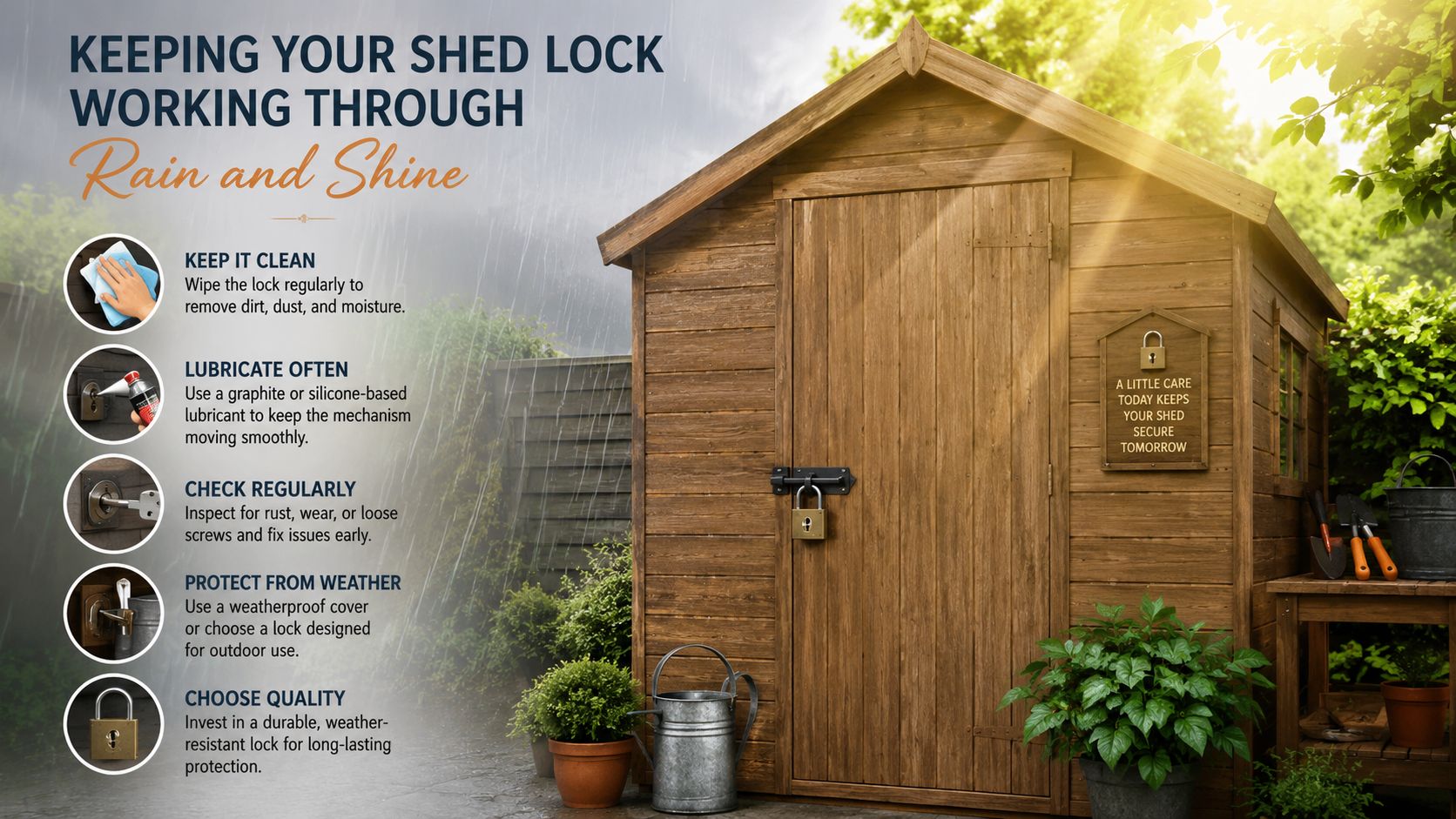
Outdoor locks live a harder life than indoor hardware. Rain, dust, salt air, garden grime, and temperature changes all create wear, and that wear shows up first as stiffness, then as sticking, then as failure. General shed-lock guidance recommends hardened, weather-resistant hardware, tamper-resistant fixings, and regular lubrication and inspection to reduce corrosion-related failures and sticking (shed door lock guidance).
Keep the mechanism clean and dry
A shed lock doesn't need heavy oil. It needs a clean mechanism and a light, suitable dry lubricant. Oil-based products tend to trap dirt, which makes outdoor locks gunk up faster. If a key starts to feel gritty or the shackle begins to stick, the lock is already telling its owner that moisture and debris have started to win.
A sensible maintenance habit is simple:
- Wipe off visible dirt: Use a dry cloth around the shackle and body.
- Check for rust spots: Surface rust is easier to deal with early.
- Lubricate lightly when needed: Use a dry lubricant rather than a sticky oil.
- Test the key fully: Lock and turn the key several times so sticking shows up before the shed is shut for the night.
- Inspect fixings and alignment: Loose screws, bent hasps, or swollen timber can put strain on the mechanism.
Watch for the small warning signs
A key that doesn't enter smoothly is usually not “just a bit stiff.” It often means the lock body is dirty, the shackle is corroding, or the hasp is no longer aligned properly. If the shackle has to be forced, the lock is wearing faster than it should.
Regular inspection also matters because outdoor hardware moves. Timber expands, the door drops, and the staple can sit slightly out of line after weather changes. A quick check catches that before the padlock starts getting blamed for a problem that came from the door.
For homeowners who'd rather not keep revisiting the same hardware, door lock maintenance advice is useful reading because the same habits that protect house locks help shed locks too, especially when the fitting is exposed to the elements.
When to Call a Professional North Shore Locksmith
A well-fitted garden shed lock should start with a strong hasp and staple, coach bolts instead of flimsy screws, a reinforced door or frame, and regular maintenance. If any of those pieces are missing, the job isn't finished. The lock might look new, but the shed still won't be secure.
The point where DIY stops making sense
Rotten timber changes the job completely. A cracked frame, swollen door, or damaged hinge line can make even good hardware unreliable, because the load moves into wood that can't hold it. That's the moment where repair comes before installation.
A professional can also help where the shed needs to fit into a broader access plan, such as a master key system for a home, strata site, or multi-use property. In some cases, it's less about buying a stronger padlock and more about making the shed's access consistent with the rest of the property. That's a different job from a simple hardware swap.
Some homeowners also just want the work done once, properly. That's sensible. Outdoor security hardware only works when it's aligned, bolted, and tested under real closing pressure, and a mobile locksmith can sort that on site with the right fittings and tools. For anyone weighing the labour and materials, locksmith cost information is a reasonable place to compare the job against a DIY run to the hardware shop.
Best time to call: when the shed door is damaged, the frame is soft, or the lock needs to be tied into other property security.
Lock, Stock & Barrel Locksmiths works across Sydney's North Shore, including St Ives, with lock fitting, repair, rekeying, and security hardware work for homes and small commercial sites. For a shed that needs proper reinforcement rather than guesswork, a local locksmith is often the cleaner fix.
If your shed door is weak, the frame is tired, or the current padlock looks more decorative than protective, Lock, Stock & Barrel Locksmiths can help with a proper on-site assessment and installation. Visit Lock, Stock & Barrel Locksmiths to request a quote or arrange a callout for shed lock repair, reinforcement, or replacement on Sydney's North Shore.