- 24 Hour Emergency Services
- Servicing Sydney's North Shore
- View On Map

-
Mail Us On
info@lsblocksmiths.com.au
-
Make a Call
0411 700 072
- View On Map
- 24 Hour Emergency Services
- Servicing Sydney's North Shore
- View On Map
-
Mail Us On
info@lsblocksmiths.com.au
-
Make a Call
0411 700 072
- Contact Us
Access Control System Installation in Hornsby NSW: A Guide

Lock, Stock & Barrel Locksmiths
On July 13, 2026
A lot of Hornsby properties reach the same point. The office has changed hands a few times, the strata committee has inherited a drawer full of labelled keys, and nobody is fully sure who still has access to the rear door, the plant room, the side gate or the shared foyer. One lost key becomes a much bigger problem when that key opens more than one area.
That's usually when people start looking seriously at access control system installation. Not because it's trendy, but because key management stops being practical. In older North Shore buildings especially, the issue isn't just security. It's convenience, accountability and avoiding another full rekey when a staff member leaves or a tenant never returns the master.
For Hornsby sites with a mix of older doors, newer tenancies and common areas, the right system needs to solve the everyday problem first. Who gets in, where, and when. After that, the hardware and wiring choices become much easier to understand.
Is It Time to Ditch the Keyring
A bulky keyring looks harmless until it starts causing operational problems. A shop manager has one copy for the front door, one for the back lane, one for the storeroom, one for the alarm cupboard. A strata manager has another set for common entries, service rooms and contractor access. Then someone leaves, a key goes missing, or a copy turns up that nobody authorised.
Mechanical keys still have their place, but they're hard to control once too many people need access. The main weakness isn't the lock itself. It's the lack of visibility. You can't switch off a lost key. You can't easily limit one cleaner to one door during one time window. And if control has slipped, the fix is often rekeying multiple cylinders and issuing fresh keys again.
What changes with electronic access
Electronic access control solves that specific headache. Instead of handing out permanent physical access, a building manager can assign a card, fob, PIN or approved credential to a person and remove it when needed. If a tenant moves out or a contractor's job ends, access is revoked without replacing every lock on site.
That's one reason demand has moved well beyond large commercial towers. The Australian market for electronic access control systems is projected to nearly double from USD 377.50 million in 2023 to USD 883.10 million by 2032, a 134% increase, which reflects a broad shift from traditional locks to scalable electronic security across Australian properties, according to Credence Research on the Australian electronic access control systems market.
Practical rule: If the main complaint is “too many keys and no clear record of who has them”, the site has usually outgrown a key-only setup.
Where older North Shore properties get caught
In Hornsby and nearby suburbs, many buildings sit in the awkward middle ground. They're not brand-new developments designed around smart entry from day one, but they're also too busy to keep relying on copied keys and manual sign-outs. Older timber doors, double brick walls, narrow risers and mixed hardware make upgrades less straightforward, but they don't make them impossible.
The sensible starting point is understanding what system fits the site. A small common-entry upgrade needs something different from a retail tenancy with staff-only back-of-house access. That's where the hardware choice matters. A more detailed breakdown sits in this overview of the benefits of access control systems for a business.
Your Options for Access Control Hardware
Most clients don't need a catalogue. They need a plain-English explanation of what each part does and what tends to work in real buildings.
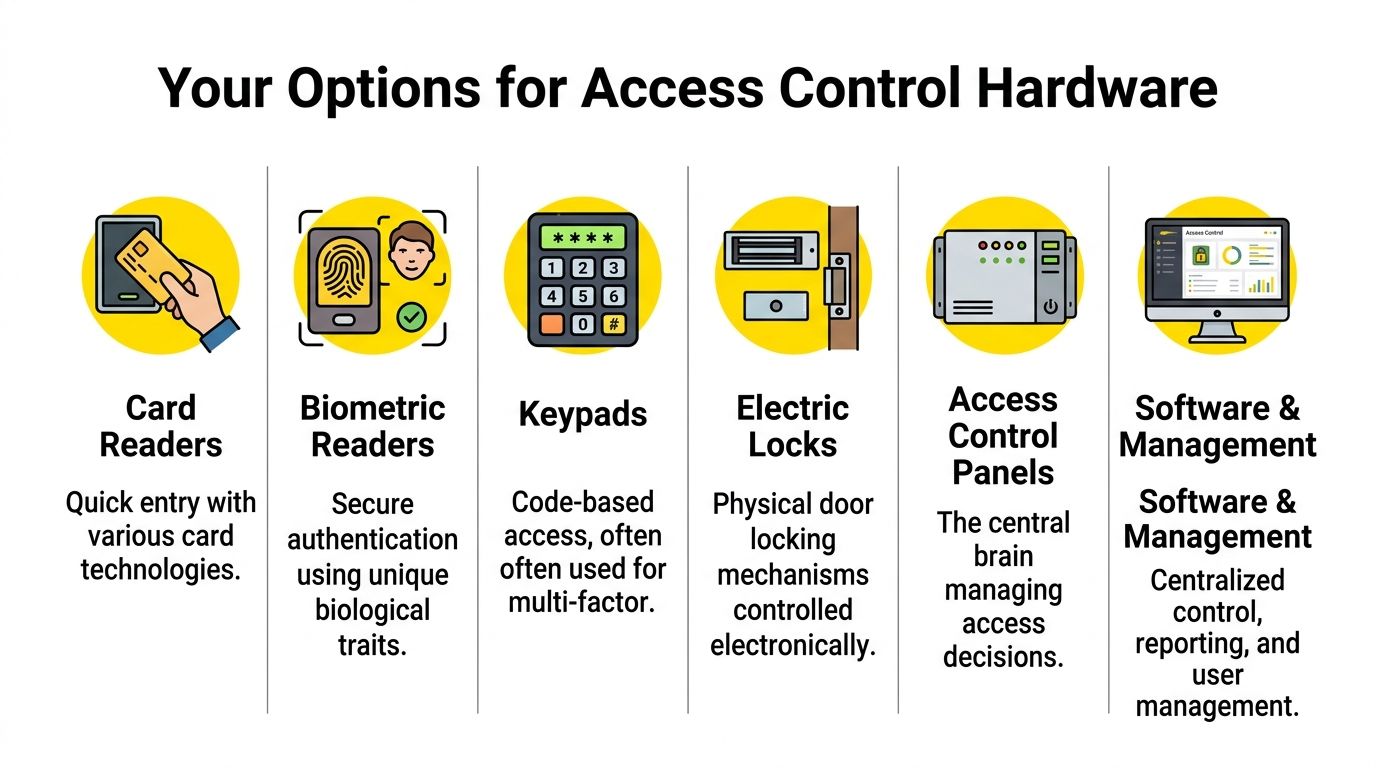
At the door, an access control system is simple. Someone presents a credential. The reader sends that information to a controller. The controller decides whether that person is allowed in. If the answer is yes, the lock releases. If the answer is no, the door stays secure.
The core parts on a typical job
Readers and credentials
Readers are what users interact with. The credential might be a card, key fob, PIN, mobile credential or biometric identifier.
- Card and fob readers suit most offices, common-area doors and shared entries. They're quick, familiar and easy to issue or cancel.
- Keypads can work well on lower-risk doors or where a code is useful as a backup. The trade-off is simple. Codes get shared.
- Biometric readers have a place in higher-security areas, but they need careful planning around user acceptance, cleanliness and the environment they're installed in.
- Mobile-based entry can be convenient, though it depends on device compatibility and the way the site wants to manage users.
For many strata and small commercial sites, cards or fobs remain the cleanest option because they balance security with easy administration.
Electric locking hardware
The lock is the physical part that secures the door. The door type plays a significant role.
| Hardware type | Often suited to | Main consideration |
|---|---|---|
| Electric strike | Doors with compatible latch hardware | Usually a tidy choice where the existing door can be adapted properly |
| Maglock | Some glass, aluminium or difficult frame conditions | Must be selected and installed with correct egress compliance in mind |
| Motorised or electronic lockset | Doors needing a more integrated lock body solution | Often chosen where appearance and door preparation matter |
A maglock isn't automatically the right answer just because it's common. On some older North Shore doors, an electric strike or a lockset retrofit ends up neater, more secure and less intrusive.
The parts people don't see matter just as much
The controller is the brain of the system. It decides who can enter and when. Good system design puts the controller in a secure location and matches it to the number of doors and the level of management the site needs.
Then there's the software. That's where users are added, permissions are changed and access events are reviewed. On a practical level, that's what turns a door from “locked or open” into a manageable building asset.
A cheap reader on the wall doesn't make a good system. The result depends on the lock choice, the controller setup, the power design and how easy the software is to manage after handover.
A useful primer on the building blocks sits in this explanation of what an access control system is. It helps before a site survey because it gives names to the parts people will hear discussed on site.
The Critical Site Survey and Design Phase
Most problems in access control installation start before any cable is run. They start when somebody assumes a North Shore retrofit will behave like a new build. It won't.
A proper site survey looks at far more than the number of doors. The installer needs to inspect the door construction, frame condition, existing lock prep, available power, cable paths, fire egress requirements and how people use the space. A front entry that sees constant resident traffic needs a different design from a rear store door used by two staff members.

What gets checked in older Hornsby buildings
In older homes, shopfronts and strata blocks, the site survey often comes down to constraints.
- Wall construction: Double brick, rendered masonry and older timber details affect how cables can be concealed.
- Door condition: Existing doors may be out of square, swollen, repaired multiple times or fitted with mixed hardware from different eras.
- Aesthetic limits: Heritage-style finishes, original timber trim and visible facades can rule out heavy-handed drilling or exposed conduit in prominent areas.
- Existing security: Some sites already rely on a master key system, intercom, alarm or shared gate access that needs to keep working alongside the new system.
That's why design matters as much as hardware selection. A reader might look fine on paper, then prove awkward once the reveal depth, frame profile or swing clearance is measured properly.
Retrofit design is usually a compromise
The best retrofit jobs balance security, reliability and the amount of disruption a client is willing to accept. Sometimes that means hardwiring the main entry and using a different approach on a side gate or internal door. Sometimes it means leaving a good mechanical lock in place and adding electronic control only where there's a genuine need.
The cost impact can be real. When retrofitting access control into Sydney's North Shore's pre-1990s housing stock, installation costs can be 30-50% higher for wireless or specialised retrofit solutions compared to hardwired systems in new builds, which is a key planning factor for heritage or fibro properties, as noted in myQ's access control installation guide.
The cleanest design on an older property is usually the one that respects the building first, then fits the technology around it.
A rushed quote that ignores cable paths, original joinery, fire doors or legacy locks nearly always causes grief later. The site survey is where those headaches are avoided.
Choosing Between Wired and Wireless Systems
This is one of the first practical decisions on any retrofit. Both approaches can work. The right choice depends on the building, the doors involved and how much disruption the site can tolerate during installation.
When wired is the better choice
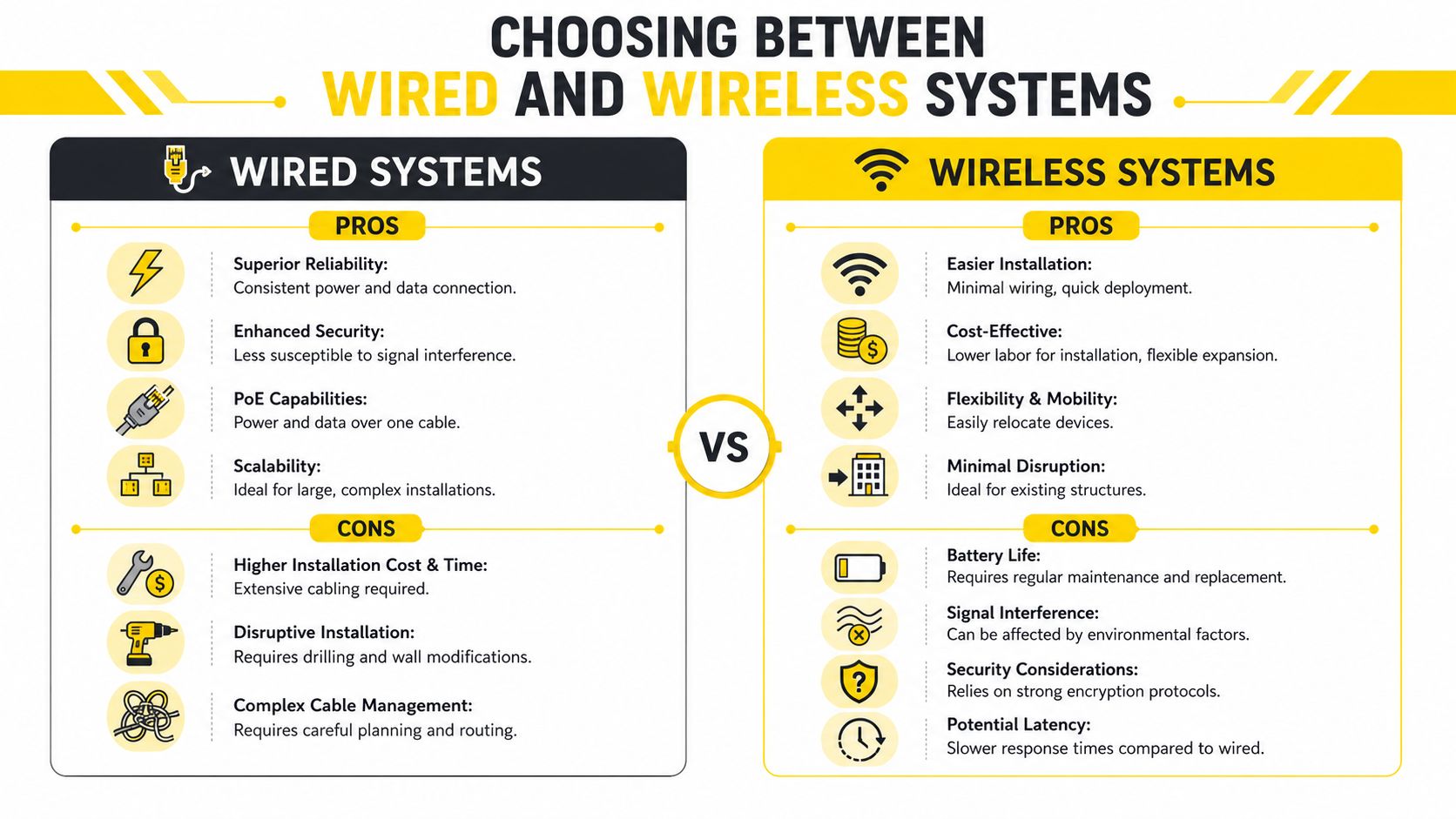
Wired systems are still the benchmark where reliability matters most. Once cables are run properly and the power supply is correctly set up, a hardwired system gives steady communication and avoids the maintenance cycle that comes with battery-operated door hardware.
They suit sites like:
- Busy commercial entries where repeated daily use puts a premium on consistency
- Main common doors in strata buildings where failure affects many residents
- Multi-door systems where centralised control and expansion matter
- Doors with challenging signal conditions such as dense masonry or structural interference
There's also a compliance side. In commercial NSW installations, the controller must have a dedicated 24V DC power supply with a UPS backup to keep locks engaged for at least 30 minutes during a power failure, which is required under wiring rules for these systems, according to this Australian access control project management guide. That gives a good sense of how resilient a professional wired setup needs to be.
When wireless earns its place
Wireless hardware can be the smarter answer where preserving finishes matters or cabling is disproportionately difficult. That often applies in older North Shore homes, heritage-style common areas and retrofits where opening walls or running visible conduit would create a mess.
A wireless system is often worth considering when:
| Question | Wired answer | Wireless answer |
|---|---|---|
| Can cables be concealed neatly? | Usually yes in accessible runs | Useful when concealment is difficult |
| Is long-term reliability the top priority? | Strong option | Can work well, but batteries and signal conditions need attention |
| Is the site sensitive to drilling or surface conduit? | Can be intrusive | Often less disruptive |
| Will regular maintenance be accepted? | Lower door-level upkeep | More ongoing battery management |
Wireless isn't a shortcut. Good wireless hardware still needs proper specification, secure credential management and a realistic maintenance plan. If nobody wants to monitor batteries or deal with occasional communication issues, it's the wrong fit.
The wrong system isn't the cheaper one or the dearer one. It's the one that ignores the building and leaves the client with ongoing workarounds.
What to Expect During the Installation
A well-run installation should feel organised, not chaotic. Most disruption comes from access to doors, cable routes and testing windows, not from the hardware itself. Good planning keeps that under control.
The physical work on site
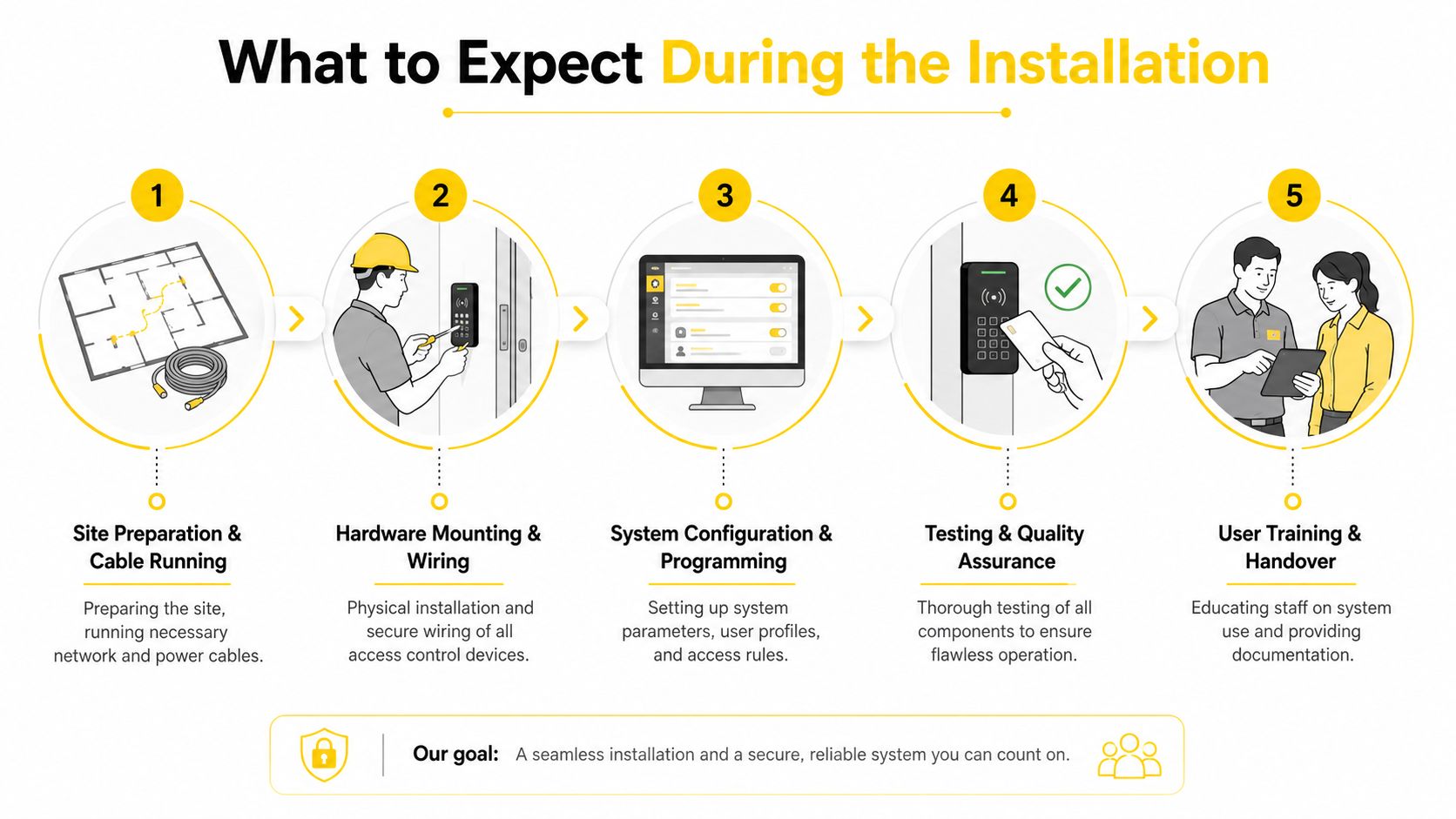
The first part is usually preparation. On a wired job, that means confirming cable routes, protecting surfaces and making sure the work can happen without blocking critical access for too long. In an occupied building, timing matters. Shared entries, shopfronts and staff doors need to stay usable as much as possible.
After that, the installer moves into the hardware phase.
Cable running and rough-in
Power and data paths are established first where needed. In older buildings this can be the slowest part because cable concealment takes care.Door hardware fitting
Readers, strikes, maglocks, request-to-exit devices and contacts are mounted and aligned. Door condition often decides how smoothly this goes.Controller termination
The field wiring is terminated at the controller and power equipment. Tidy enclosure work matters here.
A client expecting a “swap this lock and walk away” job is usually surprised by how much of the work happens behind the scenes.
Programming, testing and handover
Once the hardware is fitted, the system still isn't finished. It has to be commissioned properly. That means programming users, groups, schedules and door behaviour, then testing every scenario that matters.
A proper handover should include checks such as:
- Valid access tests: approved cards, fobs or codes open the right doors
- Denied access tests: unauthorised credentials stay locked out
- Door behaviour: releases, relocks and door position monitoring operate correctly
- Exit devices: request-to-exit hardware works cleanly and consistently
- Admin tasks: someone on site knows how to add and remove users
For business owners who want a practical example of how a local upgrade can change daily operations, this Gordon business security overhaul shows the kind of shift many smaller premises are making.
A neat install isn't enough. If the system hasn't been tested door by door and user by user, it isn't ready to hand over.
Costs and Critical NSW Safety Compliance
A common initial question concerns cost. The question they should ask just as early is compliance, because the two are tied together.
Access control pricing isn't driven by one simple factor. It changes with the number of doors, the hardware chosen, whether the system is wired or wireless, how difficult the cable path is, and what the building requires for safe exit. On an older Hornsby property, the labour involved in making the job neat can be just as important as the reader or lock brand.
What usually pushes a project up or down
A straightforward single entry in a cooperative building will always be simpler than a multi-door site with mixed frame types and restricted cable routes. Cost typically shifts based on a combination of:
- Door count and door type: Glass shopfronts, fire doors, gates and timber doors all behave differently.
- Locking method: Some doors accept an electric strike neatly. Others need a more involved solution.
- Power and controller location: Long or awkward runs create more work.
- Retrofit sensitivity: Heritage finishes and visible common areas call for more careful installation methods.
- Management requirements: A basic entry point is different from a site needing software control across multiple users and schedules.
That's why a decent quote should explain the design logic, not just list parts.
Compliance changes the design
Emergency egress is where non-professional installations often go wrong. A common point of failure is misunderstanding the Australian rules around fail-safe and fail-secure operation. NSW strata and commercial buildings have specific Building Code of Australia requirements for emergency egress, and getting that wrong can void insurance or breach safety by-laws, as outlined in this review of access control installation mistakes.
That matters because the cheapest locking method on paper might not be lawful or safe on the actual door.
For example, a door on an escape path can't be treated the same way as a storeroom or perimeter service entry. The egress arrangement, lock release behaviour and related hardware all need to match the building's use. If they don't, the installation can become a liability instead of an upgrade.
There are adjacent strata safety issues to keep in view as well. On some residential sites, entry upgrades happen alongside broader common property security works, including windows. Under NSW rules, residential strata buildings must have window safety devices that limit opening to less than 125 mm, and qualifying windows must use child-resistant locks or restrictors able to withstand 250 N in the required circumstances, based on NSW guidance on window and balcony safety and this summary of strata window lock requirements. Different system, same principle. Compliance has to be designed in from the start.
Choosing Your Installer and Planning for Maintenance
A good access control system can be undermined by poor installation just as easily as by poor hardware. That's why the installer matters more than most clients realise.
An electrician may be excellent at general electrical work and still not be the right person to design door hardware, egress behaviour, credential security and day-to-day user management. Access control sits across locks, doors, low-voltage power, life safety and building use. If one part is misunderstood, the whole job suffers.
What to check before approving the work
A sensible shortlist should include more than a website and a quote.
- Licence and trade standing: Verify the installer is appropriately licensed for the work and understands lock hardware, not just cabling.
- Retrofit experience: Ask about older strata buildings, heritage-style doors and North Shore housing stock. New-build experience alone isn't enough.
- Door-level thinking: The installer should talk about frame type, latch condition, closer strength, egress and daily use. If the discussion is only about software, that's a warning sign.
- Clear maintenance expectations: Batteries, firmware, user changes and periodic checks all need an owner.
Cybersecurity also belongs in that conversation. For NSW commercial premises, controllers must support AES-128 or higher encrypted credentials and network segmentation to meet government cybersecurity guidelines, which is the kind of detail a qualified installer should build into the design rather than leave as an afterthought, according to this access control systems specification reference.
Maintenance is part of the install, not an extra
Access control isn't a fit-and-forget product. Credentials change. Staff leave. Tenants move. Door closers drift out of adjustment. Wireless devices need battery planning. Software settings need to stay organised.
That doesn't mean the system becomes a burden. It means the handover needs to be sensible. The people managing the site should know how to remove a lost fob, add a new user and recognise when a door problem is mechanical rather than software-related.
The best long-term result usually comes from a system that the building manager can actually run without guessing.
If a Hornsby site needs a practical plan for access control system installation, Lock, Stock & Barrel Locksmiths can arrange a site visit, talk through the hardware that suits the building, and provide a clear quote. For local service coverage, the Hornsby locksmith page is the best place to start, or call to discuss the doors, gates or common areas that need attention.