- 24 Hour Emergency Services
- Servicing Sydney's North Shore
- View On Map

-
Mail Us On
info@lsblocksmiths.com.au
-
Make a Call
0411 700 072
- View On Map
- 24 Hour Emergency Services
- Servicing Sydney's North Shore
- View On Map
-
Mail Us On
info@lsblocksmiths.com.au
-
Make a Call
0411 700 072
- Contact Us
Key Cutting Cost Hornsby: 2026 Price Guide

Lock, Stock & Barrel Locksmiths
On July 9, 2026
In Sydney, a standard house key cut usually costs $4 to $20, depending on the key type, and the final price changes fast once the blank is less common or the key needs more than a simple cut. That's why one key can be a cheap spare and another can turn into a much bigger bill, especially when electronics, after-hours help, or specialised blanks are involved.
A lot of people in Hornsby don't start by asking for “key cutting cost”. They start with a small problem. They need a spare before the kids lose the only copy. They've moved into a rental and want extras made. Or they've just realised the car key in their hand isn't a plain bit of metal at all.
The confusion usually comes from one assumption. People think key cutting is one job with one price. It isn't. A basic house key, a restricted key, and a modern transponder car key might all be called “keys”, but the work behind them is completely different.
That's where clear pricing matters. The question isn't just “how much does key cutting cost?” It's “what exactly is being cut, and what else has to happen before that key will work?”
How Much Should You Really Pay for Key Cutting
A Hornsby customer walks into a shop expecting a cheap spare and gets quoted far more than the price they had in mind. Usually, the surprise is not the cutting itself. It is that the key is not a basic duplicate job at all.
For a plain household key, there is a useful starting range. In Sydney, standard house key cutting ranges from $4 to $20, depending on the key type, with specialty keys sitting higher because they use different blanks, as outlined in this Sydney key cutting cost guide.
That baseline helps, but only for simple keys. Price changes quickly when the blank is uncommon, the original is worn, or the lock belongs to a system that controls who can copy it. Restricted systems are a common example. They are designed to limit duplication, and the process is different from cutting a standard spare. If that is new territory, this guide to restricted key systems and how they affect duplication explains why the price can jump.
A lot of confusion comes from quotes that sound similar but cover different work. One price may be for a straight cut from a clean original. Another may include checking the key profile, sourcing a less common blank, testing the copy, and fixing issues caused by wear on the original. Those are not the same job, even if both end with a new key in your hand.
The ticket price is only part of the cost
A fresh, common house key is usually quick work. Cut it on the right blank, test it, and you are done.
A worn key is where people get caught. If the original has rounded edges or years of use, a machine can copy those faults perfectly. The duplicate may look fine and still drag in the lock, stick halfway, or work only if you jiggle it. A cheaper cut can end up costing more if you have to get it redone or if you assume the new key is the problem when the lock itself is tired.
Practical rule: A cheap key that works badly is not a bargain.
Before accepting a quote, ask three direct questions:
- What type of key is this? A basic house key, a restricted key, and a car key with electronics are priced very differently.
- Does the price cover only the cut, or the full job? Testing, matching the blank properly, and troubleshooting wear all take time.
- Are you copying a good original? If the source key is worn, the result may need extra work to make it reliable.
That matters on the Upper North Shore because the housing stock is mixed. In one street, you might see an older timber front door with an aging cylinder, a newer apartment key under a managed system, and a security screen lock that uses a different profile again. Any guide that gives one flat number for "key cutting cost" misses the gotchas people pay for.
Standard House Keys vs Specialised Keys
The first cost driver is the key blank itself. That's the uncut piece of metal the locksmith or machine starts with before the grooves are shaped to match the original.
A common house key blank is easy to source and quick to cut. A specialised blank is different. It may be less common, shaped differently, protected by a restricted system, or designed for a higher-security lock.
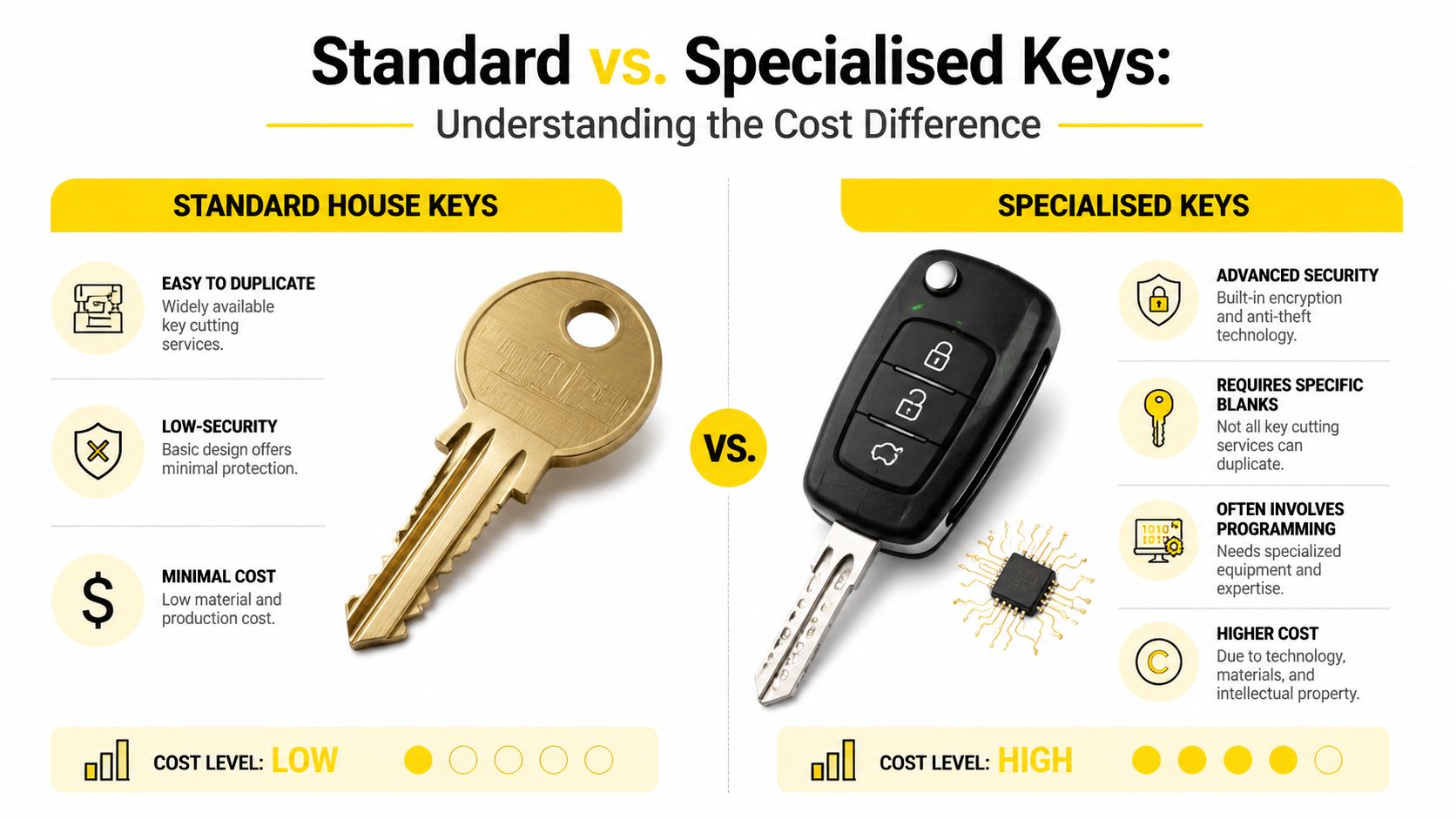
What a standard key looks like
A standard house key is usually easy to recognise. It's the familiar flat key people use on front doors, side gates, padlocks, and some older window locks. These are the keys that usually sit within the lower end of the normal price range.
They're common because the hardware is common. The blanks are widely available, the profiles are familiar, and the cutting process is relatively simple when the original key is in decent shape.
Why specialised keys cost more
Specialised keys cost more because they involve more than just running metal through a cutter. The blank may be harder to obtain, the shape may require more precision, and the lock system may be designed to limit unauthorised copies.
That applies to several situations:
- Restricted systems used in homes, offices, or strata sites where key control matters.
- High-security keys with more complex cuts or dimples.
- Older uncommon profiles where finding the right blank is part of the job.
- Vehicle-related keys where the blade is only one part of the whole system.
A good comparison is this. A plain brass house key is like a basic mechanical part. A restricted or electronic key is more like a matched component. It has to be the right shape, the right profile, and sometimes supplied under tighter control.
Some keys are cheap because the lock they serve is simple. Others cost more because the key itself is part of the security system.
For anyone dealing with controlled access or duplicated keys inside a shared property, it helps to understand how restricted key systems work in practice. That's often where people realise the extra cost isn't in the cutting time alone. It's in the hardware, the control, and the responsibility attached to the copy.
The Hidden Costs of Modern Car Keys
Modern car keys are where people get caught out most often. The visible part looks like a key, so people assume the price should be close to a standard cut. On many newer vehicles, that assumption is wrong.
The metal blade only handles part of the job. Cutting the blade may let the key turn in the lock or open the door, but the vehicle still needs to recognise the electronics inside the key before it will start.
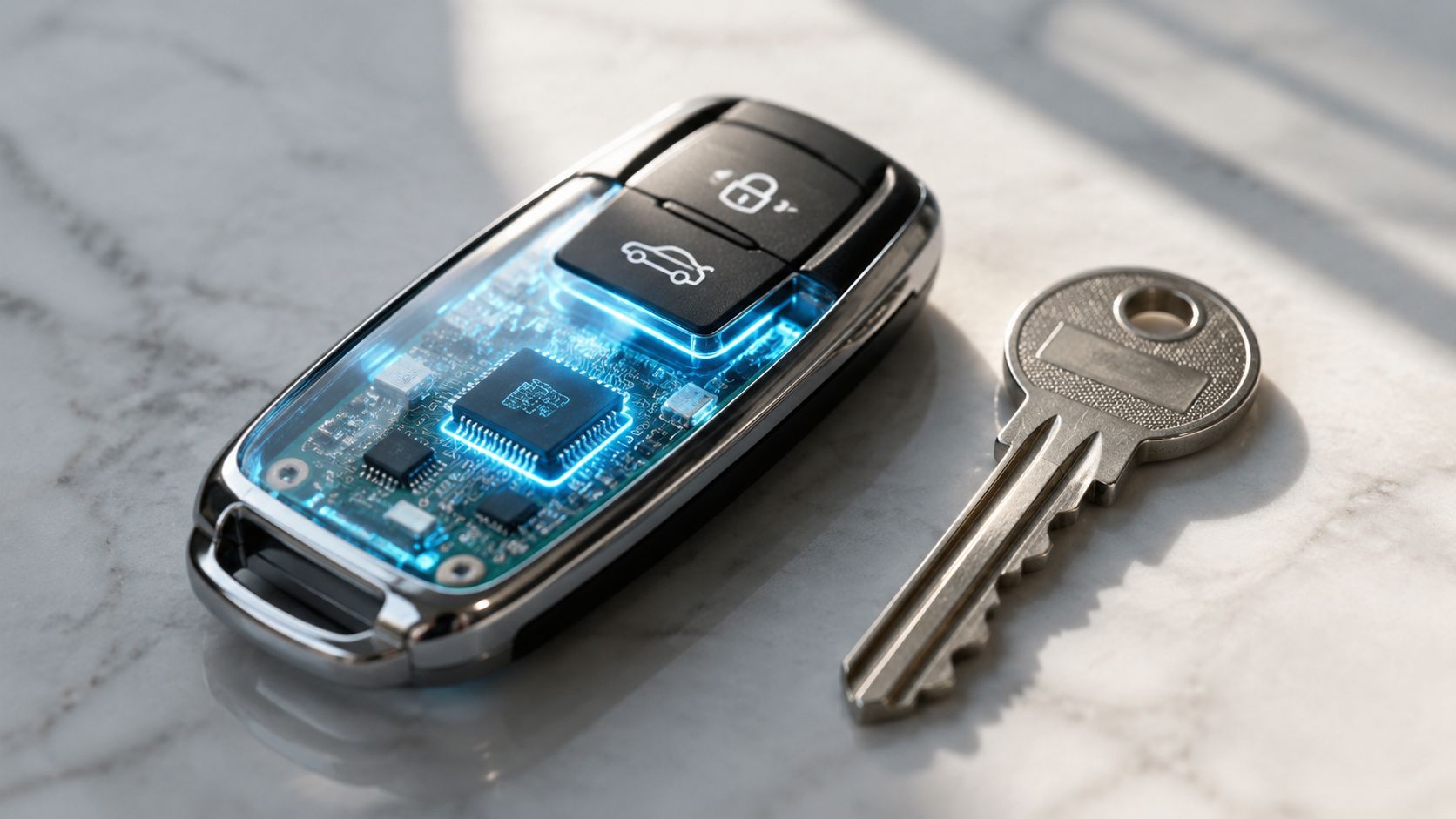
Cutting gets the key into the lock
For newer vehicle keys, the blade is only the mechanical half. A plain explanation is this: the cut gets the key into the door or ignition, but the transponder chip or smart electronics tell the car that the key is authorised to start it.
That's why many online guides miss the actual trap. This Sydney car key replacement analysis notes that many guides leave out the cost of blank key plus programming for newer keys, which can total over $200, compared with under $100 for a simple blade-only cut.
Programming is often the expensive part
Programming requires the right tools, the right software access, and the right procedure for the vehicle. That work isn't visible when someone looks at a key on a kitchen bench, but it's often what drives the final price.
The wider replacement market shows the same pattern. This Sydney car key cost breakdown puts average car key replacement at $180 to $240, with traditional mechanical keys at $80 to $150 and smart keys with proximity sensors at $250 to $600+.
A simple way to read that is that the more electronics packed into the key, the less useful a “cutting only” quote becomes.
Why online comparisons often mislead
A lot of headline prices online describe only one slice of the job. They may refer to the blade, the blank, or a very basic key type, then leave customers to discover the rest later.
That's why car owners should ask what's included. A proper comparison should separate these questions:
| What to ask | Why it matters |
|---|---|
| Is this price for cutting only? | The blade may be only one part of the job |
| Does the quote include the blank? | Newer keys can't be priced properly without the right blank |
| Does the vehicle need programming? | If yes, the electronic setup changes the total |
| Is this a mechanical key or smart key? | Those categories sit in very different cost brackets |
There's also evidence that even the cut alone can be substantial on advanced keys. In one Sydney discussion, a dealer-sanctioned locksmith quoted about $80 purely for cutting a newer car key, as shown in this Aussiefrogs forum thread about newer key cutting in Sydney.
For some high-security vehicle keys, trade discussion also shows pricing can be structured very differently. This locksmith forum example on sidewinder key cutting refers to $50 for the first cut, $25 for each additional key in the same session, and $125 for customer-supplied sidewinder blanks unless the blank is bought from the shop. That's a good reminder that unusual blanks and customer-supplied parts can change the economics of the job quickly.
Where You Get Your Keys Cut Matters
For a very simple spare, a big hardware retailer can be fine. If the original key is clean, the blank is common, and the lock isn't fussy, that option may do the job.
The problem is that cheap duplication and good duplication aren't always the same thing. A key can look right and still be slightly off in the shoulders, depth, or spacing. That's when it “sort of” works, then jams on a cold morning when someone is in a rush.
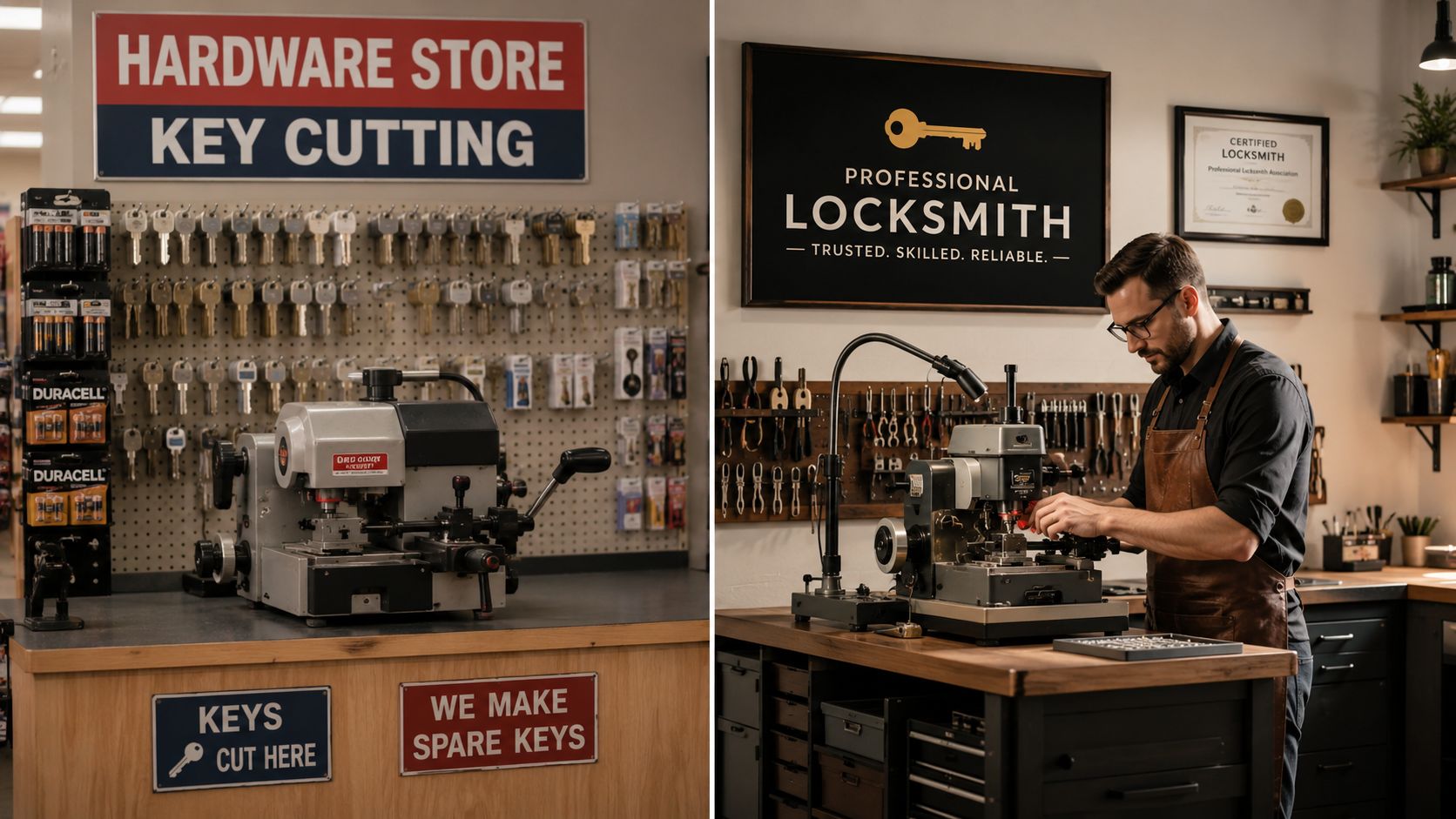
Retail copying vs locksmith work
A retail key station is generally built around speed. That suits common keys. It doesn't always suit worn keys, awkward profiles, or locks that already have some age in them.
A locksmith is usually solving a broader problem, not just tracing one shape onto another blank. That can include checking whether the source key is too worn to copy accurately, identifying the correct profile, or working from a code or lock cylinder when the original is damaged.
A bad copy of a worn key is still a bad key, even if the machine cut it perfectly.
What usually works better
For anything beyond a basic utility key, accuracy matters more than shelf price. The difference often shows up in situations like these:
- Worn originals: a locksmith can identify whether the key itself is the problem.
- Restricted or uncommon profiles: the blank and authority to cut it matter.
- Broken or bent keys: a proper workshop can often work from the remaining piece or other lock information.
- Locks with tight tolerances: small errors cause sticking and failed turns.
That's why people searching around the district for a Hornsby locksmith service area page are often better served by matching the provider to the key type, not just chasing the lowest advertised number.
The wrong cheap option can cost more later
When a duplicate doesn't work properly, the customer pays twice. First for the original cut, then again in time, travel, or a second replacement. If the faulty key snaps or jams in the lock, the bill can become a lock problem rather than a key problem.
That doesn't mean every key needs specialist handling. It means key cutting cost should be judged against reliability. For a letterbox or shed, low-cost copying may be enough. For your front door, office, or vehicle, it pays to get the right blank and the right cut from the start.
The Price of Urgency Mobile and After-Hours Fees
Emergency pricing frustrates people most when they don't know what they're paying for. A mobile locksmith isn't just charging for the cut itself. The fee usually reflects travel, stocked service vehicles, time on the road, and the convenience of solving the problem where the customer is standing.
That matters on the North Shore because many key problems don't happen during business hours. They happen after work, outside a locked house, in a shopping centre car park, or when the only working key has just failed.
Why after-hours costs jump
After-hours key cutting and emergency attendance cost more because fewer operators are available. This isn't just a Sydney pricing habit. This Sydney locksmith guide on key cutting notes that after-hours premiums can be $200 to $330 for a callout, and explains that the premium reflects the genuine scarcity of 24/7 operators, not just made-up fees.
That distinction matters. If someone needs help at night, they're paying for access to a qualified tradesperson who is available when most providers aren't.
What customers are actually paying for
A mobile and urgent job usually bundles several things together:
- Travel to site: especially relevant when the job can't be brought into a shop
- Vehicle stock: blanks, lock parts, and tools carried for immediate use
- Problem diagnosis: not every “key issue” is solved by cutting another key
- Out-of-hours availability: someone has to be available to answer and attend
For urgent access problems, it helps to deal with a provider that clearly states it handles 24 hour emergency locksmith work. The best outcome is still avoiding the emergency altogether, but when that isn't possible, transparent callout pricing is far better than vague promises and surprise add-ons.
Smart Tips for Reducing Your Key Cutting Costs
The easiest way to save money on key cutting is to avoid turning a small job into an urgent one. Most expensive key situations start with delay. The spare never gets cut. The worn key keeps getting used. The car owner assumes the key is mechanical, then finds out too late that it isn't.
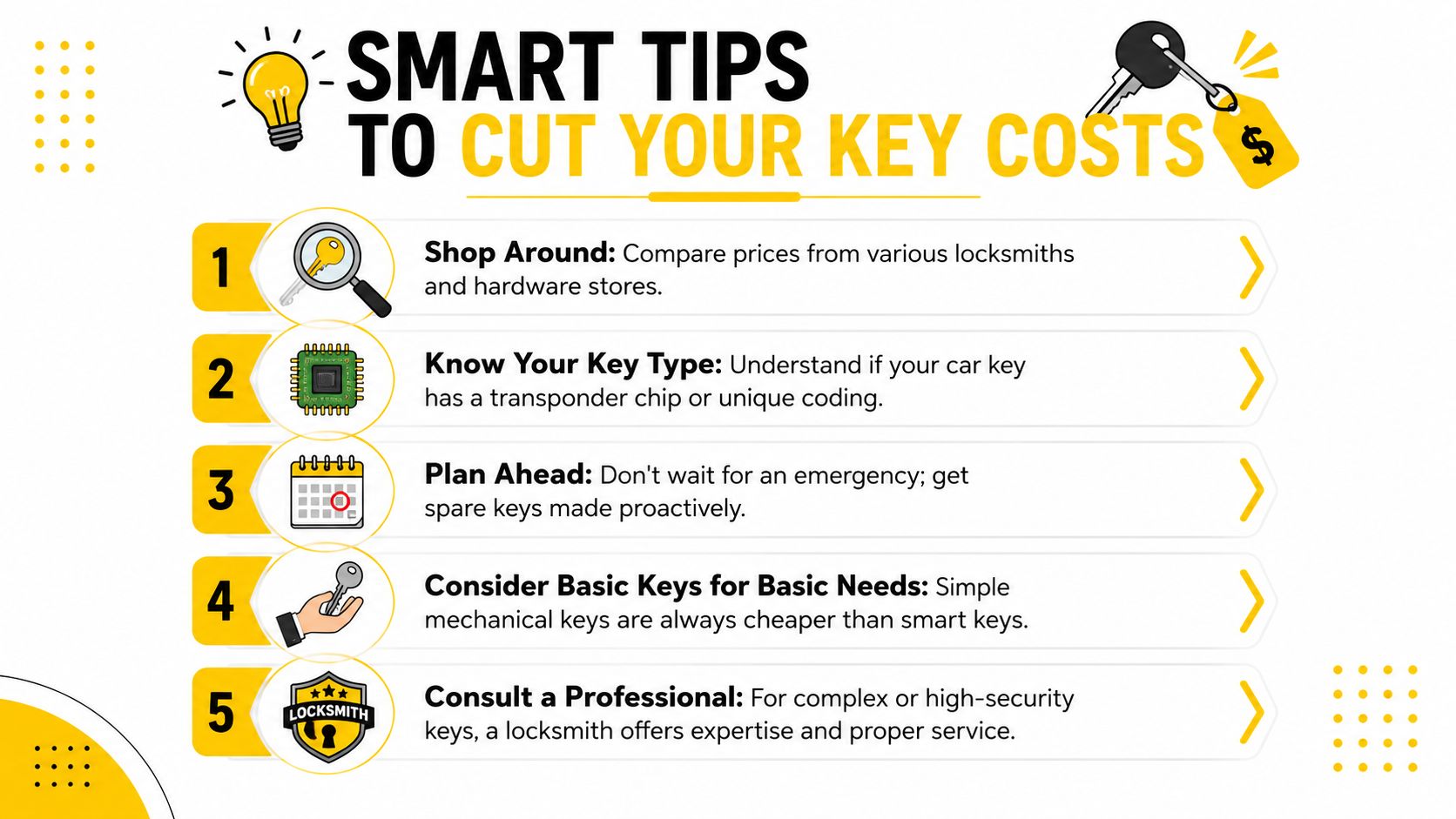
Five practical ways to keep the bill down
Cut spares before there's pressure: A planned duplicate is usually simpler than an urgent replacement. Once the only key is lost, damaged, or locked inside, the job becomes more complicated fast.
Use the best original as the source: Don't keep copying from a copy. If there's one clean, reliable original key, use that one for duplicates.
Ask what the quote includes: This matters most with car keys. If a price covers only the blade, the final total may still sit well above that once the blank and programming are added.
Get multiple keys done in one go when it suits: On some jobs, doing more than one key in the same session can make better sense than arranging repeat visits later. The exact saving depends on the key type and setup.
Check with a locksmith before heading to the dealer: Especially for vehicles and restricted systems, it's worth confirming whether the problem is a simple cut, a blank issue, a programming issue, or a worn lock issue.
If the key has buttons, a chip, or an unusually shaped blade, assume there's more to the job than cutting metal.
A simple rule for household keys
For standard household spares, get them made while the original still works smoothly. For specialised keys, ask questions before agreeing to the job. Most cost blowouts happen because the customer and the provider are talking about different things.
A fair key cutting cost is one that matches the actual work. Not just the visible key in your hand.
If you need a straight answer on key cutting cost on Sydney's North Shore, call Lock, Stock & Barrel Locksmiths or request a quote. Lock, Stock & Barrel Locksmiths is a father-and-son Master Locksmith business based in Turramurra, and the focus is simple: clear pricing, honest advice, and the right solution for the key you've got.