- 24 Hour Emergency Services
- Servicing Sydney's North Shore
- View On Map

-
Mail Us On
info@lsblocksmiths.com.au
-
Make a Call
0411 700 072
- View On Map
- 24 Hour Emergency Services
- Servicing Sydney's North Shore
- View On Map
-
Mail Us On
info@lsblocksmiths.com.au
-
Make a Call
0411 700 072
- Contact Us
Lever Handle Locks: A Practical Guide for Hornsby NSW

Lock, Stock & Barrel Locksmiths
On July 7, 2026
Replacing door hardware often starts with a simple job list. New paint, new flooring, new handles. Then the hardware wall at the shop turns into a blur of finishes, lock bodies, privacy sets, entrance sets, smart options, fire door warnings and packets that all look half the same.
That's where plenty of Hornsby homeowners, strata committees and shop fit-out managers come unstuck. A lever handle can look right, feel solid in the hand and still be the wrong choice for the door, the building, or the compliance job attached to it.
Lever handle locks are popular for good reason. They're easier to operate than knobs, they suit modern interiors, and they can work across everything from bedrooms to office entries. But the right choice depends on more than colour and price. The internal lock type matters. The function matters. On some jobs, the installation height, projection and operating force matter just as much as the finish.
Choosing a Door Handle Seems Simple Until It Isn't
A common scenario goes like this. A family in Hornsby replaces the old brass knobs in a renovated unit with sleek new lever sets. They look better straight away. Then a few problems show up. The bathroom privacy set doesn't match the latch prep already in the door. The front door lever feels light and flimsy. A hallway fire door in a strata building suddenly becomes a question mark.
That's the part hardware-store displays rarely explain well. Lever handle locks aren't one product. They're a category. Some are built for light internal use. Some are designed for repeated traffic. Some suit older timber doors. Some belong on commercial entries or fire-rated doors only when the exact hardware set has been tested for that purpose.
Good door hardware disappears into the background. Bad hardware announces itself every day with sticking latches, loose roses, awkward operation or compliance trouble.
In homes across the Upper North Shore, there's another wrinkle. Plenty of properties have had piecemeal upgrades over the years. One owner changes a bedroom handle, another swaps the laundry set, then a renovation adds a new entrance lever. The result is often a mix of backsets, spindle lengths, strike positions and finishes that don't quite line up.
Why people choose levers in the first place
Lever handles usually win because they're practical and they suit almost any style direction.
- Easier operation: They're generally simpler to use when hands are full or grip strength is limited.
- Cleaner look: Many owners prefer a lever over a round knob in modern homes and units.
- Broader function range: The same basic handle style can be supplied as passage, privacy, keyed entrance or commercial-grade hardware.
The trick is choosing the right version for the job, not just the nicest one on the shelf.
The Main Types of Lever Handle Locks Explained
The easiest way to understand lever handle locks is to split them into two layers. First is the chassis, meaning the internal body of the lock. Second is the function, meaning what the handle is meant to do day to day.
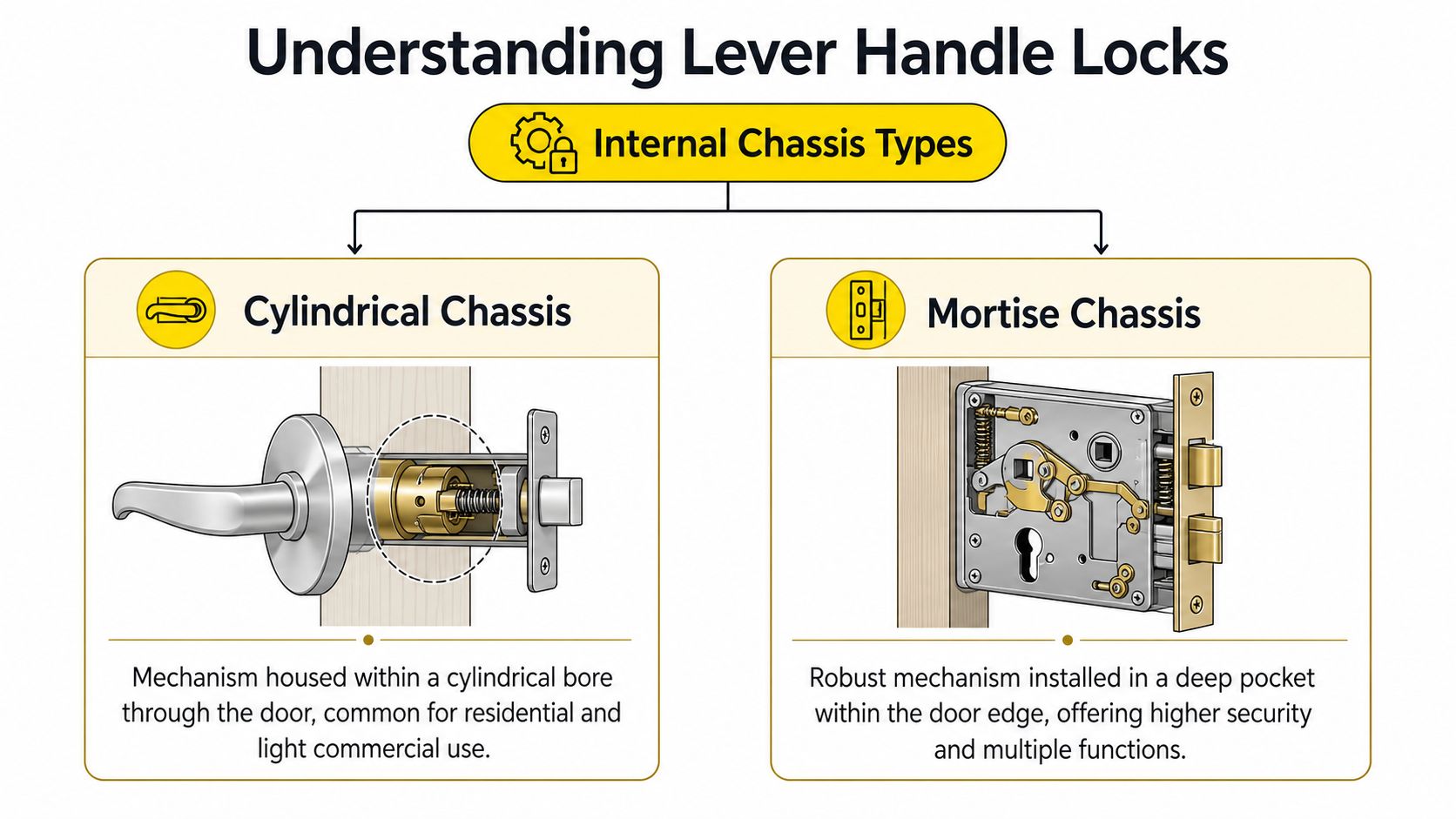
Chassis first, function second
Consider this analogy: The chassis is the engine. The function is the trim level. If the engine is wrong for the job, the extras won't save it.
Cylindrical or tubular chassis
This is the common residential setup. The mechanism fits through standard round holes bored into the face and edge of the door. It's quick to fit, easy to replace, and usually the most straightforward option for internal doors and many standard home entry doors.
They work well when the door has already been prepared for that style of hardware. They're also a sensible choice when the goal is to replace like for like without major joinery work.
Mortice chassis
A mortice lock body sits inside a pocket cut into the edge of the door. It's a more involved installation and usually a more durable one. This style is common on older solid timber doors, many commercial doors and jobs where heavier-duty operation is needed.
Mortice hardware gives more flexibility in some applications, especially where stronger locking and better long-term durability matter. It also needs accurate preparation. A sloppy mortice job causes endless trouble later.
Practical rule: Choose the chassis to suit the door and the use. Choose the function to suit the room.
For readers weighing digital access against traditional hardware, this guide on smart locks versus mechanical locks is a useful companion.
The common functions people actually buy
Once the chassis is sorted, the next question is function.
| Function | Where it suits | What it does |
|---|---|---|
| Passage | Hallways, closets, general internal doors | Latches shut but doesn't lock |
| Privacy | Bathrooms, bedrooms, ensuites | Locks from inside, emergency release from outside |
| Entrance or keyed | Front, side or office entry doors | Allows keyed security from the outside |
| Dummy | Cupboards, fixed pull applications, inactive doors | No latch, used as a pull only |
Not every function belongs on every chassis, and not every packet on the shelf explains the limitations clearly. That's why retrofits can turn messy fast.
Where commercial and fire doors are different
Generic advice often falls short. Fire doors and high-occupancy sites can't be treated like a spare bedroom door. Technical benchmarks for dual-lock lever handles used on fire-rated commercial and security doors in Australia show they've been tested for 2-hour fire resistance assemblies per AS1905.1:2005, and the spindle and screw components are engineered to fit doors between 42mm and 50mm thickness according to this Australian dual-lock lever handle product benchmark.
That matters because a nice-looking lever set from a retail shelf might physically fit a door, but still be the wrong hardware for the building's compliance needs.
Why NSW Compliance and Accessibility Matter More Than Style
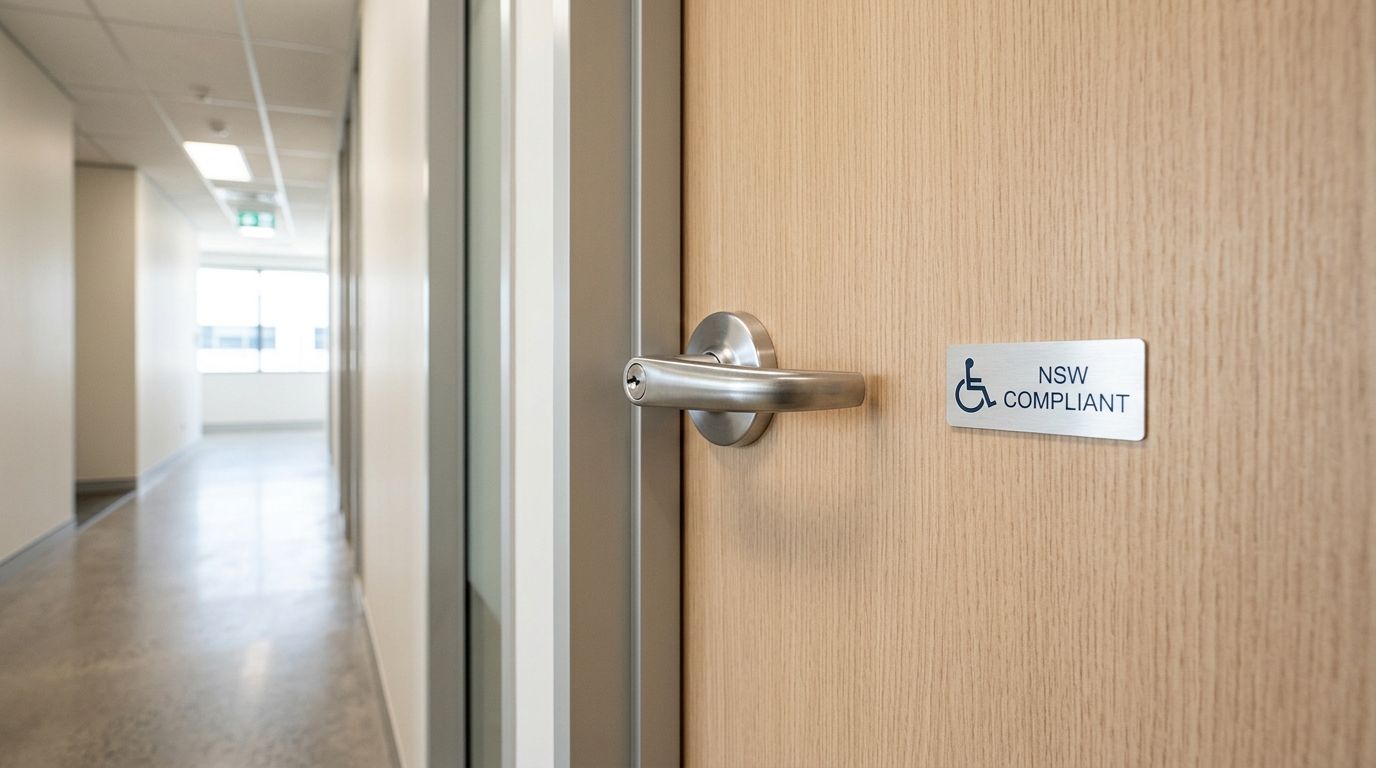
The biggest mistake with lever handle locks is assuming that if a handle works, it must be acceptable. That's not how compliance works in practice. In Sydney homes, strata buildings, offices and common areas, the legal question is often about access and safe use, not appearance.
The measurement that gets missed
In Australian properties built within the last seventy years, lever handle locks are standardised to be installed between 900mm and 1050mm from the floor, with a common installation point of about 1000mm, as outlined in this explanation of Australian door handle height standards. That range exists for accessibility and safety reasons.
On paper, that sounds simple. On site, it often isn't. Renovations can leave mismatched handle heights between old and new doors. Replacement joinery can shift prep positions. Imported hardware assumptions can confuse installers who are used to different overseas setups.
It's not just height
Handle design matters too. Lever handles intended to meet Australian accessibility requirements have dimensional expectations that affect how easy they are to grip and operate. For DDA-oriented lever handles in Australia, the maximum distance from the door surface to the lever handle is 45mm, and there must be a minimum return of 20mm, based on the same Australian standards discussion linked above.
For high-security egress and commercial access work in Australia, AS1428.1 also requires a lever throw of at least 40mm and a minimum operating force of 15N, as described in this summary of AS1428.1 door hardware requirements.
Those figures matter because a decorative handle can be easy to admire and awkward to use. In a home that may just be annoying. In a strata common area, aged-care setting, office or adapted family home, it can become a real accessibility problem.
The lock that “looks right” and the lock that's compliant are sometimes the same product. Sometimes they're not even close.
Why this matters in Hornsby and the North Shore
Older stock across Hornsby and the North Shore often gets updated in stages. That creates risk in places where people assume any modern lever is a safe upgrade. It isn't always. Strata committees, property managers and owners dealing with renovated units or multi-generational living need to think beyond style boards.
A practical way to stay grounded is to focus on these questions:
- Who uses the door: A powder room in a private house is a different brief from a shared entry or common-area door.
- What rules apply: Fire doors, access paths and strata common property can trigger very different requirements.
- What happens if it's wrong: Replacement later is always more expensive than choosing the correct hardware at the start.
For broader guidance on why trade standards and proper licensing matter in this field, the article on how the Master Locksmiths Association is leading locksmith safety standards is worth reading.
Your Selection Checklist for the Right Lever Handle
The best buying decision usually comes from slowing down for five minutes before anyone opens a catalogue. Most poor hardware choices happen because the buyer jumps straight to finish and forgets the door itself.
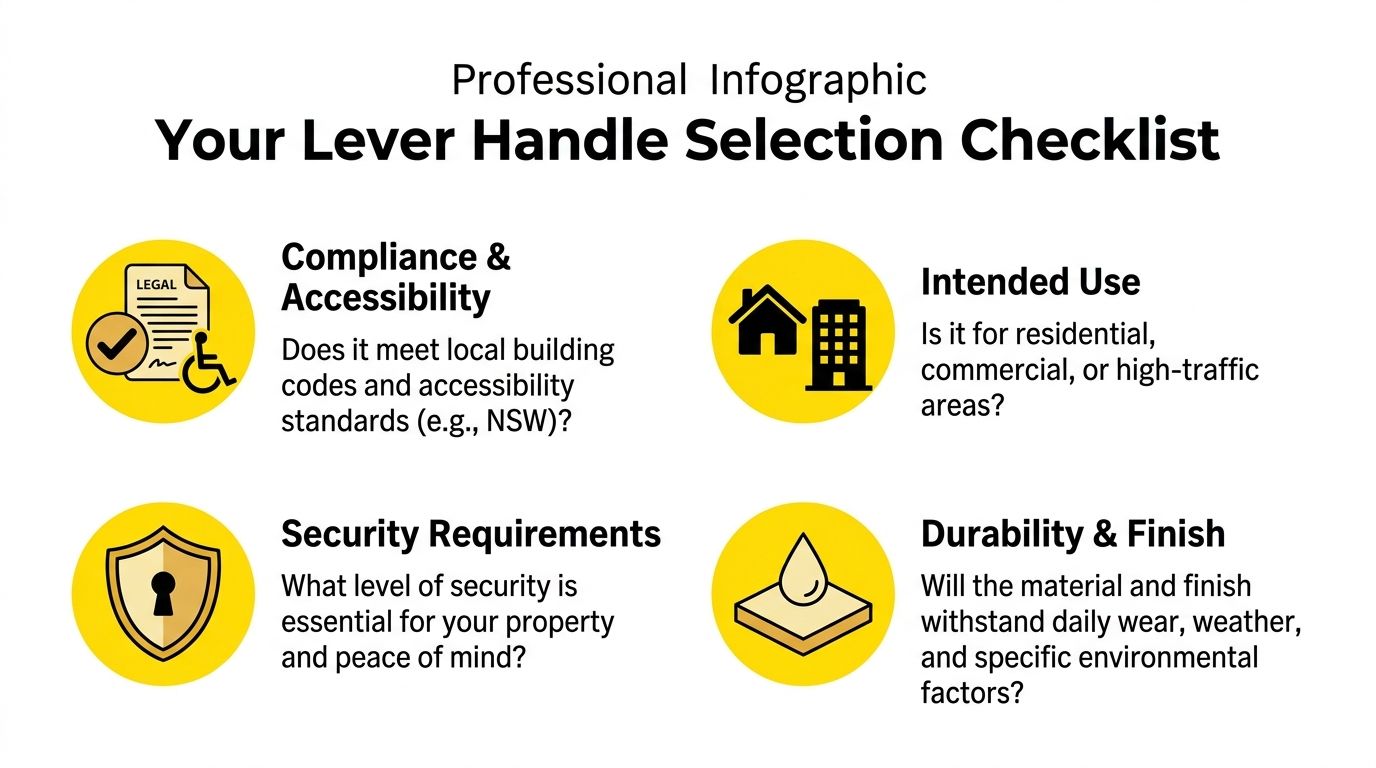
Start with the door, not the handle
Before choosing a lever set, check the basics on the actual opening.
- Door thickness: The hardware has to suit the leaf you're fitting it to.
- Existing prep: A new lever may not cover old holes, rebates or marking from earlier hardware.
- Door material: Solid timber, hollow core, aluminium and fire-rated doors all behave differently when being drilled or rebated.
- Handing and clearance: Some lever designs need more room near jambs, screens or adjacent walls.
A handle can be mechanically fine and still be a poor fit because the rose won't cover the previous footprint, or the latch position leaves the strike slightly out.
Match the function to the room
This sounds obvious, but it's where many mistakes begin.
A bathroom usually needs privacy. A linen cupboard usually doesn't need a latch at all. A side entry may need keyed access, but the lock strategy might also involve a deadbolt or other separate security hardware rather than expecting too much from a basic lever set.
Ask the compliance question early
Most existing content in Australia doesn't properly bridge the gap between style and legal requirements. There's a recognised lack of specific guidance for Sydney homeowners trying to confirm whether a handle fits the 900mm to 1050mm height range and required operating limits under DDA and AS1428.1, as noted in this discussion of the gap in door handle buying guidance.
That's exactly why compliance should be checked before purchase, not after fitting.
A cheap replacement becomes an expensive one when the wrong lever has to come back off a painted door.
A practical shortlist to run before buying
For homes
- Daily use: Will kids, older relatives or tenants use this door every day?
- Wet areas: Bathroom and laundry hardware should cope with moisture and cleaning products.
- Security: If it's an external opening, decide whether the lever is only part of the security setup or the main locking point.
For strata and apartment buildings
- Common property status: Don't assume a unit owner can change every handle without approval.
- Fire door status: If the opening is fire-rated, hardware choice becomes much more controlled.
- Uniformity: Matching finishes matter less than matching compliant function on common-area doors.
For offices and commercial sites
- Traffic level: A storeroom or staff corridor sees different wear from a meeting room.
- Access control plans: Future keying or smart upgrades should be considered now, not after installation.
- Egress: Handles on exit paths must be simple and reliable to operate.
Finishes still matter, of course. Satin stainless tends to be forgiving in high-touch areas. Matte black can look sharp but often shows wear differently. Polished finishes can suit period homes but may highlight fingerprints and scratches faster. The right answer depends on use, cleaning, and how much abuse the door will get.
Troubleshooting Common Lever Handle Problems
Most lever handle problems start small. A slight wobble. A latch that needs a push. A handle that doesn't spring back cleanly. Catch them early and the fix is often simple. Leave them too long and parts wear each other out.
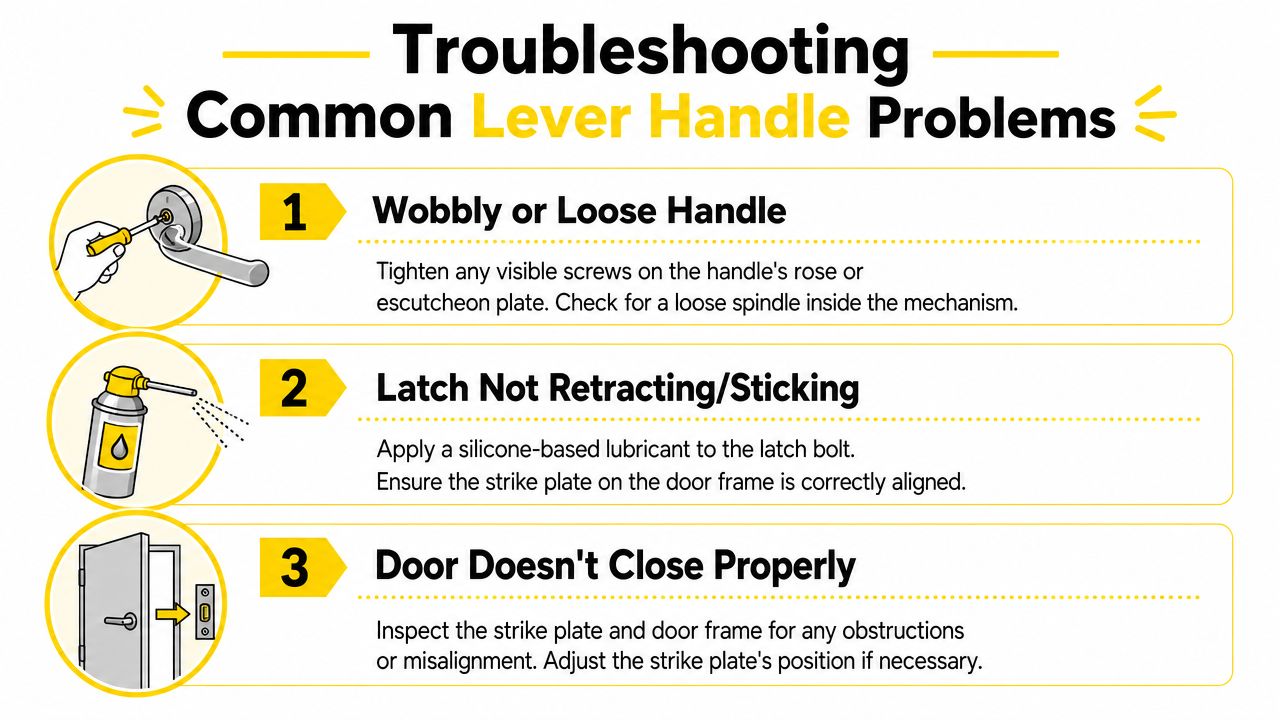
Loose handle or wobbly lever
This is one of the most common call-outs on everyday residential hardware.
Try this first:
- Check for visible fixing screws on the rose, plate or neck of the lever.
- Tighten them carefully with the correct screwdriver or Allen key.
- Hold both sides in alignment while tightening so the spindle doesn't bind.
- Test the lever several times before closing the door.
If it loosens again quickly, the issue may be a worn internal chassis, stripped fixing point or a spindle problem. That's usually the point to stop.
Latch not catching properly
When the door closes but won't latch cleanly, the handle isn't always the culprit. Often the problem is alignment between latch and strike.
Quick checks
- Look for rub marks: Fresh scratches on the strike plate usually show where things are colliding.
- Test with slow closure: Close the door gently and watch whether the latch lands high, low or short of the strike opening.
- Check seasonal movement: Timber doors can swell or shift enough to throw alignment out.
Minor strike adjustment may solve it. If the door is dropping on its hinges, fix that first. Moving the strike without addressing a sagging door only masks the problem.
If a latch needs force, don't keep slamming the door. That's how light misalignment turns into a broken lever or split frame.
Sticky or stiff operation
A stiff lever can come from dirt, paint, wear, poor fitting or a tired spring.
Use a silicone-based lubricant on the latch bolt, not a heavy grease that attracts grime. Work the handle and latch repeatedly with the door open. If the action stays rough, remove the handle only if the fixing method is clear and there's no risk of losing small parts or damaging trim.
Painted-over hardware is another classic issue in older homes and units. If paint has bridged moving parts, forcing the handle can do more harm than good.
Bathroom privacy lock emergency
A common family problem is the bathroom or bedroom privacy lock getting engaged with someone stuck inside or unable to disengage it. There's a lot of DIY advice floating around, but much of it risks damage or leaves the lock unreliable afterwards. The issue is noted in this discussion of emergency bypass concerns with locked lever handles on privacy sets.
The safe approach is simple:
- Confirm it's a privacy function: Don't assume every small external hole works the same way.
- Use the intended emergency release only: If the set is designed for that feature, use the proper release tool or the manufacturer-approved method.
- Stop if there's resistance: Forcing random objects into the access hole can jam or damage the mechanism.
If a child is distressed or the mechanism won't release as expected, skip the experiment and get a locksmith out.
When to Skip DIY and Call a North Shore Locksmith
Some lock jobs suit a careful owner with the right tools. Others don't. The dividing line is usually risk. If a mistake could affect security, fire compliance, access, or the door itself, it's better handled professionally.
Fresh mortice installations are a good example. Cutting a mortice body into a timber door takes accuracy and the right gear. A few millimetres out and the lock body sits crooked, the furniture binds, and the edge of the door can be weakened.
Jobs that usually need a locksmith
- Fire-rated doors: Hardware changes on these openings can create compliance trouble very quickly.
- Rekeying: This looks simple from the outside, but keying systems need to be pinned correctly and tested properly.
- Persistent faults: If the handle has already been tightened, lubricated and aligned, but still plays up, the problem is usually inside the mechanism or in the door prep itself.
- Master key planning: Multi-user homes, offices and strata sites need a proper hierarchy, not a box of random matching cylinders.
There's also the growing smart-lock side of the market. In Australia, the smart lock market is projected to reach US$ 358.9 million by 2033, with lever handles identified as the dominant mechanism being upgraded, according to this Australian smart lock market outlook. That doesn't mean every existing lever can or should be converted. Door prep, handing, battery access, latch type and user habits all matter.
Why local knowledge matters
North Shore properties aren't all built the same. Federation homes, brick walk-ups, modern apartments, retail tenancies and strata common areas all throw up different hardware issues. A local mobile locksmith sees the patterns quickly and knows when a neat-looking shortcut will create a larger problem next month.
For anyone weighing up the practical side before booking help, this guide on what to know before calling a locksmith in Sydney's North Shore is a helpful place to start.
Get the Right Advice for Your Locks
A good lever handle does four jobs at once. It suits the door, works reliably, supports the level of security needed and meets the rules that apply to the site. Miss any one of those and the handle can become an irritation or a liability.
That's why lever handle locks deserve more thought than one might initially realize. The finish matters. The feel matters. But the internal chassis, the function, the door preparation and the compliance side matter just as much.
For Hornsby NSW homes, strata buildings and commercial sites, the safest approach is to treat lock hardware as part of the building, not just part of the decorating. When the selection is right, the door works the way it should and nobody has to think about it again.
If a lever handle is giving trouble, a new fit-out needs the right hardware, or there's any doubt about compliance, Lock, Stock & Barrel Locksmiths can help with practical advice on the North Shore. Call to discuss the job or request a quote for your Hornsby property, strata building or business, and get the lock sorted properly the first time.