- 24 Hour Emergency Services
- Servicing Sydney's North Shore
- View On Map

-
Mail Us On
info@lsblocksmiths.com.au
-
Make a Call
0411 700 072
- View On Map
- 24 Hour Emergency Services
- Servicing Sydney's North Shore
- View On Map
-
Mail Us On
info@lsblocksmiths.com.au
-
Make a Call
0411 700 072
- Contact Us
Replacement Key Cutting Hornsby: Your 2026 Guide

Lock, Stock & Barrel Locksmiths
On July 22, 2026
You've got the key ring, the front door is still shut, and the spare you were counting on is nowhere to be found. That's the moment you realise replacement key cutting is not a nice-to-have, it's the fastest way back into a house, shop, or strata entry when the original key has gone missing or snapped off in the lock.
For homes and businesses across Hornsby and the Upper North Shore, the next move matters. A quick hardware-store copy can be fine for a common spare, but a true replacement often needs a locksmith who can work from the lock, the key code, or the hardware itself. That's where the trade starts to look less like copying and more like proper problem-solving.
That Sinking Feeling When a Key is Gone
A lost key has a way of turning a normal day into a small emergency. Someone gets home late, the front door won't open, or a shop staff member realises the only key to the back entrance has disappeared with a bag, a pocket, or a broken key ring.
That's usually when people start phoning around and get very different answers. Some places only offer duplication, which helps if the original key is in your hand. Others can handle the harder job, getting a replacement key made when the original is missing, damaged, or too worn to copy cleanly.
At Lock, Stock & Barrel Locksmiths, that difference matters because a lost-key job is rarely just about the key itself. It is about whether the lock is still worth using, whether access needs to be restored quickly, and whether the site needs extra security after the key goes missing.
Lost key replacement help starts with those questions, not with a guess at the counter.
Practical rule: if the original key is gone, the right question is not just “Can a key be cut?” It's “Can the lock be matched safely and legally?”
For Hornsby homes, rentals, and small businesses, that question comes up every week. A landlord wants a new tenant sorted. A business owner needs the back door working again. A family member is locked out and the only spare is miles away. The pressure is real, but the fix usually starts with the right kind of information, not a guess at the counter.
More Than Just Making a Copy
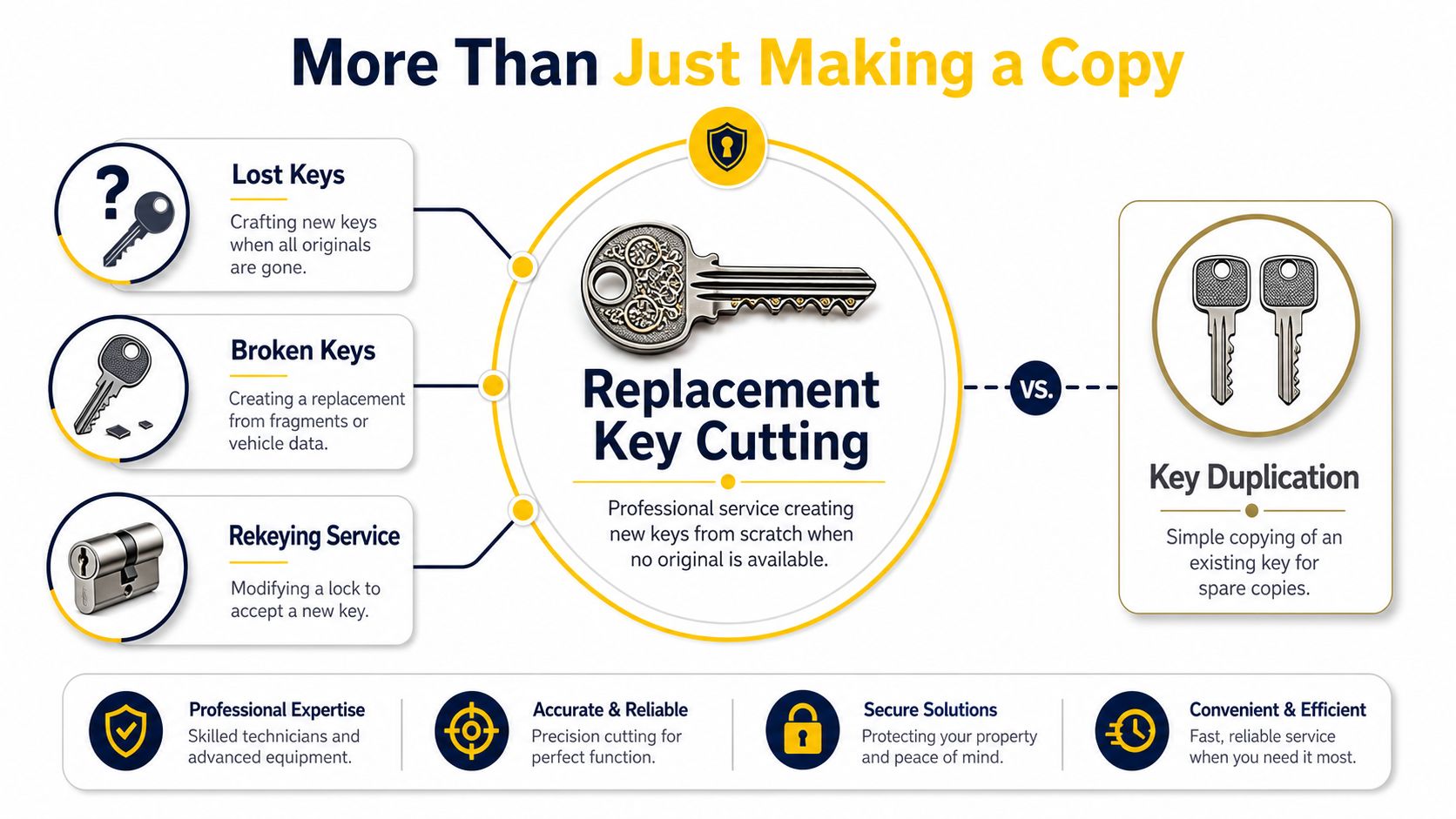
People often lump “key cutting” and “copying a key” together. In the trade, they are different jobs. Key duplication starts with an existing key in good enough shape to trace, while replacement key cutting can start from a lock, a code, a photo, or a manufacturer record when the original key is not on hand.
That difference matters in practice. A missing key is not solved by a quick machine copy, because there may be nothing to trace. A locksmith has to match the key to the lock family and the bitting pattern, then choose the right blank and cutting method for the job. In some cases, a code number is the cleanest route, because it ties the replacement to the correct key pattern and lock record.
Why that matters in real life
A worn key can produce a poor copy. A bent key can produce a poor fit. A missing key calls for a different method altogether. That is why homeowners, landlords, and strata managers often need more than a kiosk machine and a fast scan of the blade.
A good locksmith starts with the lock and the problem, not the machine. If the lock is sound, a replacement key can often be made without changing the hardware. If the key is part of a restricted system, the process is tighter for security reasons. If the lock itself is worn or faulty, cutting a new key solves only part of the job.
Lost-key work is about restoring access, not just producing metal. That is why code cutting and lock-based matching are such useful tools.
The practical takeaway is simple. Replacement key cutting is the service people need when the original key is not available, and that is a very different job from walking into a shop with a spare already in hand (Shore Safe Locksmiths on cutting without the original).
The Three Main Ways We Cut New Keys
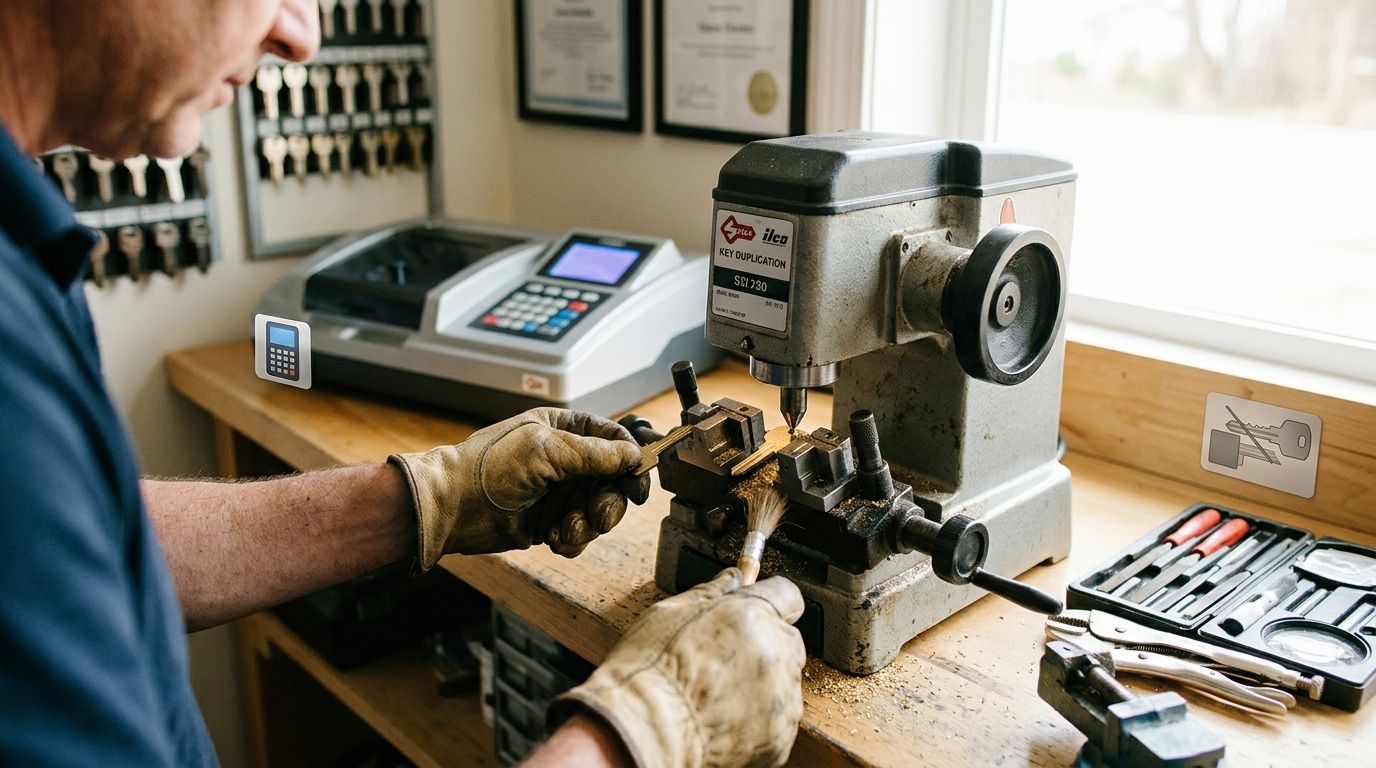
Duplication from an existing key
This is the straightforward job. A working key goes into the machine, the cutter traces the blade, and a new key is cut to match it. For common house keys, it is usually the quickest option when the original is clean, straight, and still giving a good result.
The catch is simple. If the original key is worn or bent, the copy can carry those faults over. A hardware store copy is fine for a lot of everyday keys, but it depends entirely on the key you bring in. If that key is damaged, the new one often needs a bit of adjustment before it feels right in the lock.
Cutting from a code
A lot of replacement key work happens with no original key on hand. In that case, a locksmith can cut from a code number instead of tracing an existing blade. That code links the blank and the cut pattern to the right lock family and record, which is why it is so useful when the key is missing and the job needs to be done properly.
This method suits keys that are tied to a recorded system, including many restricted or commercial setups. It also avoids the guesswork that can come with trying to copy a key that is not there. For the right lock, code cutting gives a cleaner result than chasing a worn sample around a machine.
Matching from the lock itself
Sometimes the lock is the only reliable starting point. The locksmith checks the cylinder, reads the keyway, chooses the correct blank, and cuts a key to suit what the lock requires. That takes more judgement than a simple copy, but it is the practical route when the original key has gone missing or the available key cannot be trusted.
There is also a trade-off here. Lock-based matching can solve the access problem without changing the whole lock, but it depends on the lock being in workable condition. If the cylinder is damaged or the mechanism is too worn, a new key alone may not be enough.
Each method fits a different job. Duplication is fast when the original is good. Code cutting suits recorded keys and missing originals. Matching from the lock is the fix when the lock has to do the talking. If you want a plain explanation of how that choice compares with rekeying or replacing the hardware, this guide on rekeying versus replacing residential locks sets it out clearly.
Cutting a Key vs Rekeying or Replacing a Lock
A lot of confusion starts here. People ask for a replacement key, when what they really need is a security reset. The right answer depends on the hardware, the access risk, and whether the lock is still worth keeping.
Australian pricing guides put simple key duplication at $5–$20 per key and broader key-cutting jobs at about $80–$250 per job. The same guides show rekeying often lands around $70–$130, while changing a lock can sit at $70–$200 or even $80–$220 per lock depending on the hardware (TradeRefer key cutting guide). That gap is why cutting a replacement is usually the cheapest option when the lock itself is still fine.
When each option makes sense
| Scenario | Best Option | Reasoning |
|---|---|---|
| You still trust the lock and just need another working key | Cut a replacement key | Cheapest path when the original hardware is suitable |
| A key is missing and you want access restored without changing the whole lock | Rekey the lock | The old key stops working, which helps protect the property |
| The lock is worn, damaged, or outdated | Replace the lock | New hardware is the better long-term fix |
| You need a spare for a tenant, family member, or staff member | Cut a replacement key | Fast and cost-effective for routine access control |
| You're unsure who still has a copy | Rekey the lock | Better security than guessing who kept a key |
The practical decision is often about risk, not price alone. A spare for a trusted household member is one thing. A lost key after a tenancy handover is another. That's why the right recommendation can shift from cutting to rekeying, even when the lock still works.
For a closer look at the trade-off, the related guide on rekeying versus replacing residential locks is worth reading before making a call.
What to Expect When You Call Us in Hornsby
A mobile locksmith call should feel organised, not vague. Start by explaining the lock, the key type, and why you need the replacement. If you can send a photo of the lock face, the keyway, or even a surviving key, that often saves time once the locksmith arrives.
The main issue is that a missing key is not always a simple duplication job. Common residential keys are usually straightforward. A key with a restricted profile, a master-keyed system, or a harder-to-match blank can take more care, especially if the original is gone and the locksmith has to work from the lock itself. For jobs that need more than a quick cut, the cut may be done from code or by reading the lock, rather than copying a worn key by eye. That is the difference between a hardware-store duplicate and proper replacement key cutting.
Practical rule: if speed matters, tell the locksmith what the lock is, where it is fitted, and whether the original key is missing or broken.
What usually helps the job move faster
- A clear photo of the lock face: This helps identify the lock family and likely blank.
- Any surviving key fragment or spare: Even a damaged original can help the locksmith read the cut pattern.
- Proof of occupancy or ownership: This is especially important when the original key is gone.
- The exact location: Hornsby, a nearby suburb, a shopfront, a unit, or a strata common area all change the logistics.
The mobile model is useful because it brings the cutting job to the property rather than forcing you to travel with a lock, a broken key, or a door that will not secure properly. It also lets the locksmith judge the right method on the spot, which matters when the job is more than ordinary duplication. A standard shop counter can handle many common keys, but a mobile locksmith is better placed to sort out replacement work that needs code cutting or a closer look at the lock, as Coastal All key cutting notes.
Handling Restricted Keys and Getting the Right Advice
Restricted key systems need stricter handling because they're designed to stop casual copying. In Australia, the Locksmiths Guild of Australia requires locksmiths to establish a customer's identity and verify ownership before cutting a replacement for a restricted system (LGA code of practice). That's not red tape for the sake of it, it's part of the security.
For strata, commercial sites, and higher-control residential systems, that process protects everyone who relies on the same access control. It also explains why a regular shop counter isn't always the right place for a replacement. If the key belongs to a master-keyed or restricted setup, the locksmith may need to check authorisation before anything is cut.
The related guide on restricted key systems goes deeper into why these rules exist. The short version is simple. If the key is ordinary, the job is usually straightforward. If the key is restricted, the process should be tighter, not looser.
For Hornsby households, strata managers, and business owners, that's the point of using a licensed Master Locksmith. The right advice can save money, but it can also stop a security mistake before it starts. If you need a replacement key cut in Hornsby or nearby, call Lock, Stock & Barrel Locksmiths or request a quote through the Hornsby service page.