- 24 Hour Emergency Services
- Servicing Sydney's North Shore
- View On Map

-
Mail Us On
info@lsblocksmiths.com.au
-
Make a Call
0411 700 072
- View On Map
- 24 Hour Emergency Services
- Servicing Sydney's North Shore
- View On Map
-
Mail Us On
info@lsblocksmiths.com.au
-
Make a Call
0411 700 072
- Contact Us
Smart Lock Installation Sydney: A Master Locksmith’s Guide

Lock, Stock & Barrel Locksmiths
On August 22, 2026
A homeowner in Turramurra loses a set of keys and starts searching for smart lock installation Sydney. An apartment resident in Chatswood wants keyless entry for family members, cleaners, or trades. A small office manager wants access records without carrying a heavy ring of keys. Each situation sounds like a straightforward hardware upgrade, but Sydney doors rarely offer a one-size-fits-all installation.
The lock has to suit the door thickness, backset, lock body, latch geometry, fire rating, power arrangement, and building approval process. In strata properties, the front door may form part of a regulated fire-safety system, while window safety responsibilities can sit with the owners corporation. A smart lock can solve a genuine access-control problem, or it can create binding, approval disputes, unreliable entry, and expensive remedial work.
Why Smart Locks Are More Complex Than They Look
A North Shore homeowner may begin with a simple problem. Keys have gone missing, a family member needs regular access, or a tradesperson needs entry without being handed a permanent copy. A digital lock appears to offer the obvious answer, with app access, PINs, cards, or other electronic credentials replacing the traditional key.
The difficulty starts when the advertised product meets the actual door. A mortice lock, a separate deadbolt, and a latchset each transfer the lock's movement differently. Even two doors that look identical from the hallway can have different internal cut-outs, backsets, strike positions, or clearances. A unit that fits neatly on one door can bind on another.
A practical overview of what smart locks are and whether they're worth it can help with the broad decision. The purchase still needs a door-specific assessment before anyone drills, orders replacement hardware, or promises an owners corporation that the change will be harmless.
The apartment problem is usually bigger than the lock
Apartment residents face another layer. The entry door may be fire-rated, and adding an electronic lock or drilling new cut-outs can affect the door's approved configuration. Hardware must be approved for that exact fire-door type, and Owners Corporation consent may be required before the order is placed.
A deadbolt-only smart lock may not be suitable where the fire door needs to self-latch. A compliant self-latching solution has to work with the door and its existing fire hardware, not just with the owner's phone. The wrong retrofit can leave a resident with a lock that looks modern but doesn't close, latch, or retain the required approval pathway.
Practical rule: A smart lock isn't automatically a security upgrade. It becomes an upgrade only when the door, hardware, users, building rules, and fallback access method all work together.
Convenience needs a fallback
Wi-Fi can drop. Batteries can run flat. An app account can change when a tenant moves out or a property manager changes. A lock that depends entirely on one phone or one cloud account is a poor fit for a household or workplace that needs dependable entry.
The right questions come before product selection:
- What problem needs solving? Lost keys, temporary access, audit records, or integration with an intercom are different requirements.
- Who controls access? A family home, rental, office, and strata lot each have different permission and approval concerns.
- What happens during failure? The lock should have a planned mechanical or external emergency method, plus a battery arrangement that users can maintain.
- Who owns the maintenance task? In a strata building, the answer may depend on the door, by-laws, common property, and Owners Corporation decisions.
That is why a proper smart-lock job starts with the door rather than the product brochure.
Checking Your Door Before You Buy a Smart Lock
The first inspection should be physical, not digital. Product pages often focus on finish, app features, and access methods. A locksmith starts by identifying the door's construction and the lock already installed, because those details determine whether the new unit can transfer movement cleanly and sit in the existing openings.
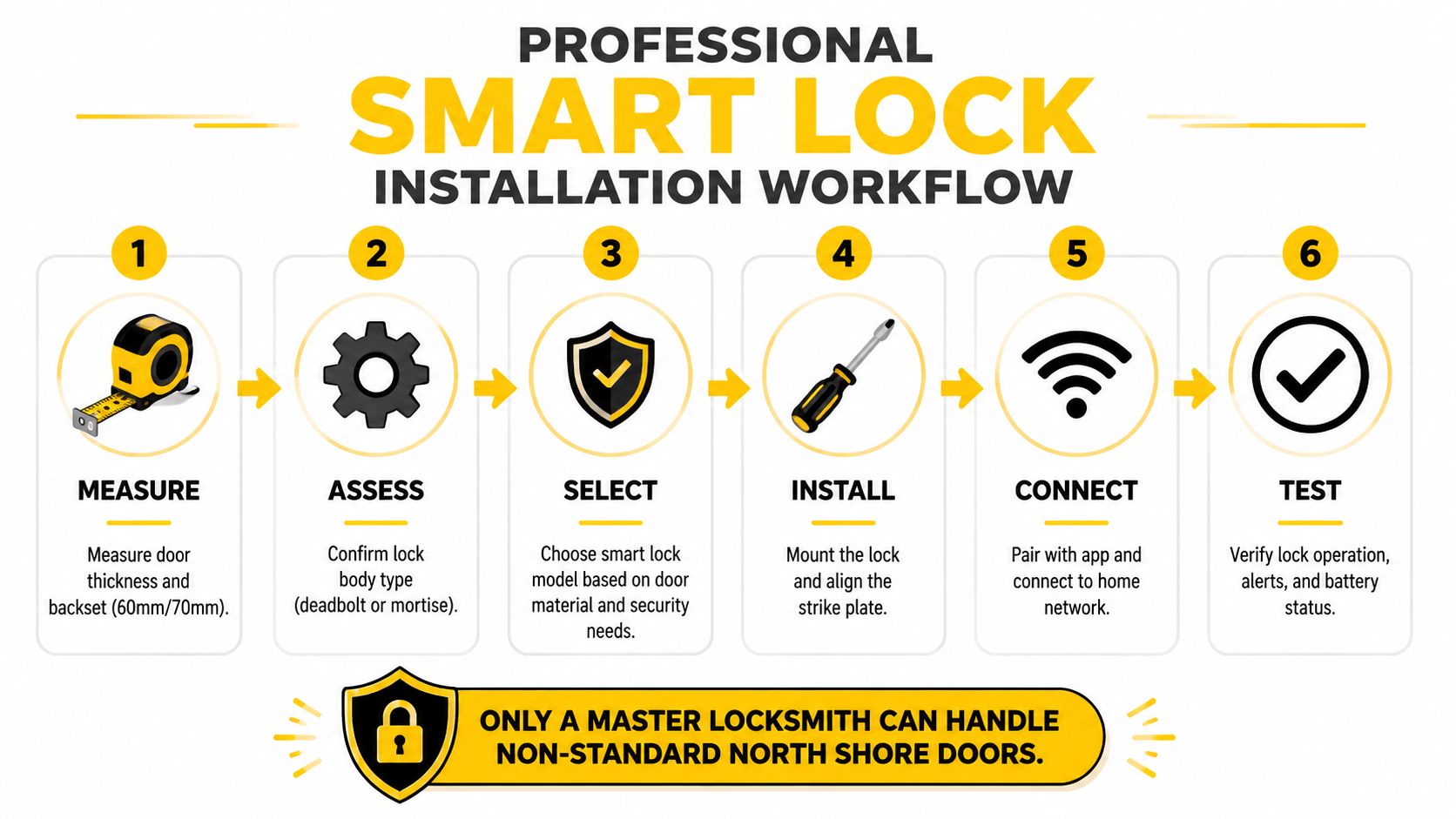
Australian residential doors commonly use 60 mm or 70 mm backset mortice configurations, as outlined in this Australian smart-lock compatibility guide. Backset is the distance from the door edge to the centre of the lock follower or cylinder. Measuring from the edge to the centre of the existing hardware, rather than guessing from the faceplate, helps prevent ordering a lock whose latch lands in the wrong place.
Measure the existing arrangement
The assessment should record:
- Door thickness: The internal and external escutcheons need enough material and clearance to clamp securely without fouling the frame.
- Backset: Confirm whether the mortice is 60 mm or 70 mm, rather than assuming the common size.
- Lock body: Identify a mortice, deadbolt, or latchset, then check how the internal drive operates.
- Door handing and swing: The lock must suit how the door opens and how the latch meets the strike.
- Existing cut-outs: A replacement that needs different holes may leave unused openings or require changes to the door.
- Frame and strike alignment: A smart lock can't compensate for a door that already drags, sags, or misses the strike plate.
Standards such as AS 4145.2 can be relevant to hardware selection, particularly in controlled environments. NSW Department of Education hardware schedules also call up C6 corrosion resistance for door hardware in specified settings, which shows why the underlying hardware specification matters rather than just the electronic module.
Stop at the fire tag
Apartment owners should inspect the door edge for a fire tag or other fire-door identification before buying anything. The relevant question isn't whether a lock is marketed as fire-rated in general. The question is whether the proposed hardware is approved for that exact fire-door type.
Adding an electronic lock, drilling a new cut-out, or changing the latch can invalidate compliance unless the door maker supports the modification and the Owners Corporation approves the work. Guidance on electronic locks and fire doors highlights the narrow range of hardware that may be accepted on fire-rated doors. A wrong selection can force major remedial work, including replacement of the door.
For accessible or institutional applications, lever-style furniture and alignment with AS 1428.1 and the Building Code of Australia may also matter. The safe process is to photograph the door edge, identify the hardware, check the approved hardware information, and obtain building approval before ordering.
If the door is fire-rated, non-standard, unusually thick, badly aligned, or already damaged, the sensible point to call a Master Locksmith is before drilling begins. That is the stage where compatibility can still be changed without turning a product purchase into a door repair.
How a Master Locksmith Installs and Commissions a Smart Lock
A professional installation is not the removal of an old lock and the fitting of a new faceplate. The locksmith first confirms the measurements and the door's condition, then decides whether the selected unit can operate the existing latch or mortice without forcing the mechanism.
The work starts with mechanical fit
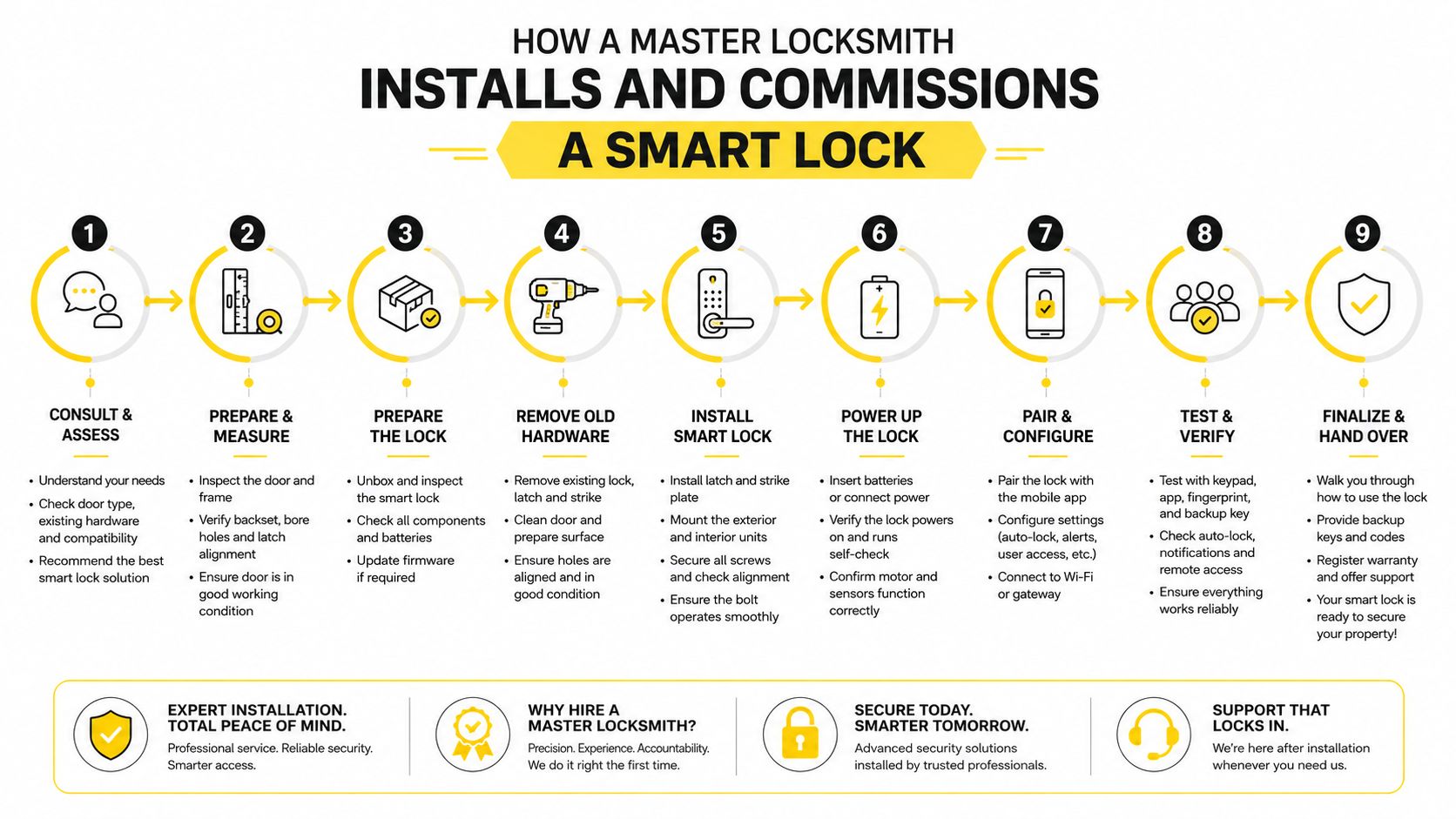
The sequence normally follows the door, not the app:
- Measure the door thickness and backset. The installer confirms the dimensions and checks whether the existing cut-out matches the proposed body.
- Identify the lock body. A mortice, deadbolt, and latchset require different internal drive arrangements.
- Check alignment. The door should close without lifting, dragging, or pushing against the frame.
- Review approvals. A fire-door tag, approved hardware information, and Owners Corporation consent need attention before modification.
- Select the compatible unit. The internal drive geometry must match the latch or mortice so the motor isn't forced to overcome a misaligned mechanism.
- Fit the hardware. The locksmith mounts the components, checks clearances, and aligns the strike plate.
- Set the access methods. App credentials, PINs, cards, or other approved methods are configured for the intended users.
- Check the power arrangement. Battery replacement access, low-power behaviour, and emergency power or mechanical override are verified.
- Commission the door. The installer tests locking, unlocking, self-latching, relatching, alerts, and the mechanical override.
Commissioning reveals shortcuts
A lock can appear to work while the door is open and fail when the frame applies pressure. Testing must therefore include the door closed, the latch fully seated, and the strike under normal conditions. If the motor strains, the lock may be compensating for a door alignment problem that will shorten battery life and frustrate users.
The mechanical override deserves equal attention. The property must still have a deliberate entry plan if the battery is flat, the phone is unavailable, the app account changes, or the network connection stops working. Wi-Fi should support the chosen access process where required, but the door shouldn't become unusable just because the internet has dropped.
A neat installation is not enough. The lock must close, latch, unlock, relatch, and recover from ordinary power and access failures without guesswork.
DIY fitting often fails at the transition between the lock body and the frame. A hole can be in the correct visual position but still leave the latch misaligned. On a fire door, an unauthorised cut-out creates a more serious approval problem. Professional commissioning checks the mechanical behaviour before handing access to the occupants.
Smart Locks Versus Mechanical and Restricted Key Upgrades
A smart lock isn't always the cleanest answer. A family that has misplaced keys may need rekeying. A rental with frequent tenant changes may benefit from a controlled key system or a lock designed for straightforward cylinder changes. An office with several staff members may need a restricted key hierarchy, an electronic access record, or a combination of both.
The decision should follow the access pattern. If users need temporary credentials, remote permission changes, or an audit trail, electronic access may justify its added complexity. If the problem is that too many old keys are circulating, a mechanical rekey can remove those keys without introducing batteries, apps, firmware, or account administration.
A practical comparison
| Option | Best For | Key Control | Strata and Fire-Door Fit |
|---|---|---|---|
| Smart lock | Homes, rentals, offices, or shared access points needing temporary permissions or activity records | Digital credentials can be added or removed, subject to the product and account setup | Must match the door approval pathway. Fire-rated doors require approved hardware and proper consent |
| Mechanical rekey | Lost keys, a new occupant, or a straightforward change of who can enter | Existing cylinders are changed so old keys no longer operate | Usually simpler, but the door and cylinder still need to be assessed |
| High-security mechanical lock | Owners who want robust mechanical protection without app dependence | Key control depends on the cylinder and the way copies are managed | Often easier to keep within an approved door configuration, subject to the exact hardware |
| Restricted key system | Multi-user homes, offices, strata services, and sites needing a controlled key hierarchy | Key duplication is managed through an organised restricted system | Can be a practical fit where electronic modification is unsuitable, but approval still matters |
A restricted system can be particularly useful for a North Shore office where cleaners, managers, and staff need different access levels. The restricted key system guide explains why key control can solve a problem that a consumer smart lock doesn't address cleanly.
Match the option to the property
A rental owner may value temporary access, but the property manager still needs a reliable process when tenancy details change. A family home may prefer a smart lock for regular trades access, provided the owner understands how credentials are removed. A strata lot may need a mechanical upgrade because the fire door accepts only approved hardware.
Cost isn't one simple product price. The drivers include door preparation, compatible lock bodies, fire-door approval, electrical or network requirements, replacement cylinders, ongoing battery maintenance, and any remedial work needed to correct an existing alignment problem. A cheaper online lock can become the more expensive choice if it doesn't fit the cut-out or cannot be approved.
Security, Cybersecurity, and Outage Realities
The assumption that a smart lock is automatically safer than a mechanical lock needs challenging. Digital access can reduce the problem of copied keys, but it introduces new dependencies, including phones, app accounts, batteries, network connections, and user permissions.
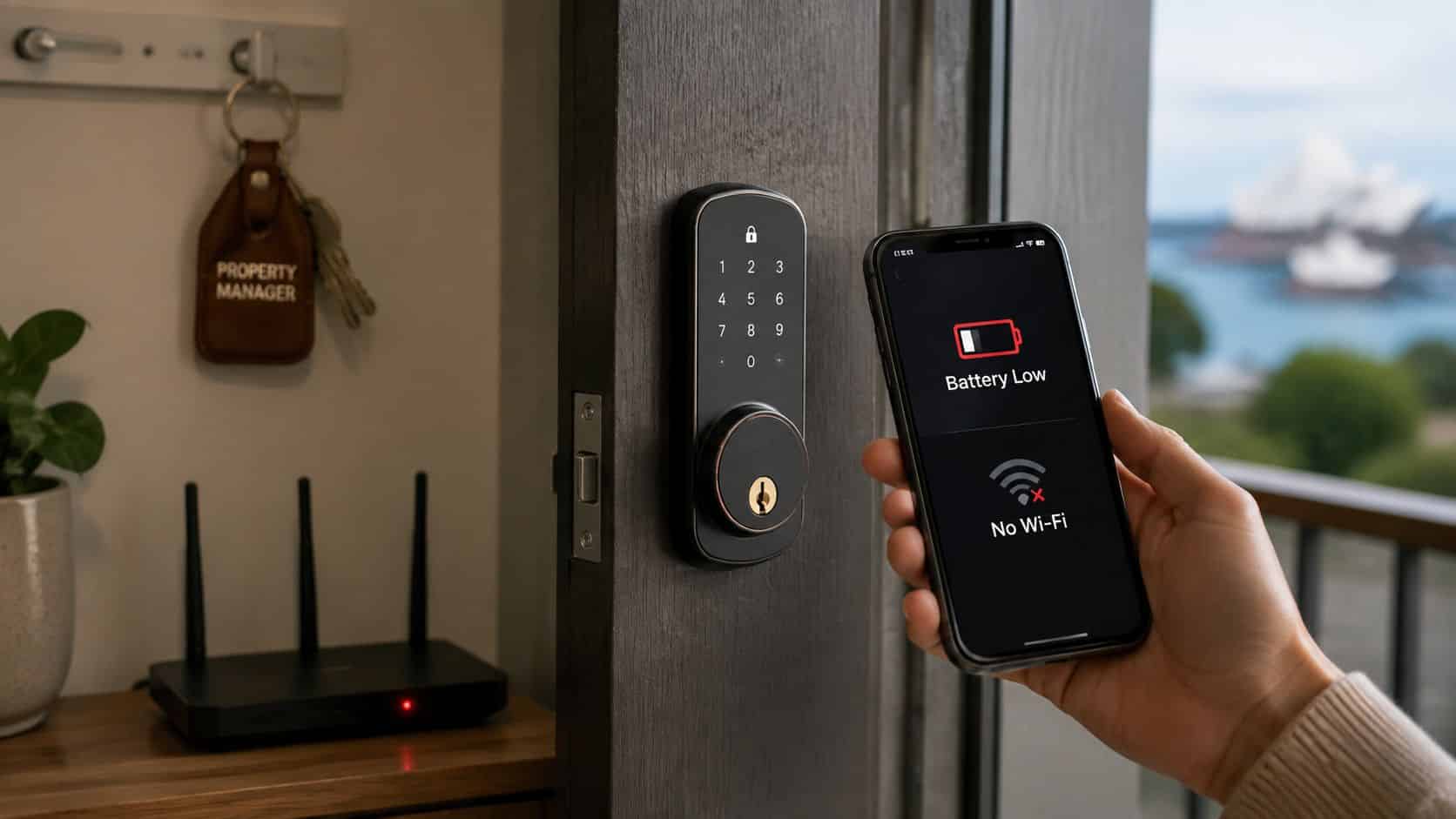
A Wi-Fi outage may stop remote functions while local access still works, depending on the system. A flat battery can create a lockout if the emergency method wasn't planned. A former tenant or contractor may retain app access if the administrator doesn't remove the credential. An account takeover can affect every door connected to that account.
Specify failure behaviour
A sensible specification asks what the lock does without internet access, how occupants receive low-battery warnings, and whether a physical key, external power point, or other emergency override remains available. The installer should demonstrate those methods rather than just saying the lock has a backup feature.
Temporary access also needs administration. A cleaner may need a limited code, a tradesperson may need access for a defined visit, and a property manager may need control after a tenancy change. Unique credentials are easier to remove than a shared PIN, but only if someone actively reviews and deletes them.
Integration has a purpose and a cost
Intercom-linked entry can be useful in an apartment or office where access needs to connect with a broader system. Activity records can help identify who entered, but they also create an information trail that needs responsible account management. More integrations mean more settings, permissions, and connected services to maintain.
The strongest installation keeps the mechanical fallback usable and makes the electronic layer serve a clear purpose. If the only requirement is replacing a lost key, a rekey may deliver the result with fewer failure points. If the property needs temporary access, audit records, or multi-user management, smart technology may be worthwhile when the door and administration are handled properly.
When to Call a Local Master Locksmith on the North Shore
Professional assessment is essential when the door is fire-rated, the lock body is non-standard, the frame is misaligned, or the property sits within a strata scheme. Owners should obtain approval before modifying apartment entry doors, and they should confirm who carries responsibility for the door hardware and ongoing maintenance.
Window safety can also enter the conversation in multi-level housing. NSW rules identify a qualifying high-risk window as one that can open and sits less than 1.7 metres above the floor, where the floor is at least 2 metres above outside ground level. Compliant devices must restrict the opening to under 125 mm and resist 250 newtons of force, about 25 kg, according to the NSW planning framework for window safety. NSW strata guidance also records the formal requirement for qualifying residential buildings from 13 March 2018, with the same opening threshold explained by Kidsafe NSW.
That overlap matters because apartment owners often treat door access, window safety, insurance, and building approval as separate issues. The owners corporation is generally responsible for installing and repairing qualifying window safety devices, while an owner who installs one must notify the corporation within 7 days, as set out in the NSW strata regulation. A local locksmith can identify which questions belong with the locksmith, the strata manager, the door manufacturer, or the Owners Corporation.
For a planned installation, the guide to calling a North Shore locksmith helps prepare the details needed for a useful quote or site visit. A properly selected lock, fitted to the actual door and commissioned under normal conditions, is more dependable than repeatedly replacing cheap units that never matched the building.
Lock, Stock & Barrel Locksmiths provides smart-lock assessment, installation, mechanical upgrades, rekeying, and window safety work across Sydney's North Shore, including strata and commercial properties. For a door-specific recommendation or quote, visit Lock, Stock & Barrel Locksmiths and arrange a site assessment before ordering hardware.