- 24 Hour Emergency Services
- Servicing Sydney's North Shore
- View On Map

-
Mail Us On
info@lsblocksmiths.com.au
-
Make a Call
0411 700 072
- View On Map
- 24 Hour Emergency Services
- Servicing Sydney's North Shore
- View On Map
-
Mail Us On
info@lsblocksmiths.com.au
-
Make a Call
0411 700 072
- Contact Us
Wall and Floor Safes in NSW: A Practical Buyer’s Guide

Lock, Stock & Barrel Locksmiths
On August 11, 2026
A family finishes a renovation on the Upper North Shore and suddenly the passports, a few pieces of jewellery, old share certificates, and a bit of cash are living in different drawers, a bedside table, and the kitchen junk cupboard. That's usually when the conversation changes from “should there be a safe?” to “what kind of safe suits this house, this slab, and these valuables?”
For North Shore homes, wall and floor safes aren't decorative extras. They're fixed, concealed installations, and the decision sits where the building fabric meets the assets you're trying to protect. In Australia, that matters because the broader safes and vaults market is expanding, with research valuing it at USD 8.6 billion in 2023 and projecting USD 18.7 billion by 2032 at a 9% CAGR, while another report placed it at USD 8.43 billion in 2024 and forecast USD 17.28 billion by 2033 at 8.3% CAGR (Allied Market Research). The product category isn't niche, and fixed safes are part of that growth.
Why a Safe Belongs on the North Shore Homeowner's List
A North Shore household usually doesn't start looking at safes because life is calm. It starts after a scare, a tenancy change, a renovation, or an insurer asking awkward questions about where the valuables sit. A family that once tossed passports and heirlooms into a drawer quickly realises that drawer security is just wishful thinking.
The right response isn't buying the biggest steel box in a catalogue. It's deciding whether the house needs a concealed fixed safe, and where that safe can live without clashing with wiring, plumbing, or the way the home is framed. On Sydney's North Shore, that usually means a wall cavity, a slab, or a framed floor system, not a portable box under a bed.
Practical rule: if the safe can be carried out, the job isn't finished.
That's the whole mindset shift. Wall and floor safes are chosen because they can disappear into the building, and that makes them a better fit for households that want documents, small valuables, or cash kept out of sight but still available. The decision is also tied to insurance reality, because the storey you tell yourself about “safe enough” often doesn't match what an insurer or locksmith wants to see.
A home on the North Shore also isn't a blank canvas. Older timber-framed rooms, apartments, terraces, and renovated houses all change the answer. A good safe choice respects the structure first, then the valuables second.
Wall Safes and Floor Safes Compared Side by Side
A wall safe sits inside a cavity between studs, and a floor safe sits below floor level, often in concrete, with the lid or door finishing flush with the surface. That difference sounds simple, but it changes everything from access to concealment to what kind of building can take the install.
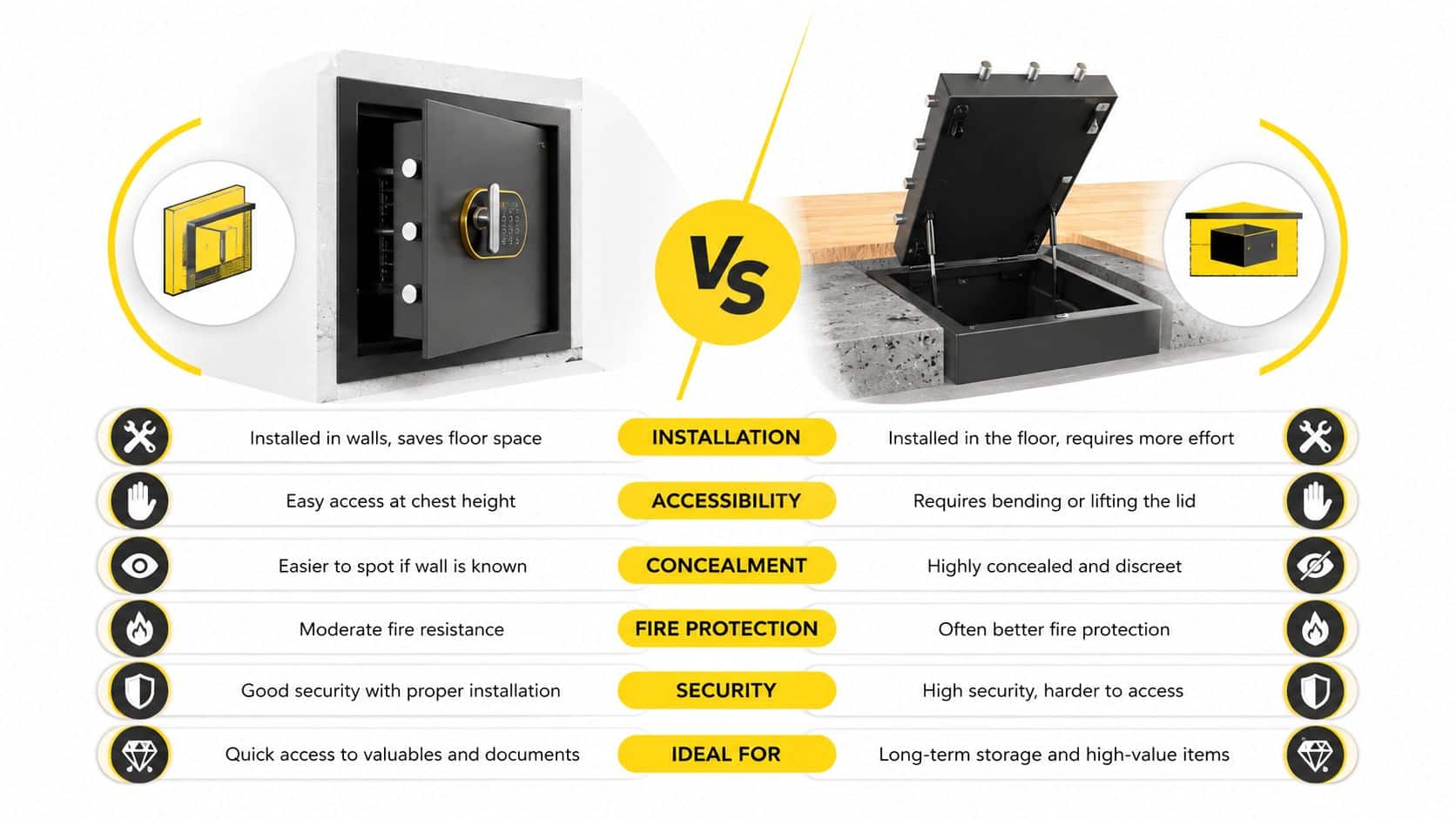
| Factor | Wall safe | Floor safe |
|---|---|---|
| Cavity or slab need | Needs a usable stud bay and wall depth | Needs floor depth, usually concrete or a framed floor system |
| Access height | Eye or chest height, easier for regular use | Low access, usually kneeling or bending |
| Visibility | Easy to hide behind a mirror, painting, or panel | Easy to hide under a rug or furniture |
| Capacity | Limited by the wall cavity | Often roomier, because the floor can offer more structural depth |
| Best use | Documents, passports, jewellery, items accessed often | Long-term storage, bulkier valuables, less frequent access |
The internal link that matches wall-safe work is wall safe installation and supply, because the wall option is where fit, cavity depth, and trim-out matter most.
Wall safes are the more convenient choice when the contents get opened regularly. Floor safes win when concealment and capacity matter more than convenience. In plain English, wall safes suit the thing you'd rather reach without kneeling, while floor safes suit the thing you don't want seen at all.
Security Ratings, Fire Ratings and What the Numbers Mean
Safe brochures love label soup. Security rating, fire rating, body thickness, bolt count, door thickness, it all gets thrown at the buyer as if one number can do every job. It can't.
A security rating tells you how the safe holds up under attack testing. A fire rating tells you how long the safe can keep the inside within a survivable heat range for the contents. Those are different jobs, so judge them separately. A safe set into concrete is not automatically fire-protected, and that assumption catches plenty of buyers out.
For wall and floor safes, the product specs tell you more than the marketing copy does. Catalogued units in this category range from about 13 kg for compact models up to 119 kg for larger ones, with internal volumes from around 7 L to 180 L, and heavier units can include 10 mm one-piece steel doors and 22 mm rotating deadbolts (BestSafes). Mass helps because it slows prying and removal. Door steel and boltwork matter because they buy time against drilling and forced entry.
That is why a lock alone does not make a safe strong. A solid lock inside a weak body still loses to a crowbar or a removal attempt. Judge the safe as a whole, body, door, locking points, and the way it is fixed into the structure.
The internal link that belongs with these rating questions is what makes a safe safe, because the buyer needs the rating conversation before they start comparing colours or trim. If the safe is protecting paper documents, a meaningful fire rating matters. If it is protecting jewellery and cash, body strength and anchoring move higher up the list.
Anchoring Is the Whole Job
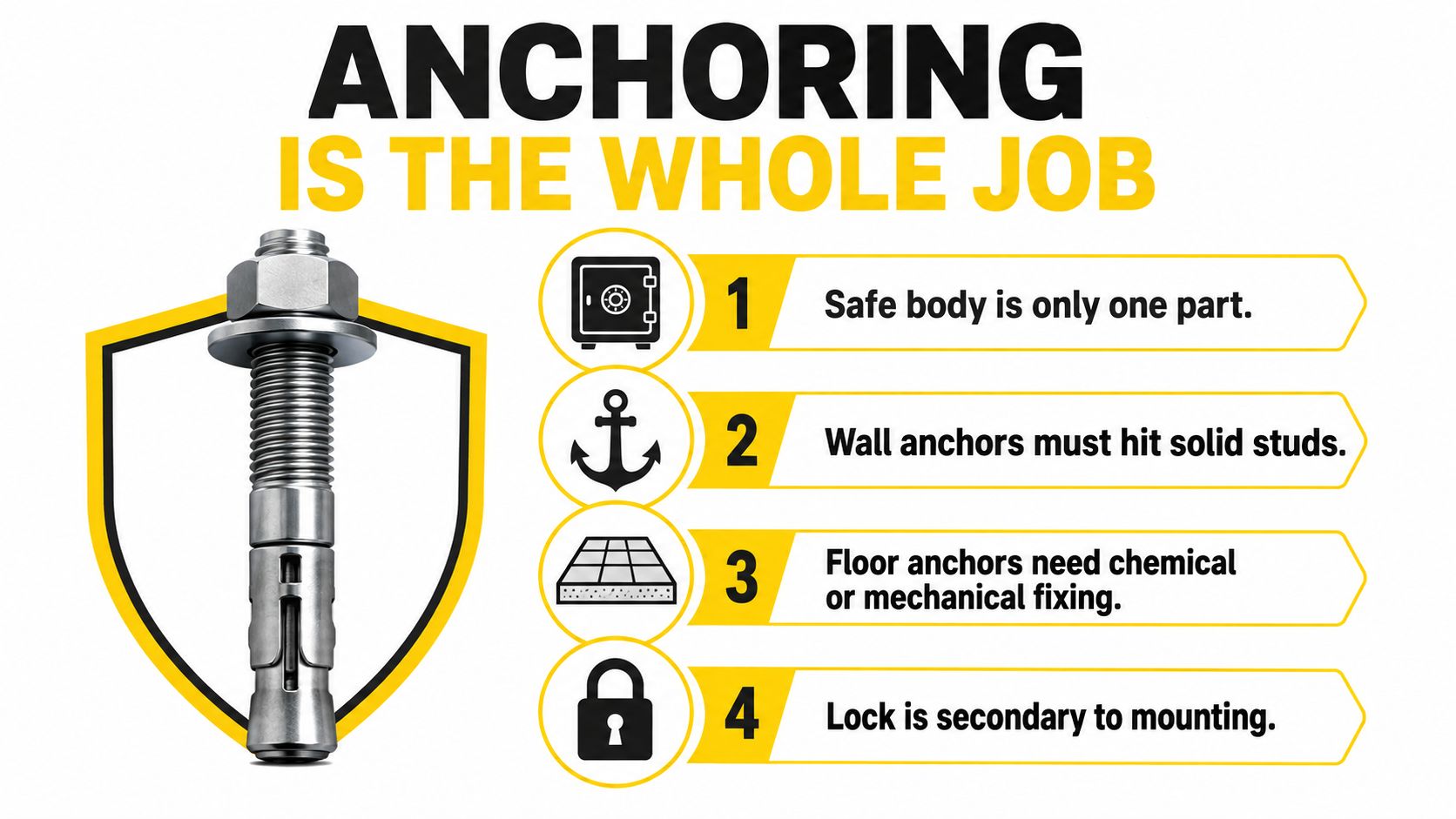
Most buyers get it wrong. They focus on thickness, weight, and lock type, then leave the unit sitting there like a heavy ornament. That's how good safes get beaten.
An industry source says 1 in 6 home burglaries involves theft of the entire safe when it isn't bolted down, and only 10% of homeowners bolt their safe to the floor as recommended (WiFiTalents). That lines up with what installers keep seeing. If a thief can roll or drag the unit out, the rest of the spec sheet barely matters.
An unanchored safe is a removal problem, not a lock problem.
Wall safes need solid fixing into studs or a concrete surround that gives them real resistance to pull-out and prying. Floor safes need proper fixing into the slab or a prepared concrete pour, with the base and sides doing part of the resistance work. A safe that “looks heavy” still loses if it can be tipped, levered, or lifted quickly.
For floor work, one installation guide calls for 4000 PSI concrete as the minimum professional standard, an excavation area at least 6 inches wider than the safe on all sides, a 4 to 6 inch concrete base, and a 1:2:3 cement, sand, and aggregate mix (SureLock Key). That's the difference between a box sitting in a hole and a safe that's embedded.
The takeaway is blunt. If the mounting is weak, the safe is weak. If the mounting is right, the steel finally gets a chance to do its job.
How Installation Works in a Sydney Home
Sydney homes are rarely built around the safe. The safe has to fit the home, and on the North Shore that means working around timber-framed internal walls, older renovations, and slab-on-ground construction that leaves little room for improvisation.
A wall safe is usually limited by the cavity itself. One documented design is sized for 16-inch on-centre stud spacing, includes pre-drilled anchor holes and a built-in flange to avoid replastering, and its hardware adds about 2 inches to the outside depth once the handle, dial, and hinge projection are counted (The Safe Man product catalogue). Measure the cavity, plasterboard thickness, and projection before any cut goes in. If those dimensions are off, the safe ends up proud of the wall or forced into a space it cannot properly fit.
Floor safes are a different job. One manufacturer's guide says to dig the hole at least 3 inches deeper than the safe, line the hole with plastic if needed, set the wrapped safe in place, finish with concrete, and wait 48 hours before using it (Maximum Security installation guide). The same guide gives a 48-hour wait before removing formwork when the unit is surrounded by 10 cm of concrete on all sides. That waiting period is not a suggestion. Rushing it weakens the set and risks movement before the concrete has done its job.
Problems show up before the drill or shovel starts. Rebar, plumbing, floor heating, slab depth, and apartment access can all change the job. A floor safe in the wrong slab can turn into expensive demolition. A wall safe in the wrong cavity can miss studs, foul on utilities, or sit proud of the finished wall.
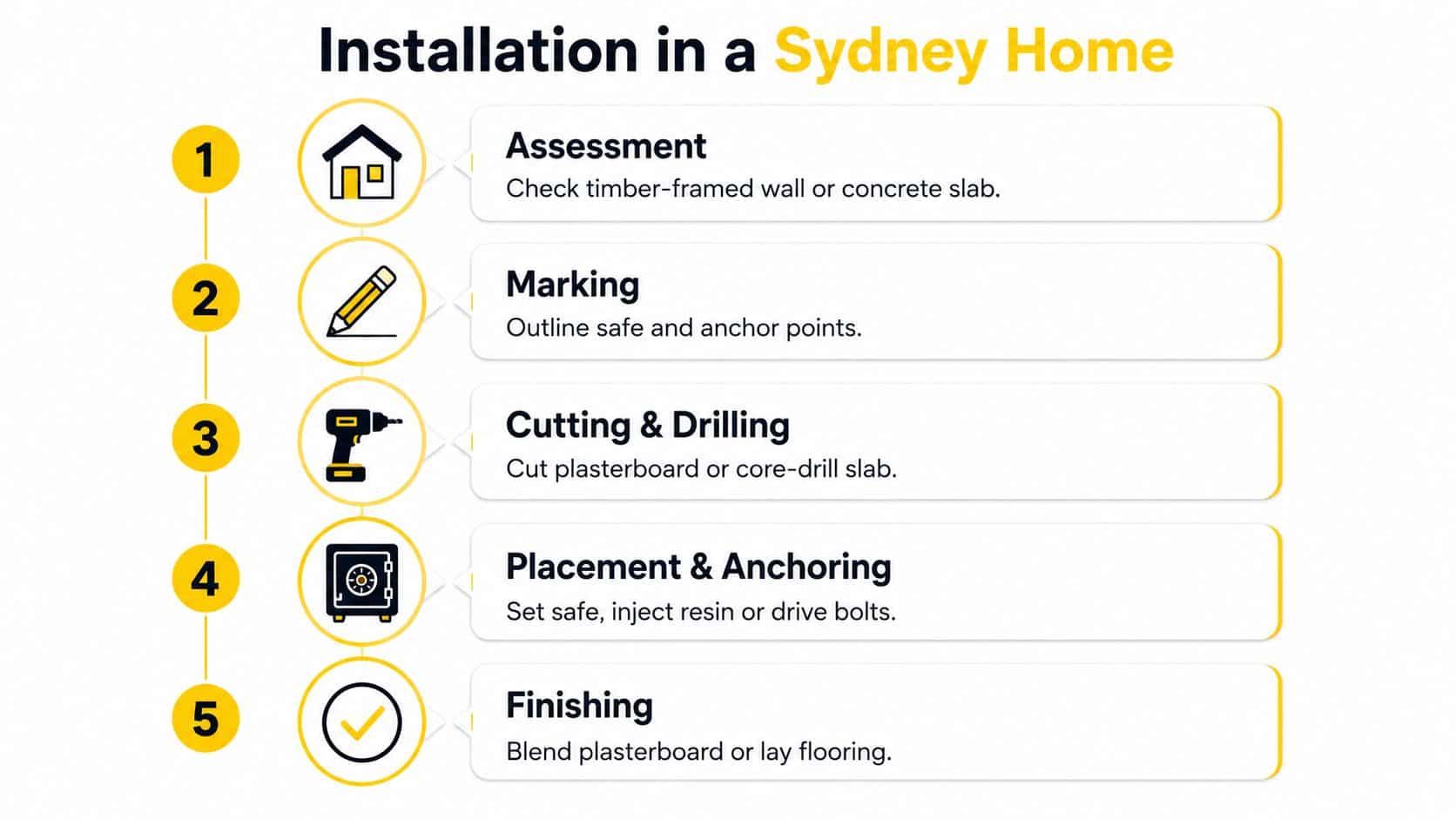
That is why a proper site measure matters more than the brochure. A locksmith who already works in Sydney housing stock will spot slab limits, cavity depth problems, and access issues before the install starts. If you are trying to compare labour, access, and fit-up for a wall unit, wall safe installation cost is the right place to start because the measure-and-fit stage is where most mistakes are avoided.
Choosing the Right Safe for What You Own
The wrong buying habit is easy to spot. Someone picks the largest safe in the brochure because bigger feels safer. That is the wrong way to buy.
A family home storing passports, jewellery, and a small cash float does not need the same safe as a home office with client records and backup drives, and neither needs the same setup as a small business protecting float or controlled records. Pick the unit that fits the building and the contents without wasting cavity space or slab depth.
Start with the contents, then check the structure. Match the internal volume to what has to go inside, with enough room to store the items without forcing them into awkward stacks. A 7 L unit is a different proposition from a 180 L unit, and the bigger one is not automatically better if the wall cavity cannot accept it or the site cannot support the install.
Three practical matches
- Family valuables: Wall safe, when the contents are mostly documents, jewellery, and a little cash, because regular access matters.
- Home office storage: Floor safe, if the material is less frequently accessed and the building can accept a proper embed.
- Small business use: Heavier fixed unit, because the issue is removal resistance and secure anchoring, not just hiding the box.
The contents matter just as much as the box. Paper records and other heat-sensitive items need a fire rating checked on its own, because not every floor safe carries one. Wall safes also hit cavity limits quickly, which makes them a poor fit for oversized binders or bulky folders.
Buy to the building and the asset profile, not to a fantasy of “maximum security”. Overspecifying a safe in the wrong location wastes money. Underspecifying the contents leaves the risk on the table.
Compliance, Insurance and When to Call a Locksmith
For most domestic installs in NSW, the compliance picture is straightforward. The trouble starts with strata, apartment rules, and insurer expectations. A body corporate may want approval before any wall or floor work goes ahead, and an insurer may want evidence that the safe is properly rated and anchored.
That's why a licensed, mobile locksmith matters. A Master Locksmith with an NSW Police Master Licence is the sort of person insurers and building managers are usually more comfortable dealing with, especially when there's documentation attached to the job. Lock, Stock & Barrel Locksmiths is a mobile North Shore locksmith service that handles wall and floor safes, site measures, and installation work across the area, which is the sensible route when the cavity or slab question isn't obvious.
The cleanest workflow is simple. Measure the site, check the building constraints, choose the safe to match the structure, then book the install. That avoids the very common mistake of buying online first and discovering on install day that the cavity is too shallow or the slab isn't suitable.
The exact decision a homeowner should make before picking up the phone is whether the job needs a wall safe, a floor safe, or neither. After that comes the question of who's fitting it, because the installation is the product as much as the steel box is.
Questions North Shore Homeowners Ask Before Installing
Tenants ask this first. A renter usually can't install a wall or floor safe without written landlord consent, and strata by-laws can still apply even when the landlord says yes. A fixed safe changes the building fabric, so it isn't treated like a freestanding cupboard.
Humidity comes up next, especially around the lower North Shore and harbour-side suburbs. Coastal air, condensation, and slab conditions can all matter, and not every home safe is waterproof or equally resistant to corrosion. Cheaper bodies can rust sooner in damp conditions, so the contents and the environment need to be considered together.
Insurance is usually the practical reason the conversation gets serious. A safe may help satisfy insurer conditions, but the insurer normally wants to know the rating and whether the safe is anchored properly. Documentation helps, and that's part of why a licensed locksmith is the better path than a casual handyman.
DIY installation sounds tempting until the first mistake. Floor safes are particularly poor DIY candidates because a bad cut, bad pour, or bad position is expensive to undo. Wall safes that need concrete encasement are the same story, because once the cavity or slab is compromised, the repair can cost more than the original job.
If the site is uncertain, don't guess. Guessing is how expensive holes get made in the wrong place.
A fixed safe should make life calmer, not create a renovation problem. For most North Shore homes, the right move is a measured site visit, a proper recommendation, and an install that fits the building instead of fighting it.
If a wall or floor safe is on the list, Lock, Stock & Barrel Locksmiths can measure the site, talk through the cavity or slab constraints, and handle the installation without the guesswork. Visit Lock, Stock & Barrel Locksmiths to request a quote or book a site visit, and get the safe matched to the house before the first cut is made.