- 24 Hour Emergency Services
- Servicing Sydney's North Shore
- View On Map

-
Mail Us On
info@lsblocksmiths.com.au
-
Make a Call
0411 700 072
- View On Map
- 24 Hour Emergency Services
- Servicing Sydney's North Shore
- View On Map
-
Mail Us On
info@lsblocksmiths.com.au
-
Make a Call
0411 700 072
- Contact Us
Office Door Lock Repair Pymble: Fast & Reliable Service

Lock, Stock & Barrel Locksmiths
On July 17, 2026
For most North Shore offices, the first question is cost, and a standard business-hours repair usually starts at $90 to $120 plus parts, with after-hours work often landing higher depending on the fault. The second question is how quickly the door can be made secure again, and that depends less on luck than on whether the problem is a simple adjustment, an internal failure, or a lock that should've been replaced earlier.
A lot of office managers land here in the same state. Staff are waiting in the corridor, the front door won't lock, the key won't turn cleanly, or the handle has gone soft with no warning. Work stops while someone decides whether this is a quick fix, a security issue, or both.
Office door lock repair in Pymble often isn't just about the lock itself. Older North Shore buildings move. Strata fit-outs get altered over time. Doors that worked fine six months ago start scraping, sticking, or refusing to latch because the opening has shifted slightly. That's why the right fix starts with diagnosis, not guesswork.
That Monday Morning Feeling When the Office Door Won't Open
It usually happens at the worst possible time. First person in can't get the key to turn. Someone else tries the handle and gets nothing. Then the door opens, but won't lock again when deliveries start arriving. The whole morning goes sideways because one piece of hardware has failed at the exact moment the office needs to function.

In Pymble and across the Upper North Shore, that scenario is common in older commercial buildings. A lock can look like the problem when the underlying issue is movement in the frame, a worn strike, or a latch that's been under stress for months. Office managers usually want the same two answers straight away. What's this going to cost, and can the site be secured today?
Why quick DIY fixes often backfire
The temptation is to spray lubricant into the keyway, force the key, tighten whatever screws are visible, and hope for the best. That works badly in commercial settings, especially when the lock is part of a lever set, restricted cylinder, or shared tenancy entry.
In Sydney's North Shore, where older office buildings and strata titles frequently cause door frame shifts, DIY attempts often worsen internal mechanism damage, leading to 40% higher long-term repair costs compared to professional realignment according to this analysis of jammed lock repair risks.
Practical rule: If the key is binding, the latch is scraping, or the door only locks when lifted or pushed, treat it as an alignment problem first, not a lubrication problem.
That's also why local knowledge matters. A commercial suite in an older building near Pymble locksmith service coverage usually has different hardware and frame issues from a newer retail tenancy or warehouse unit. The fix has to suit the opening, the building, and the way the office uses the door each day.
Diagnosing Common Office Door Lock Problems
A good repair starts with naming the fault properly. “The lock's broken” is understandable, but it can mean half a dozen different things. The symptoms usually point to the cause if they're described clearly.

When the key turns badly or not at all
If the key goes in but won't turn smoothly, there are a few usual suspects:
- Dirty or worn cylinder pins that no longer line up cleanly with the key
- Cylinder tailpiece or cam wear causing uneven engagement
- Pressure from the door frame pushing the latch or bolt out of alignment
- Damage after forced use when staff keep trying the key after resistance starts
A key that suddenly feels rough often isn't random. Something inside has worn, or the door has shifted enough to load the lock body.
When the handle feels loose, floppy, or spins
This is common on high-traffic office doors with key-in-lever hardware. The outside lever gets used constantly, often one-handed, often while someone is carrying a laptop bag or coffee. Over time, the spindle, return spring, or internal hub can wear out.
Signs include:
- Lever drops lower than normal
- Handle returns slowly
- Key functions, but lever won't retract the latch
- Handle turns with very little resistance
That sort of fault usually means internal wear, not just a loose screw.
When the latch is sticky or the door won't catch
This is one of the most misdiagnosed commercial door problems. Staff often blame the lock because the latch won't enter the strike cleanly. In many cases, the frame or strike plate has shifted enough to make the lock work under strain every day.
Office door lock repair failures are frequently caused by misaligned latch mechanisms due to building settlement or frame warping, and NSW repair guidance notes that misalignment exceeding 2mm significantly increases force on internal components and accelerates wear.
If the door only locks when it's pulled hard, lifted slightly, or slammed, the latch and strike probably aren't meeting where they should.
When the key breaks or the lock jams solid
This is usually the end stage of a problem that's been building for a while. The lock has been tight, staff have kept using it, and eventually the key snaps or the cylinder seizes. Extraction might save the cylinder, but not always. Much depends on whether the damage is isolated to the keyway or whether the cam, plug, or lock body has failed as well.
A helpful way to report the issue on the phone is to say what the door is doing, not what anyone thinks the fix is. “Key turns halfway then stops” is useful. “Needs a new lock” might be right, but it can also be an adjustment job.
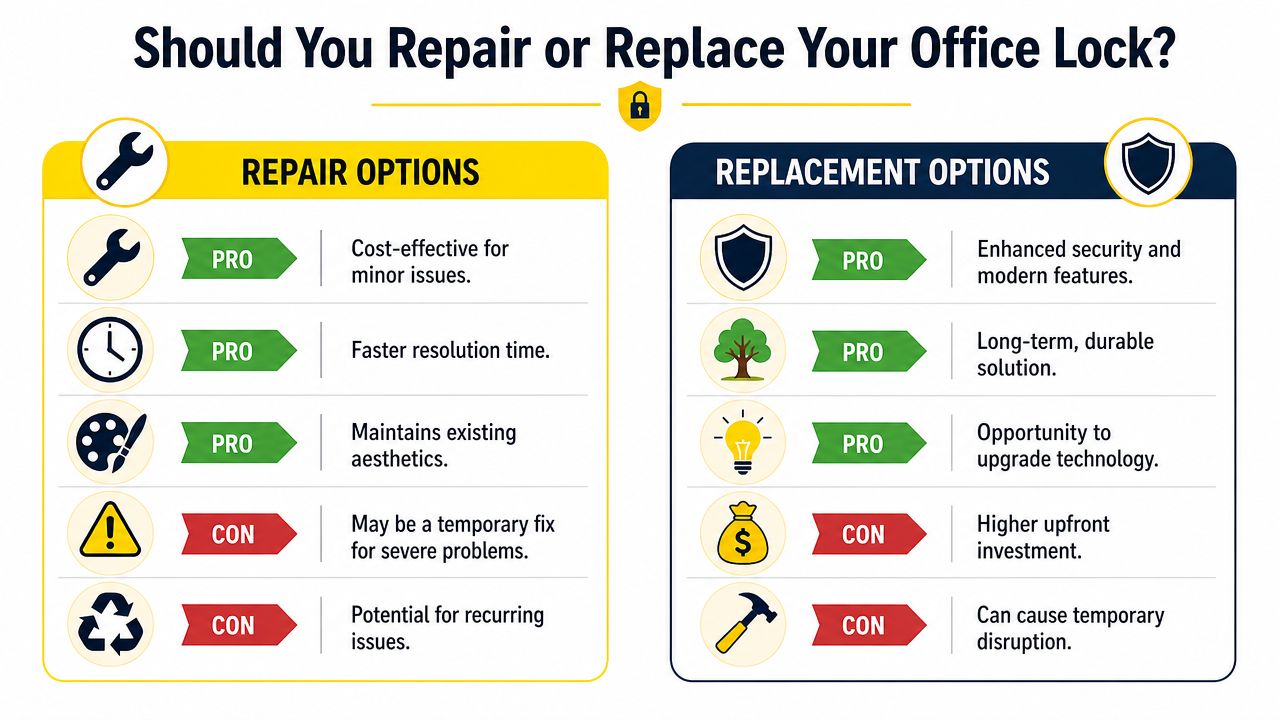
Should You Repair or Replace Your Office Lock
Repairing the existing lock is often the sensible option. Sometimes it's the expensive mistake. The right call comes down to cost, security, and how reliable the hardware will be after the work is done.
Cases where repair usually makes sense
If the lock is a decent commercial-grade unit and the fault is external to the mechanism, repair is often the better value choice. That includes strike adjustment, door realignment, cylinder servicing, or replacing a worn component inside an otherwise solid lockset.
Repair also makes sense when:
- The lock is part of a master key system and changing it would create unnecessary keying work
- The hardware suits the door and access pattern and only one component has failed
- The issue is recent and isolated, not part of a pattern of recurring faults
Cases where replacement is usually smarter
A cheap or light-duty lock on a main office entry rarely ages well. If it has repeated faults, poor key control, visible wear, or weak security, replacement is often the cleaner decision. There's no value in rebuilding tired hardware that still leaves the site with the same weaknesses.
In commercial office environments, mechanical key-in-lever sets experience a 40% higher failure rate compared to deadbolt systems within a 5-year period due to spindle stress, which is why commercial lock servicing guidance points office managers toward preventative servicing and stronger hardware choices.
Quick comparison table
| Situation | Better choice | Why |
|---|---|---|
| Good quality lock, latch not meeting strike | Repair and realign | The lock may be sound, while the opening has shifted |
| Restricted or master-keyed cylinder with minor wear | Repair or rekey | Keeps key system intact |
| Worn budget lever on main entry | Replace | Reliability and security are both questionable |
| Lock damaged after forced entry | Replace | Security integrity matters more than saving the body |
| Repeated jamming after previous adjustments | Replace, and inspect door set | Ongoing faults usually mean cumulative wear |
Decision point: If a repair restores function but leaves the office with a weak cylinder, poor key control, or hardware already near the end of its life, replacement is the better business decision.
Where cylinders are the weak link, a proper cylinder lock replacement for commercial doors can solve both the immediate fault and the bigger security problem in one visit.
What to Expect When You Call Your Local Locksmith
Most office managers don't need a technical lecture. They need a clear process, a straight answer, and no surprises once someone is on site.
What gets asked on the phone
The first call is about narrowing down the likely fault. Useful details include whether the door is open or shut, whether the key still enters, whether the handle moves, whether access control is connected, and whether the door is part of a shared tenancy or strata common area.
Those details matter because a shut and jammed door is approached differently from a door that opens but won't secure. A master-keyed cylinder is handled differently from a standard office lever set. If there's an electronic strike, intercom release, or restricted key system involved, that changes the repair path as well.
What happens on site
A proper attendance usually follows this order:
- Assess the whole opening. Not just the cylinder or handle, but the door, frame, latch, strike, hinges, and any closer tension affecting alignment.
- Confirm whether the fault is repairable. Some jobs need adjustment and servicing. Others need new parts or full replacement.
- Explain the options clearly. The office manager should know what restores function now and what reduces repeat call-outs later.
- Carry out the work and test it repeatedly. The lock should operate cleanly with the door open and closed.
That last point matters. A lock can seem fine while the door is open and still fail once the frame pressure comes back into play.
Commercial issues that change the job
Office work often brings a few added complications:
- Strata responsibilities for common area doors or shared access points
- Restricted key systems where replacement cylinders must match an existing hierarchy
- After-hours access where the priority is securing the premises first
- Staff movement that makes it hard to close an entry for long
The best repair isn't the one that gets the key turning. It's the one that gets the door locking, latching, and operating properly under normal office use.
For strata or mixed-use properties, responsibility can matter just as much as the hardware fault. If the problem sits in a common property frame, shared entry, or building-managed opening, that affects approval and scope before work starts.
Understanding Office Lock Repair Costs and Timelines
Price matters, especially when the office is already losing time. The useful way to look at office door lock repair is to separate labour, timing of the call, and parts.

What the base repair cost usually covers
Across Australia, the average cost to repair a commercial door lock during business hours ranges from $90 to $120 excluding parts, while after-hours emergency repairs can increase to $150 to $300, as set out in Australian locksmith repair pricing guidance.
That figure is a starting point, not a promise that every fault falls neatly into one bracket. A simple alignment issue can stay close to the lower end. A seized commercial lock, damaged lever set, or urgent after-hours attendance usually won't.
What makes one office lock job cost more than another
The main cost drivers are straightforward:
- Lock type. A basic cylindrical lock is one thing. Commercial mortice hardware, restricted cylinders, and integrated door sets are another.
- Fault severity. Adjustment is cheaper than extraction, internal rebuild, or replacing failed components.
- Time of day. Emergency work carries a premium because it disrupts schedules and usually has a stronger urgency component.
- Parts required. Cylinders, lock bodies, levers, strike plates, and matching restricted hardware are separate from labour.
A common source of confusion is the difference between “repair” and “make secure.” If a lock has failed after hours, the immediate job may be securing the premises so staff can leave safely, with final replacement or keying work done once the right parts are organised.
Timelines are driven by diagnosis, not guesswork
Most delays come from one of three things:
| Delay factor | Why it matters |
|---|---|
| Hidden frame movement | The lock fault won't stay fixed if the opening is still out |
| Non-standard hardware | Older commercial fit-outs don't always use readily matched parts |
| Key system constraints | Restricted and master-keyed setups need the right cylinder pathway |
An office manager usually doesn't need an exact minute-by-minute forecast. What helps is knowing whether the job is likely to be a same-visit repair, a secure-now-and-return job, or a replacement that needs matching hardware ordered properly.
Beyond the Repair Proactive Maintenance and Security
A working lock is only the immediate win. The bigger goal is avoiding the next failure when the office is busiest.
Simple habits that help locks last longer
Good maintenance is basic, but it has to be the right kind of maintenance. Office staff can help by reporting small changes early. A key that starts dragging, a latch that catches, or a lever that sags slightly should be looked at before it turns into a lockout.
Useful habits include:
- Report resistance early instead of forcing the key or handle
- Keep the door closing properly by watching for dragging, slamming, or latch misalignment
- Avoid random sprays and oils inside cylinders, especially where electronic hardware is nearby
- Check duplicated keys that may be poorly cut and adding wear to the cylinder
Security upgrades that prevent repeat emergency work
Not every office needs a full hardware overhaul. Some do need a smarter cylinder and better key control. That's especially true for street-facing doors, shared building entries, or older commercial suites still running standard euro-profile cylinders.
In Sydney, lock snapping is estimated to account for 2% to 4% of break-ins, which makes anti-snap cylinder upgrades a practical preventative step for commercial premises.
That matters because a break-in doesn't just mean stolen property. It usually means a damaged cylinder, a compromised door, and urgent repair work before the business can operate normally again.
Strata and compliance matter too
For North Shore commercial sites inside strata buildings, hardware choices can't ignore building rules. Shared entries, window devices, and common property obligations can all shape what gets repaired, upgraded, or approved. A lock that works mechanically still has to fit the broader compliance setting of the building.
For ongoing reliability, regular care beats repeated emergency attendance. A practical starting point is a simple door lock maintenance guide for common wear issues and then a proper review of any entry points that are sticking, hard to key, or using outdated cylinders.
Small lock problems rarely stay small in a busy office. They either get fixed early, or they get dealt with during a disruption.
If your Pymble office door won't lock, won't open, or is starting to show the usual signs of wear, speak with Lock, Stock & Barrel Locksmiths for a clear repair path and a proper quote. For urgent jobs, call. For planned work, request a quote and get advice that suits the building, the hardware, and the way your office runs.