- 24 Hour Emergency Services
- Servicing Sydney's North Shore
- View On Map

-
Mail Us On
info@lsblocksmiths.com.au
-
Make a Call
0411 700 072
- View On Map
- 24 Hour Emergency Services
- Servicing Sydney's North Shore
- View On Map
-
Mail Us On
info@lsblocksmiths.com.au
-
Make a Call
0411 700 072
- Contact Us
Coded Key Cutting Explained for North Shore NSW Homes

Lock, Stock & Barrel Locksmiths
On August 4, 2026
Coded key cutting builds a key from the lock maker's code instead of copying an existing one. That's usually the right call when the original key is lost, worn, stolen, or isn't available.
On Sydney's North Shore, that comes up in ordinary homes all the time, from a misplaced front door key to a strata unit where the only spare has vanished. A shop kiosk can copy a key that's already in hand, but it can't solve the problem when there's nothing decent to copy from, which is where code-based cutting becomes the practical fallback.
When a Missing Key Becomes a Coded Key Cutting Job
The call usually starts with a small, annoying problem. The only key has gone missing, the spare is in a drawer you can't find, or a former tenant never handed back the last copy. In that moment, a normal duplicate isn't a real option, because duplication depends on having an original to trace from.
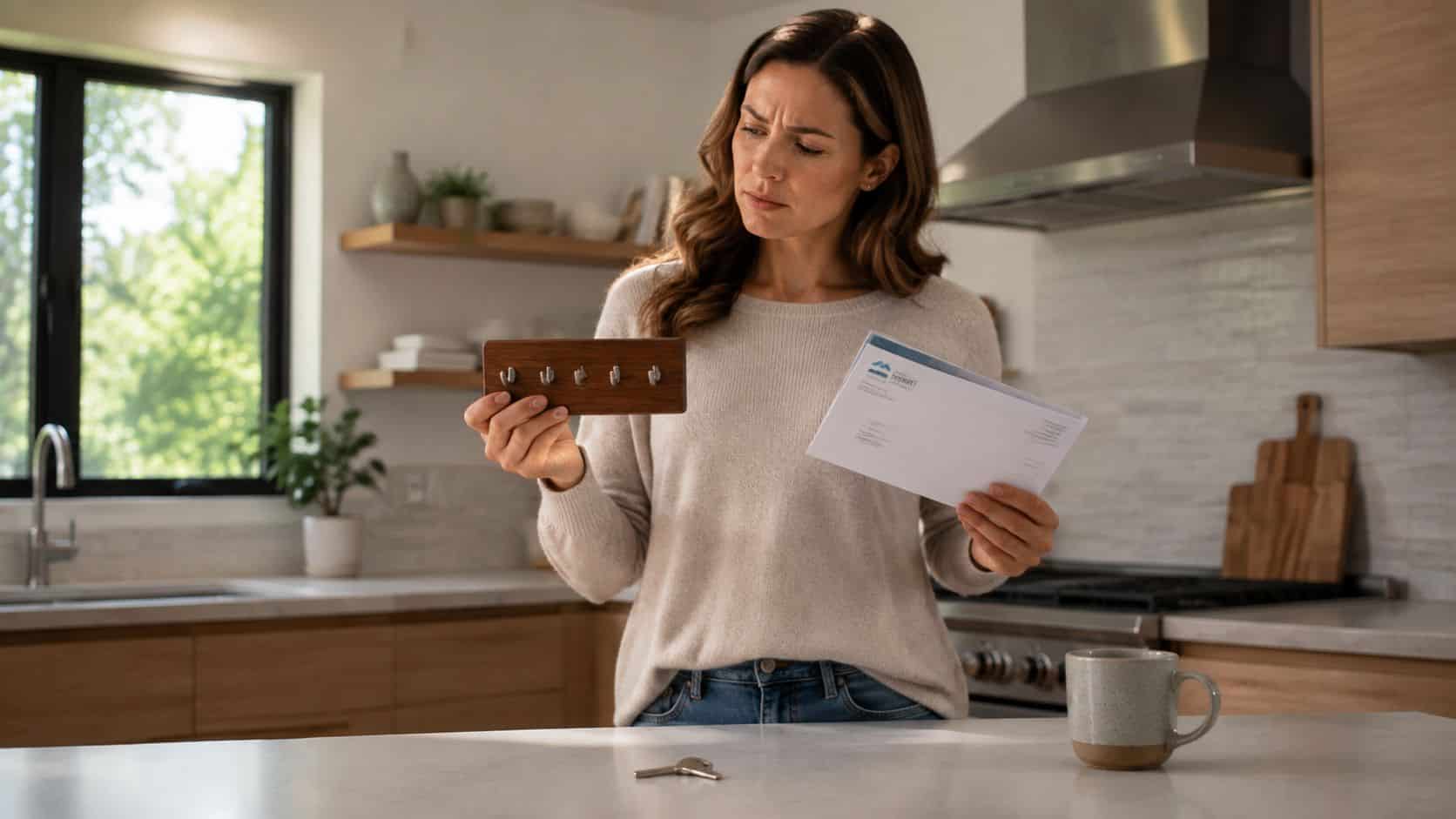
The original key is the starting point for one job, not the other
A standard copy reads the shape of a key already in hand. Coded key cutting starts somewhere else, at the lock maker's specification, so the locksmith can build a new key even when the original has disappeared. That's why the trade uses code work for lost-key replacements, some rekey jobs, and situations where the only remaining key is too rough to trust.
A code card is the bridge between the lock and the new key. Without that reference, the locksmith is guessing.
The code card matters because it carries the depth and spacing information for the right blank family. It is not a generic template, and it isn't interchangeable from one lock type to the next. That difference is what lets the locksmith work from the code rather than from a worn sample.
For a North Shore homeowner, that often means less back-and-forth and fewer dead ends. It also means the job can be handled properly when the original key is sitting with a former tenant, a property manager, or nobody at all. For that kind of problem, see lost key replacement options.
Why the kiosk at the shops isn't the answer
A kiosk can be fine when the original key is clean and accurate. It struggles when the only copy is bent, rounded, or missing altogether. In those cases, the right question isn't whether a copy can be made from what's left. It's whether the locksmith has the code, the blank, and the right machine to build the key from scratch.
That's the line between a duplicate and a coded cut. One repeats an existing key. The other reconstructs the key from the lock maker's own data.
What a Key Code Actually Means
A key code is just a shorthand for the lock maker's cutting specification. It tells the locksmith how deep each cut should be and how far apart those cuts should sit along the blade. That's the difference between a rough copy and a key built to factory geometry.
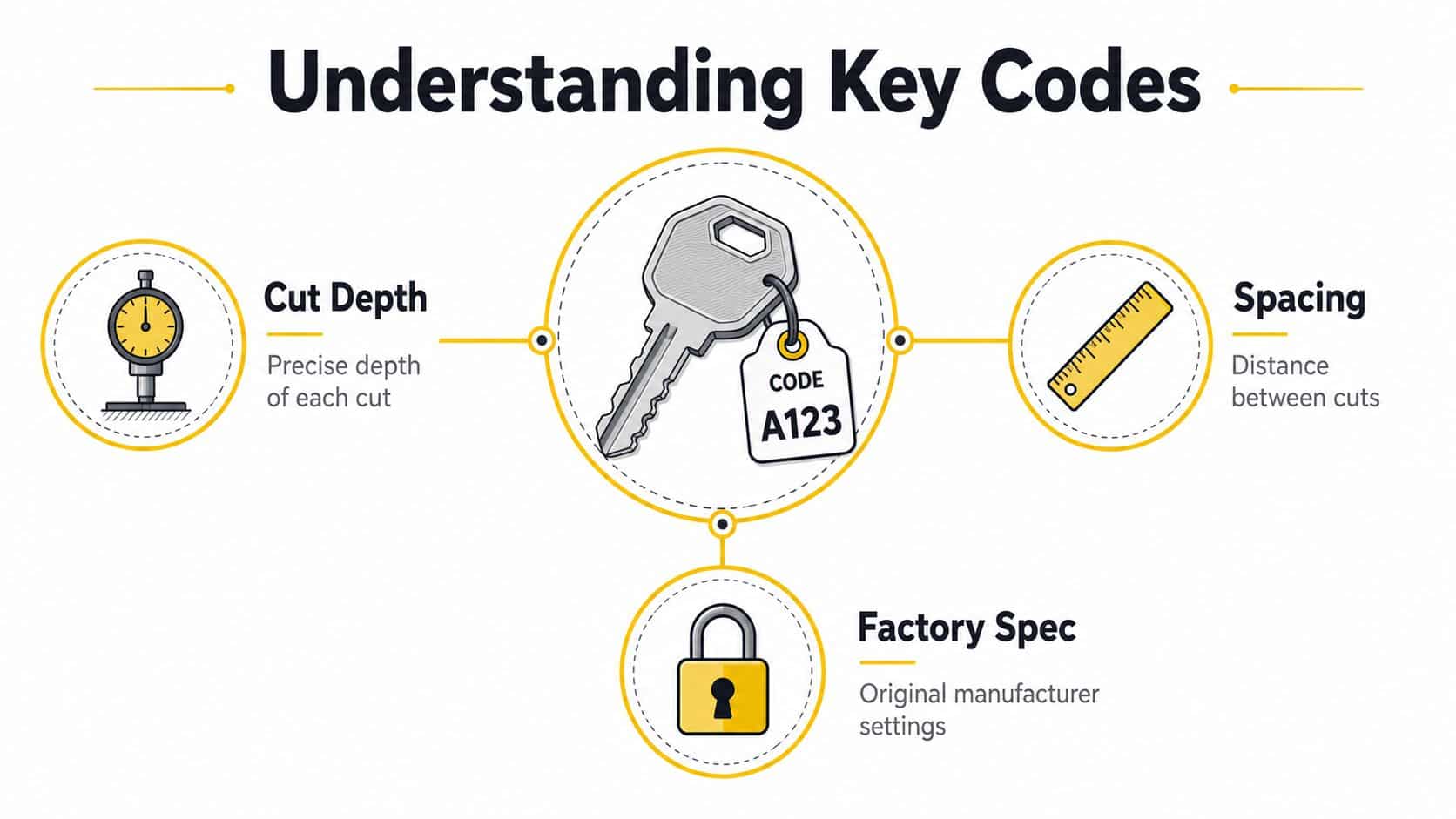
Depth numbers and spacing numbers do different jobs
Schlage-style code data uses depth progressions in .015 inch increments from 0 through 9, and the depth numbers run from the bow to the tip, with higher numbers meaning deeper cuts. That gives the locksmith a measurable pattern rather than a guess based on wear or shine on an old key. The cut depth tells the machine how far to descend at each position.
Spacing is the other half of the equation. The cuts have to land in the right places, not just at the right depths. A code card used with a code machine carries the individual markings for both the depth locations and the space locations for a specific blank or family of blanks, which is why the right card matters as much as the right blank.
Why the code is better than eyeing up a worn key
A worn key can look serviceable and still be misleading. Its valleys can be rounded, its shoulders can be battered, and its edges can be distorted from years in a pocket or handbag. A code, by contrast, starts from the manufacturer's own numbers, so the locksmith isn't rebuilding from damage.
Practical rule: if the key's shape looks tired, the code is usually the cleaner starting point.
That's also why code work is so useful when a family member brings in an old key that “sort of still works”. Sort of is not a good standard for a front door, a strata entry, or a garage lock. The code gives the locksmith a known baseline before the machine ever starts moving.
How the Locksmith Turns a Code Into a Working Key
A proper code cut is a workshop process, not a guess-and-check routine. The locksmith reads the code card, chooses the correct blank, fits the right jaw and cutter, then clamps the blank into the machine. After that, the machine follows the code positions with controlled motion instead of hand-filing each valley.
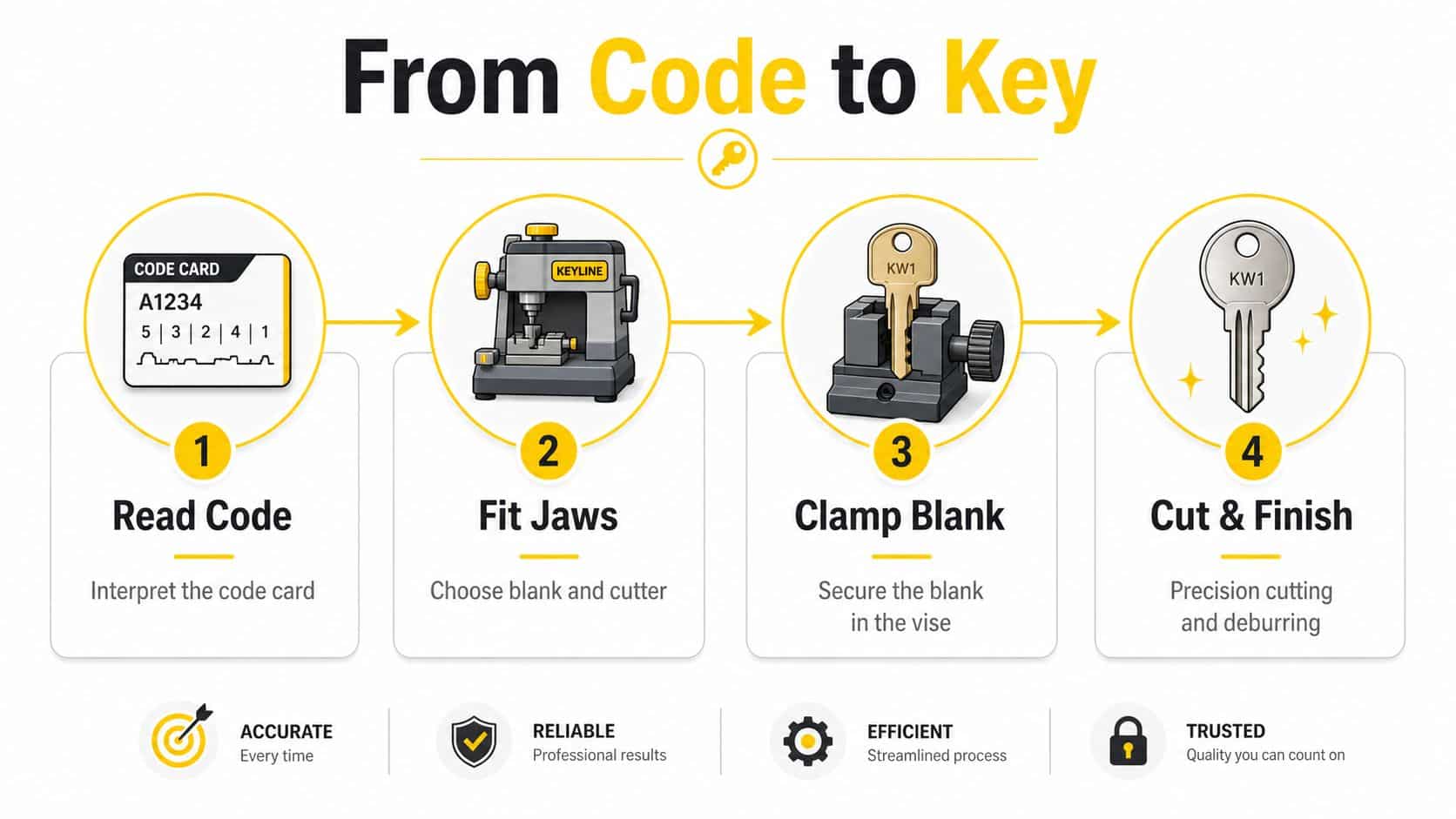
What the machine is really doing
Modern professional machines rely on controlled axis movement, and that's the main reason they're used for code work. ILCO's EZ-Code uses precision stepper-motor carriage movement with an X-Y tolerance of +/-0.002", while Silca's Unocode F100 uses 2-axis ball screws driven by step motors and a cutter speed of 1070 rpm. Keyline's machine line uses 2- or 3-axis stepper-driven systems with cutters up to 10,000 rpm. GM Global Tools
That technical setup matters because repeatability comes from the machine, not from the operator trying to mimic a worn key by eye. A code-cut key is usually more consistent than a duplicate made from a tired original, especially when the original has visible wear or slight deformation.
The small details that separate a good cut from a bad one
The cutter profile has to suit the key family. Blade angle matters. Shoulder-versus-tip gauging matters too. Locksmith guidance notes that wafer-lock spacing is typically factory-set around 0.083"–0.098", while pin-tumbler systems using 0.095" diameter pins are usually spaced about 0.109"–0.140". Wider 0.115" pin systems are typically 0.150"–0.160". Locksmith Ledger
Those spacing bands are small enough that the wrong cutter can create trouble fast. A machine can be accurate and still produce the wrong key if the cutter shape or gauging setup doesn't match the blank. That's why professional code work is about matching the whole system, not just punching in numbers.
Why Coded Cutting Usually Beats Copying a Worn Original
Older North Shore homes often still have locks that have seen decades of use. The key in the owner's hand may be the only one left, but it's often not a clean reference anymore. A duplicate copies the wear along with the shape, which means the new key can inherit the same rounding, the same deformation, and the same little errors.
What a duplicate copies that a code cut avoids
A copy machine reads the original as it exists today. If the original has worn peaks, flattened shoulders, or bent edges, those flaws can show up in the new key. A code cut starts from the lock maker's specification, so it isn't anchored to that damage.
That difference becomes important in closely spaced bittings. Locksmith guidance notes that pin-tumbler spacing under 0.100" may require a special or asymmetrical cutter, which is a good reminder that tiny errors can matter a lot on some key families. Locksmith Ledger
Why the fresh key often feels smoother
A fresh code-cut key often turns more cleanly because it's built to the intended geometry instead of to a worn sample. The lock's pins or wafers still need to line up properly, so the new key has to match the family and the blank exactly. But when that match is right, the difference is easy to feel in the hand.
For households that have lived with one tired key for years, that can be the most noticeable part of the job. The new key doesn't feel “fancier”. It just feels right because the starting point was correct.
A key that only works after a bit of jiggling is already telling the locksmith something's off.
When Code Cutting Needs Extra Work on the North Shore
Coded cutting isn't magic, and older hardware can still throw a curve ball. A code can be correct on paper and the key can still bind, skip, or fail if the lock cylinder is worn, the blank is non-standard, or the keyway isn't as straightforward as the code card suggests.
The usual trouble spots
The awkward jobs tend to share the same features.
- Worn cylinders: the lock itself may be tired, so even a correctly cut key feels inconsistent.
- Mixed keyways: the wrong blank family can make a technically accurate cut useless.
- Non-standard blanks: older residential hardware can need blanks that aren't sitting in every van.
- Closely spaced bittings: some keys need a special or asymmetrical cutter to avoid adjacent-cut interference.
A decent locksmith doesn't keep recutting blindly when that happens. The right move might be to verify the code against the actual lock, touch up the cut by hand, or recommend a rekey if the cylinder is past its useful life.
Why a real service call sometimes ends with a different answer
That honesty matters on the North Shore because a lot of local hardware is older, mixed, or serviced over many years by different trades. A code-cut key can be the right starting point and still not be the final fix if the lock body itself has moved on. In those cases, the goal is not to prove the machine was right. The goal is to get the door working properly.
There's a practical line between a key problem and a lock problem, and that line gets blurred when people keep trying to force one good cut to rescue a bad cylinder. A working locksmith spots that difference early.
Restricted, Master Keyed and High Security Systems
Restricted and master-keyed systems raise a different question. The code can tell the locksmith how to cut the key, but it doesn't automatically give anyone the right to have one. On a restricted system, the issuing locksmith controls duplication, and proof of authorisation matters more than the code itself.
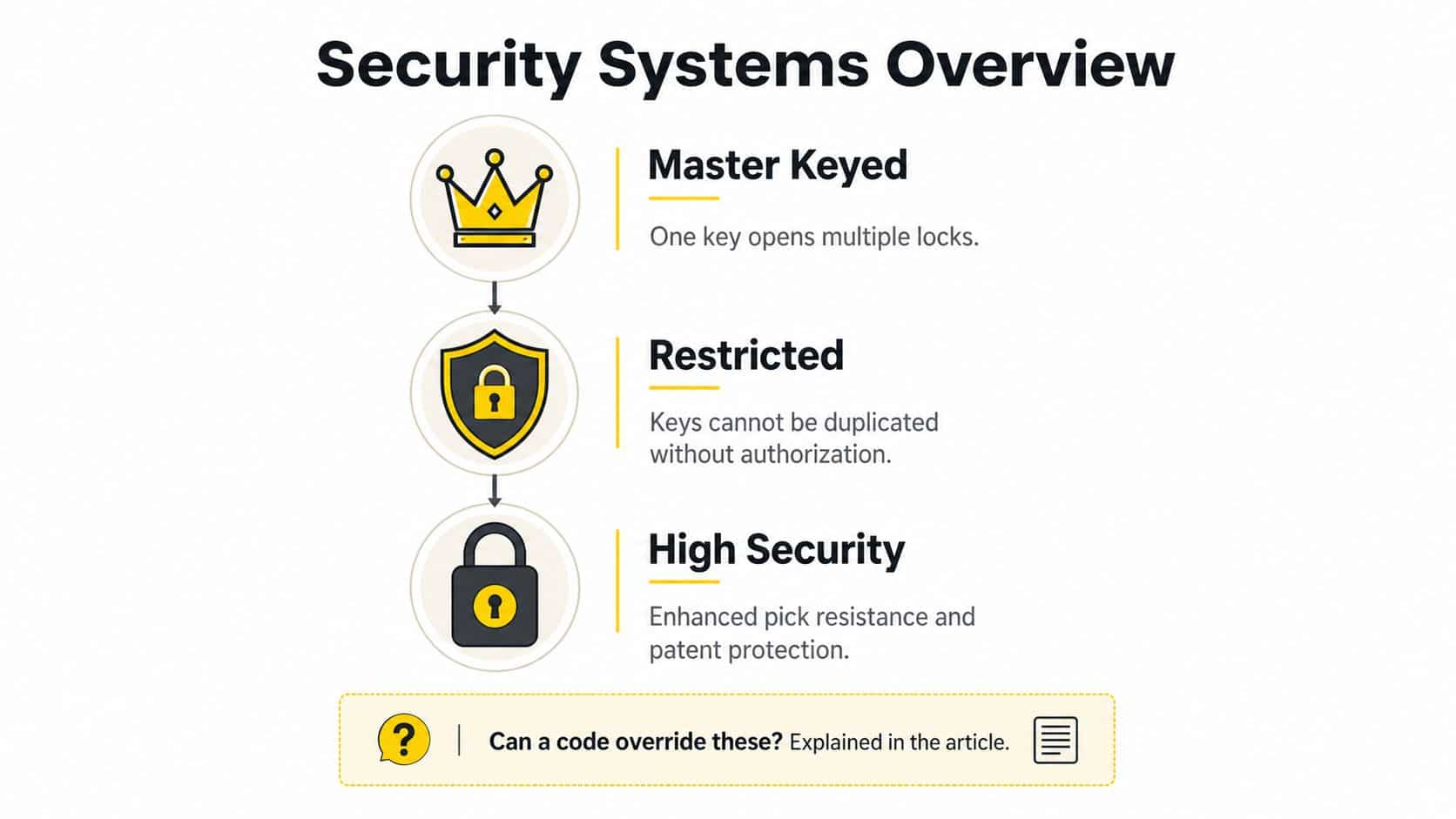
What the paperwork is doing
A security card is there to prove who can request a copy. It isn't just a formality. It's part of the control system, especially where the site owner wants to limit who can get extra keys. For a fuller explanation of those controls, see restricted key systems.
Master-keyed systems add another layer. One key may open multiple locks, while another key only opens one room or one tenancy. That hierarchy has to be respected, because the code describes the cut, not the access level. A locksmith still has to work within the site's key structure.
Why digital history helps
A modern key-cutting demonstration shows machines now include a history function that stores prior jobs and sorts them into categories such as automotive and duplicate key work. That shift matters because code cutting is no longer just a one-off mechanical task. It's part of a searchable workflow that helps with repeat jobs and key control over time. YouTube demonstration
For restricted or master-keyed sites, that record keeping helps reduce confusion when a replacement is needed later. The code still matters. The authorisation does too. Both have to line up.
What to Expect From a North Shore Coded Key Cutting Call
A sensible call usually starts with a few basic details. The locksmith will want to know what type of lock is on the door, whether the key is lost or worn, and whether the site uses a restricted system or a security card. That saves wasted trips and gives the locksmith a better read on whether code cutting, rekeying, or another fix is the cleanest route.
The usual sequence on site
- Check the lock and paperwork. The locksmith confirms the lock type, blank family, and any security card or authorisation that goes with it.
- Look up the code. If the code is available, it's matched to the right blank and cutter setup.
- Cut the key. The machine does the work, using the correct carriage movement and cutter profile for the key family.
- Test in the actual door. The new key should be tried in the lock before the job is finished, because the door and cylinder have the final say.
For a general guide to cost factors, the relevant overview is key cutting cost information. The final outcome still depends on the lock type, the blank, and whether the system is restricted or master keyed.
A North Shore homeowner doesn't need machine jargon at the kitchen table. What matters is whether the locksmith can make the key that works, explain any limits plainly, and tell the truth if the lock needs more than a fresh cut. Lock, Stock & Barrel Locksmiths handles key cutting, including keys cut to code and pattern, as part of its mobile locksmith work across the North Shore.
If a lost, worn, or unavailable key has turned into a door problem, Lock, Stock & Barrel Locksmiths can assess the lock, cut to code where that's the right fit, and talk through whether a rekey makes more sense. Visit Lock, Stock & Barrel Locksmiths to request a quote or call for coded key cutting on the North Shore.