- 24 Hour Emergency Services
- Servicing Sydney's North Shore
- View On Map

-
Mail Us On
info@lsblocksmiths.com.au
-
Make a Call
0411 700 072
- View On Map
- 24 Hour Emergency Services
- Servicing Sydney's North Shore
- View On Map
-
Mail Us On
info@lsblocksmiths.com.au
-
Make a Call
0411 700 072
- Contact Us
Commercial Door Lock Installation: Sydney Guide 2026

Lock, Stock & Barrel Locksmiths
On July 25, 2026
A front door that drags, a latch that misses the strike, or a compliance notice from the building manager is usually the moment a property owner realises the lock was never the whole job. On a commercial site, commercial door lock installation has to balance security, daily traffic, fire-door compliance, and the way the door set was built in the first place. If any one of those is ignored, the hardware might still fit, but it won't necessarily work, and it may not stay compliant.
That's the part many guides leave out. A lock can look solid on the bench and still fail on site because the door leaf, frame, strike, closer, and key system weren't treated as one assembly. On Sydney's North Shore, that matters in offices, retail units, strata entries, and common areas where one wrong hardware choice can create call-backs, access complaints, or a compliance problem that becomes expensive to unwind.
Why Commercial Door Lock Installation Demands More Than a Drill
A strata manager gets the call on a Monday morning. The office entry lock is sticking, the tenant wants it fixed fast, and the fire door beside it has a self-closer that's been “fine for years”. That's a familiar site visit, and it's exactly where shortcuts get expensive. A commercial lock job isn't just drilling holes and tightening screws, it's reading the door, the frame, the traffic load, and the compliance obligations around the opening.
For commercial premises in Australia, the lock choice sits inside a broader framework. AS 4145.2-2008 has long been a benchmark for door and window furniture, classifying hardware into Grade 1, Grade 2, and Grade 3 performance levels for durability and security, with Grade 1 intended for the heaviest-duty commercial use. That matters on busy doors because the installer isn't just fitting a key turn, they're matching hardware to the expected wear, insurer expectations, landlord requirements, and the realities of daily use.
What usually goes wrong on site
The failures aren't dramatic at first. A latch starts binding, a strike plate sits a little proud, or the handle height feels awkward for regular users. Over time, the door gets slammed harder, the closer works against a misaligned latch, and the lock body wears faster than it should.
Practical rule: if the door doesn't close cleanly before the hardware goes on, the new lock won't fix that on its own.
That's why proper commercial door lock installation begins before the first screw is driven. A good locksmith checks how the door sits in the frame, whether the closer is doing its job, and whether the opening is asking for a heavier-duty solution than the current hardware provides. On North Shore sites, that's the difference between a quick replace-and-revisit job and a proper long-term fit.
Choosing the Right Commercial Lock Type for Your Premises
The right lock depends on the door's job. A back office door, a retail entry, a suite door inside a strata building, and a fire-rated corridor door all behave differently, so the hardware has to suit the opening rather than the other way around. That's where a lot of budget mistakes happen, especially when a residential-style product gets pushed into a commercial setting.
Matching the lock to the door
Mortise locks suit main entrances and higher-demand openings because they sit deep in the door and can handle heavier use when they're paired with the right frame prep and strike support. Cylindrical lever sets are common where a cleaner lever operation is needed and the door prep already suits that style, but they still need accurate bore and backset geometry to avoid sloppy operation. Deadbolts are often chosen for secondary doors, especially where simple, sturdy security is the main goal and access control is otherwise handled another way. Electronic access-control locks fit sites that need key control, auditability, or after-hours management, but they also bring power, backup, and maintenance questions that mechanical locks don't.
The practical filter is traffic. A door with constant entry and exit needs hardware built for repeated cycles, not a lightweight product chosen because it was on the shelf. In the Australian context, that's where the AS 4145.2-2008 grading framework helps, because it gives owners and managers a way to think about commercial-duty hardware rather than treating every lock as interchangeable.
| Lock Type | Typical Use | Security Level | Traffic Suitability |
|---|---|---|---|
| Mortise lock | Main entrances, busy commercial doors | High | High |
| Cylindrical lever set | Offices, internal commercial doors | Medium to High | Medium |
| Deadbolt | Back doors, secondary access points | High when properly installed | Low to Medium |
| Electronic access-control lock | Strata entries, offices, managed access points | High with correct setup | Medium to High |
A useful rule of thumb is simple. If the door gets hard use, needs tighter control, or sits on a compliance-sensitive opening, the hardware choice has to be made with the whole assembly in mind, not just the lock cylinder. That's where a site survey saves money, because it stops the wrong lock from being bought twice.
The Commercial Lock Installation Workflow From Survey to Sign-Off
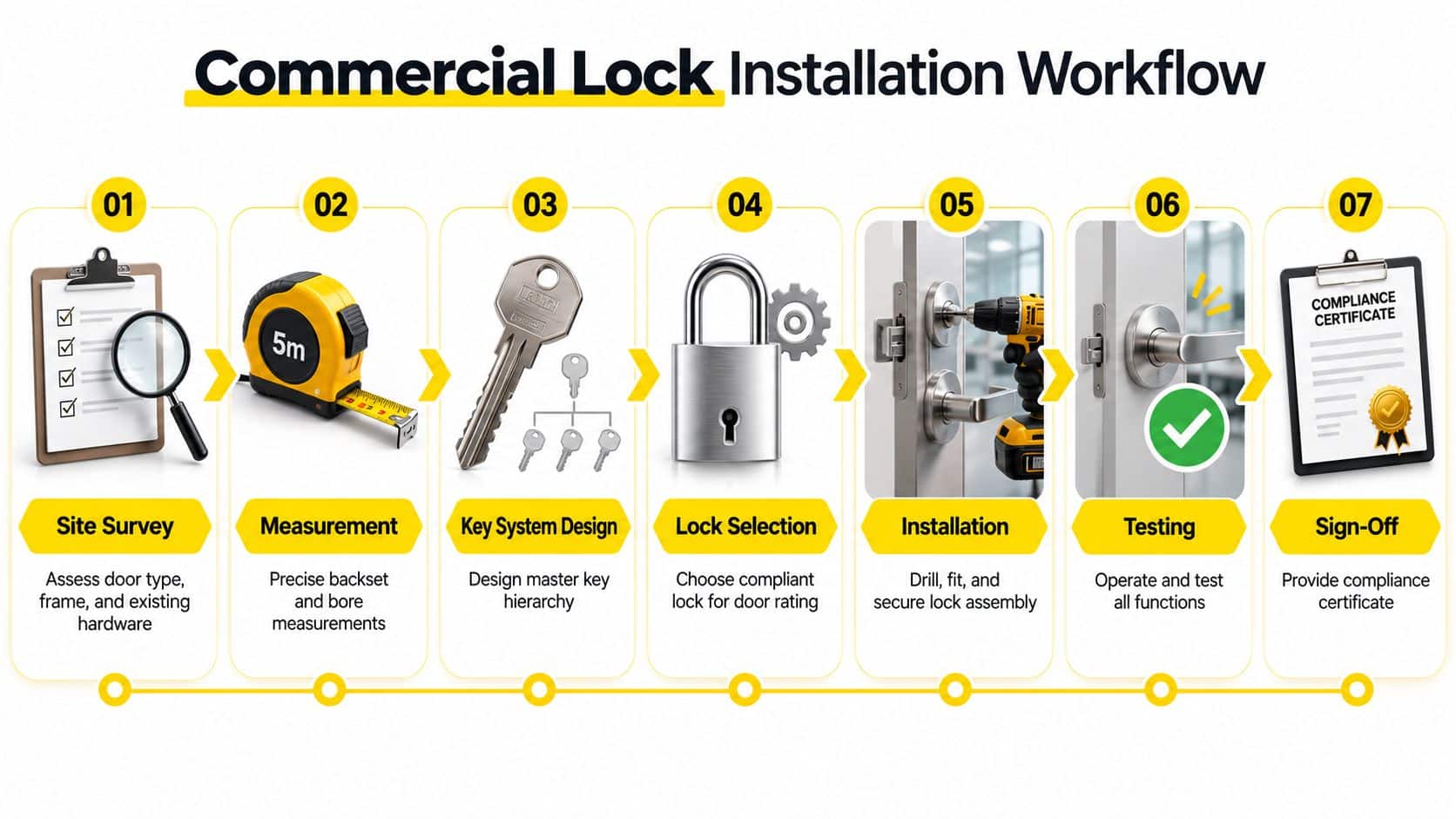
A proper installation has a rhythm to it. First comes the survey, then the measurements, then the hardware choice, and only after that does the actual fitting begin. Skipping any of those steps is how a neat-looking install becomes a binding latch, a loose strike, or a return visit when the key won't turn smoothly.
What gets checked before the drill comes out
A site survey starts with the door itself, the frame, the closer, and whatever hardware is already there. On commercial lever-set work, standard geometry matters. A common instruction set uses a 38 inch handle height, 2-3/8 inch or 2-3/4 inch backsets, a 2-1/8 inch face bore, and a 1 inch by 1/2 inch strike prep at the jamb intersection, because small deviations can cause latch misalignment and premature wear. Installers dry-fit the latch and strike before tightening screws so the retractor tail moves freely and the door closes cleanly.
The next job is the fit-up itself. The installer traces or marks the strike, prepares the recess so it sits flush, and checks that the latch enters cleanly without forcing the door. For mortise work, strike alignment and depth matter just as much as the lock body.
The last check is the one that saves the callback
After fitment, the door has to be tested in actual use, with the closer operating, the key turning, and the latch engaging repeatedly. If the hardware is new but the door still feels heavy, the issue may be in the frame or closer rather than the lock. That's why sign-off matters. It gives the owner or manager a chance to see the opening working as intended, not just looking finished.
For a straightforward installation and repair path, the service page at Lock Installations and Repairs is the relevant starting point, especially when the opening needs proper assessment before replacement.
Fire Door Compliance and Australian Building Code Obligations
A common mistake on commercial sites is assuming that a lock swap is a small maintenance job. On a fire-rated or smoke-rated door, it can be much bigger than that. The door set has been tested and approved as a complete assembly, so changing one part without checking the rest can affect the rating, the egress path, and the building's NCC obligations.
Why the door set matters more than the lock alone
In Australian building work, compliant commercial lock installation is often controlled by the door set, not the lock in isolation. If the opening is part of a fire or smoke compartment, the installer has to match the hardware prep to the door leaf, thickness, and frame geometry specified by the manufacturer and the relevant tested door set. That's especially important on steel or metal doors, where screw retention and trim alignment directly affect latch engagement and self-closing reliability.
Commercial lock compliance guidance also states that if the door is fire-rated, the lock needs a matching UL listing such as UL 10C, and the compliance has to be checked at the full door assembly level because a compliant lock on a non-compliant frame or door can void the assembly's rating. That's the trap. The hardware can be fine on paper and still be wrong for the opening.
A fire door is not a parts catalogue. It's a tested system, and the system has to stay intact after the work is done.
What should happen after replacement
A sensible post-installation check looks at closing action, latch engagement, and whether the door still behaves as the approved assembly expects it to. If a door is dragging, sticking, or failing to self-close after the lock change, the job isn't complete. The issue may be the hardware prep, the closer, or the fact that the selected lock wasn't suitable for that opening in the first place.
This is the point where a property manager should ask for clarity, not assumptions. If the door is fire-rated, the installer needs to know that before the job begins, and the paperwork or confirmation after the job should reflect what was fitted.
Mechanical Locks Versus Electronic Access Control for Australian Businesses
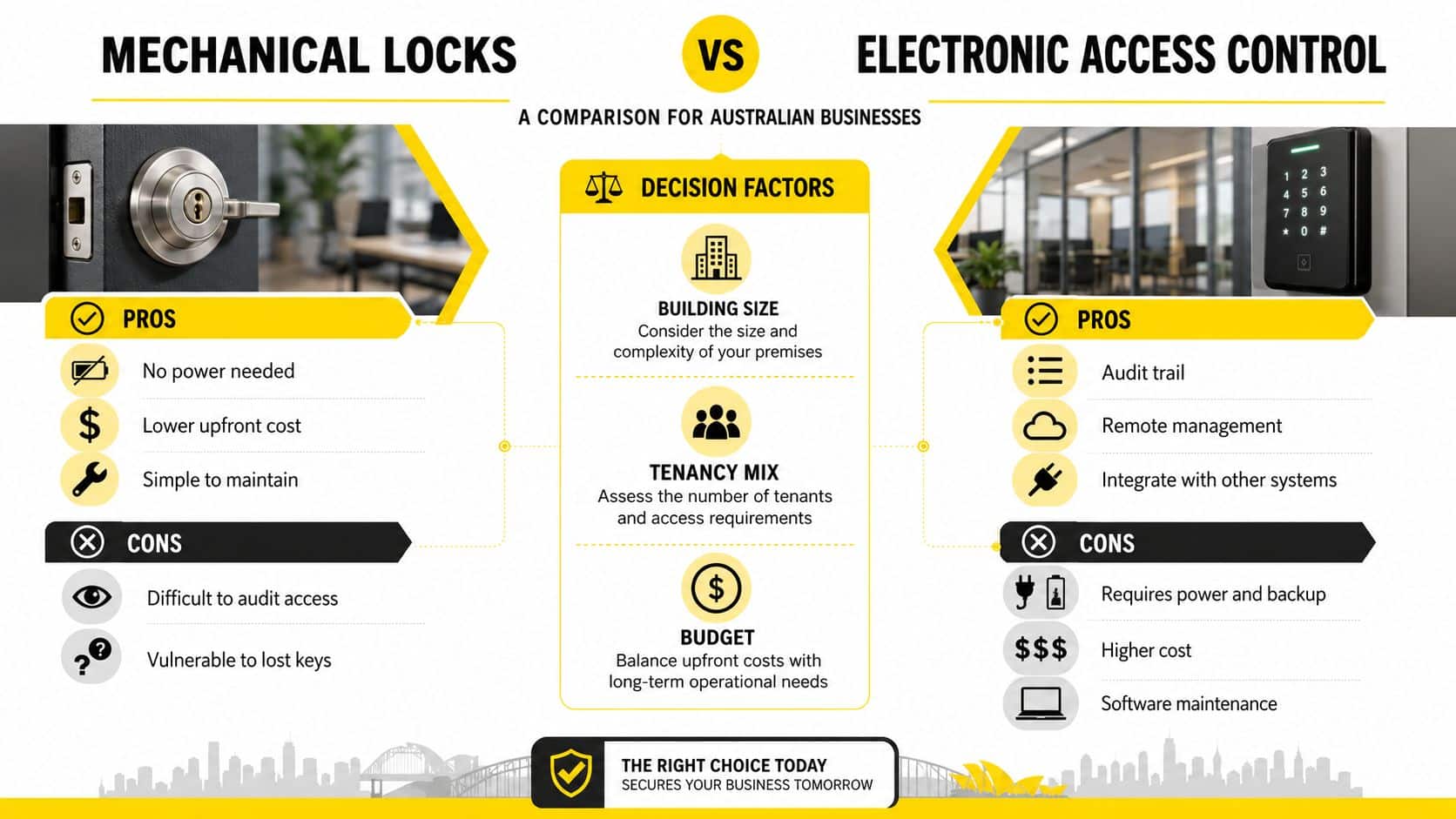
Mechanical hardware still wins on simplicity. It doesn't need power, it's easy to explain to staff, and it usually has fewer things that can fail on a normal weekday. Electronic access control brings a different set of advantages, but it only works well when the door, frame, cabling, backup power, and exit requirements are all handled properly.
The real trade-off
Mechanical locks are the conservative option. They suit sites that want low complexity, straightforward maintenance, and limited exposure to software or battery issues. They can be a good fit for back-of-house doors, lower-traffic entries, and buildings where access doesn't need to be logged in detail.
Electronic systems suit managed sites better, especially where access needs to be changed often or tracked centrally. The trade-off is maintenance. Battery-backed systems need checking, fail-secure and fail-safe behaviour has to be matched to the door's role, and retrofit hardware has to work with closers, alarms, and any existing master key arrangement without creating compliance issues.
For Australian buyers, the question is often not “mechanical or electronic”, but “what does this opening need to do during normal use, a power outage, and an emergency?” That question matters on strata entries, offices, and retail sites where poor fitment can create access complaints or egress problems.
Retrofit choices need more than a product brochure
The useful test is whether the hardware can be installed without weakening the door set or creating a maintenance burden the site won't manage. A connected lock that no one services properly is a liability, not an upgrade. That's why a site assessment before selection is the safe move, especially on North Shore buildings with mixed-use tenancy patterns and older door hardware.
For sites planning an upgrade, the access-control service page at Access Control System Installation is the logical reference point when electronic entry is on the table.
Designing a Master Key System That Actually Controls Access
A master key system only works when the hierarchy is planned with discipline. Without that, every tenant, manager, cleaner, and contractor ends up carrying the wrong keys, or too many of them, and the building loses control over who can get where. On multi-user commercial sites, the point is not to hand out fewer keys for the sake of it. The point is to define access clearly.
Access should follow the building, not the other way around
A good commercial hierarchy usually starts with the individual user level, then moves up to area-level access, and finishes with a master key that covers the permitted group of locks. That structure helps offices, retail complexes, and strata buildings keep day-to-day access manageable without turning the whole site into a universal key environment. Restricted key systems add another layer because keys can only be duplicated by authorised personnel, which reduces unauthorised copying and keeps the record trail cleaner.
For managers, the value is visibility. A structured system tells them which key opens which door, who should hold it, and where access must stay locked down. That matters when staff leave, tenancies change, or maintenance contractors need temporary access.
Where master key planning goes wrong
The usual failure is inconsistency. One door gets rekeyed without updating the hierarchy, or a contractor key is treated like a permanent key, and the whole system drifts. Good record-keeping prevents that drift. It also makes future changes less painful, because the hardware and the key schedule still match what's on the site.
For a practical overview of how the hierarchy is built, the page on How Master Key Systems Work is the right reference. On the ground, the same principle applies whether the site is a small office suite or a larger strata property. Access control only stays controlled when the key plan, the lock prep, and the naming of each door all line up.
Maintenance, Warranty, and When to Call a Master Locksmith
A commercial lock should be treated like working hardware, not a fit-and-forget fitting. Latch engagement changes over time, screws loosen, strikes wear, and doors settle. Regular checks catch those issues before staff start forcing the handle or propping the door open because it “sticks sometimes”.
The maintenance jobs that actually matter
The basics are plain enough. The latch should engage cleanly, the strike plate should stay flush, and the moving parts should be kept free of obvious wear or contamination. If a lock starts dragging or the key feels rough, the problem should be looked at before the mechanism chews itself up.
Replacement becomes the smarter option when the hardware is no longer doing its job reliably, or when the door set no longer supports the lock properly. On fire-rated openings, that decision has to be made carefully, because the compliance issue can be more serious than the mechanical fault.
Why a dedicated locksmith record helps
A licensed Master Locksmith keeps track of what's on the building, what was changed, and how the key system is structured. That record matters when a tenant changes, a key goes missing, or the site needs an after-hours response. For North Shore businesses and strata sites, one organised service history is often the difference between a quick fix and a long audit of old hardware.
Lock, Stock & Barrel Locksmiths fits into that picture as a mobile North Shore option for installation, rekeying, and commercial lock work when a site needs a proper assessment rather than a guess.
If a commercial door is sticking, a fire door has had hardware changed, or a key system no longer makes sense, book a site assessment with Lock, Stock & Barrel Locksmiths and get the opening checked properly before the next problem becomes a compliance issue.