- 24 Hour Emergency Services
- Servicing Sydney's North Shore
- View On Map

-
Mail Us On
info@lsblocksmiths.com.au
-
Make a Call
0411 700 072
- View On Map
- 24 Hour Emergency Services
- Servicing Sydney's North Shore
- View On Map
-
Mail Us On
info@lsblocksmiths.com.au
-
Make a Call
0411 700 072
- Contact Us
Door Lock Repair Cost on Sydney’s North Shore

Lock, Stock & Barrel Locksmiths
On August 14, 2026
A front door that sticks on a wet morning in Turramurra, a deadbolt that suddenly won't turn in Wahroonga, a keypad that flashes but won't release the latch in Gordon. Those are the jobs that send people searching for door lock repair cost, and the trouble starts because most online price guides try to turn a mixed trade job into one neat number. In practice, the bill usually depends on the fault, the hardware, the timing, and how far the locksmith has to travel across the North Shore.
For basic repair work in Australia, public pricing data puts small on-site jobs in a broad band, often around A$50–A$250 for repair-type work, with lock repair or key extraction commonly quoted at $50–$200 per lock in general locksmith guides, which is a useful floor for a simple fault rather than a full changeover. Full replacement is a different bill altogether, with standard replacement often sitting around A$80–A$225 per door and more involved removal-plus-replacement work reaching $150–$500+ depending on the hardware. That gap is why the cheapest-looking quote isn't always the cheapest fix. Locksmith cost guide and door lock replacement pricing
A good locksmith doesn't price the metal alone. The cost comes from diagnosis, labour, parts, access, and whether the existing lock can be made reliable again without swapping the whole thing.
What a Door Lock Repair Actually Involves
A client calls because the key goes in, but the deadlock feels gritty and needs a shove. On the day, the job rarely starts with a screwdriver. It starts with a proper look at the door, the frame, the latch movement, the key, and the strike alignment, because the symptom isn't always the cause.
The visit usually runs in a sequence
A technician first checks whether the fault is mechanical, worn, or just out of line. That matters because a key that binds can point to a tired cylinder, while a latch that misses the keeper often means the door or strike has shifted. A quick adjustment can solve one job, while another needs the lock pulled apart and parts inspected on the bench.
Practical rule: the call-out fee is usually paying for diagnosis as much as repair. A careful locksmith spends time ruling out the wrong fix before replacing good hardware.
When the fault is clear, the next step is the repair or replacement of the small part that's failing. Sometimes that's a cylinder service, sometimes it's a latch, sometimes it's a strike plate reset, and sometimes the lock body itself is too worn to save. The final step is testing, not just once, but several times with the door open and closed so the client doesn't discover the same problem that night.
A two-minute adjustment and a two-hour parts job can look like the same “repair” from the outside. That's why one front door can be fixed quickly and another takes time, even though both are billed as on-site locksmith work.
A simple visual helps.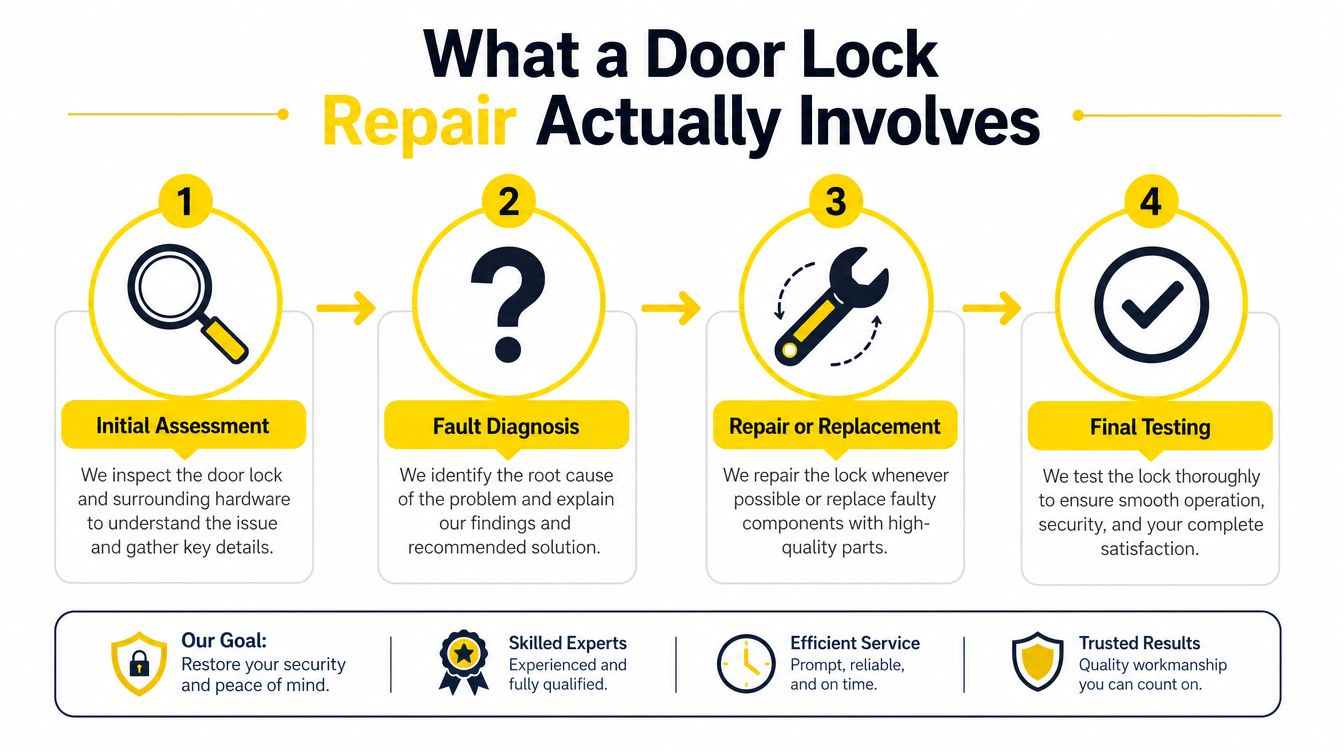
The Four Biggest Cost Drivers Behind Any Repair Quote
The quote usually moves for four reasons, and the bill often makes sense once each one is isolated. Labour time sits first, because the locksmith is paid for attendance, diagnosis, disassembly, refitting, and testing, not just for the part in the hand. The same fault can be cheap if the fix is obvious, and expensive if the door has to be taken apart carefully.
Labour time and access
If the door is easy to work on, the job stays cleaner and faster. If the lock is buried in a tight frame, set into older hardware, or tied to a misaligned door leaf, the locksmith spends longer tracing the problem. That labour is usually the biggest difference between a tidy repair and a bill that climbs.
Parts and lock grade
Some jobs need nothing more than adjustment and cleaning. Others need a cylinder, latch, strike plate, or internal module. A higher-grade lock also tends to cost more to service because the parts are heavier, the mechanism is more exacting, and the repair usually takes more care.
Urgency and attendance timing
Daytime booked work is easier to batch across nearby suburbs. After-hours work is harder to organise, so the travel and staffing model changes. Emergency attendance also leaves less room to diagnose slowly, which is one reason urgent jobs cost more than routine ones.
Lock type and repair complexity
A straightforward mechanical lock is one thing. A mortise lock, a commercial-grade set, or a keypad unit is another. The more the repair depends on fault isolation, the more the bill starts reflecting technician skill and time rather than the face value of the lock itself.
A quote that looks high isn't always padded. Often it's just carrying the cost of a lock that's harder to open, harder to source parts for, or harder to make compliant once it's fixed.
A useful way to read any estimate is to ask which of those four levers is doing the work. Once that's clear, the number usually stops looking mysterious.
A simple hierarchy graphic helps show the pattern.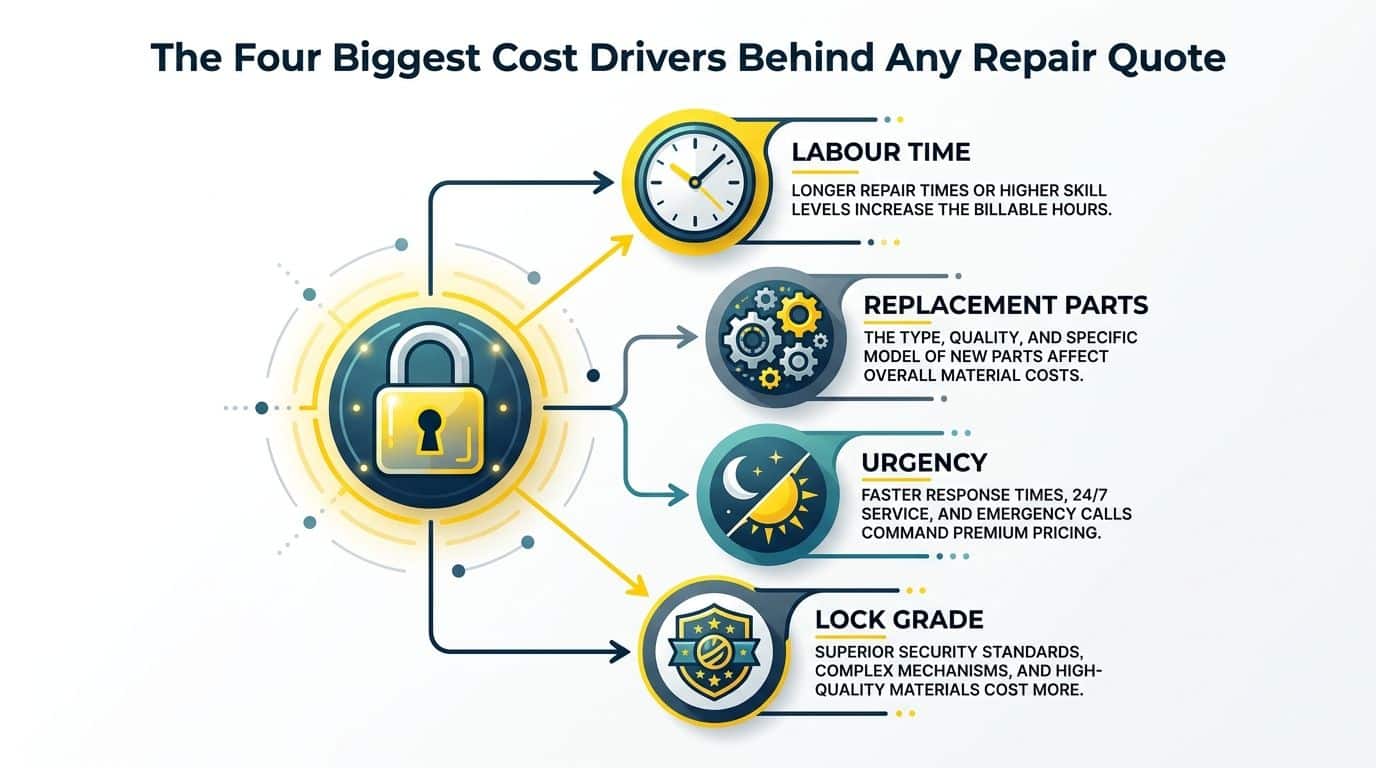
Repair, Rekey, or Full Replacement
The cheapest answer isn't always the smartest one, but the most expensive one usually isn't needed either. A sticky key, a worn cylinder, and a broken lock body all look like “the lock is bad” to a homeowner, yet they call for different work and different price bands. The practical decision is to match the fix to the fault.
| Option | Best for | Typical AU price band | Key trade-off |
|---|---|---|---|
| Repair | Hardware that's sticking, loose, or out of line but still sound | Often sits within the basic repair band around A$50–A$250 for repair-type jobs | Keeps the existing lock, but only works if the mechanism is still serviceable |
| Rekey | Old keys, key control changes, tenancy turnovers, or cylinders that still work well | Usually cheaper than full replacement when the cylinder is reusable | Old keys stop working, but the lock body stays in place |
| Full replacement | Broken cases, failed mechanisms, damaged cylinders, or hardware that's worn past sensible repair | Commonly around A$80–A$225 per door for standard replacement, with more involved jobs higher | Costs more upfront, but can be the right move when parts are failing |
A repair makes sense when the lock still has a sound body and the issue is adjustment, wear, or a part that can be serviced. Rekeying makes sense when the hardware works but the key situation has changed, especially in rentals or after a turnover. Full replacement makes sense when the case is cracked, the mechanism is stripped, or the hardware has reached the point where patching it would be false economy.
The mistake people make is assuming “new” always means safer. Often it just means more labour and more parts. A worn but repairable lock can still give solid service once the fault is isolated properly, and that's why a clear assessment matters before anyone reaches for a replacement.
For homeowners weighing those choices, this rekeying versus replacing guide is a useful companion read before the work is booked.
Common North Shore Lock Types and What Repairs Cost
North Shore homes don't all wear the same hardware. A post-war deadlock in Wahroonga behaves differently from a mortise lock in a Lindfield apartment, and a patio door lock in a modern build can fail for reasons that have more to do with alignment than the lock face itself. The type of hardware usually tells the locksmith where the time will go.
Deadbolts and simple key-in-knob sets
These are usually the most straightforward to service when the fault is mechanical. If the bolt is sticking, the strike is off, or the key is dragging, the repair is often about alignment, cleaning, or a worn internal part. These jobs tend to sit closer to the lower end of repair pricing because the mechanism is simpler and easier to access.
Mortise locks and older entry hardware
Mortise locks are a different animal. They often involve more disassembly, more care on refit, and more time spent making sure the case and faceplate sit correctly in the door. That extra labour is why mortise work often feels dearer, even when the visible fault looks small.
Patio, sliding, and auxiliary locks
A patio lock that won't catch properly may be the lock, the keeper, the roller setup, or the door position. That means the locksmith often has to look at the whole opening, not just the latch. Repairs can be economical when the hardware is still healthy, but they become more involved when the door itself has shifted.
Basic electronic and keypad locks
These are usually priced by complexity, not by glamour. A dead keypad, wiring issue, or internal failure can turn a simple repair into a diagnostic job, and the technician needs to isolate whether the problem is mechanical, electrical, or both. For that reason, these jobs often take longer than plain mechanical repair.
Lock, Stock & Barrel Locksmiths lists lock installation and repair among its services, including work on deadlocks, security locks, and digital locks. That matters here because the repair approach changes with the hardware, and the right technician needs the right stock on the truck.
| Lock type | Typical repair challenge | Cost tendency |
|---|---|---|
| Deadlock | Strike alignment, wear, key drag | Usually simpler |
| Mortise lock | Disassembly, refit, internal wear | Usually higher labour |
| Patio lock | Door movement, keeper alignment | Can vary widely |
| Electronic lock | Fault isolation, power or keypad issues | Usually more complex |
For cylinder-specific faults and rekey-style work, this cylinder lock replacement page is relevant when the problem has moved beyond a small adjustment.
When NSW Compliance Changes the Repair Bill
A lock job can start as a simple fix and end as a compliance decision. That happens most often in strata buildings, rentals, and shared properties, where the hardware has to suit more than one person's preference. Once approved hardware, tenancy expectations, or safety obligations come into the picture, the cheapest repair isn't always the one that stays acceptable.
Strata and rental settings change the brief
In strata, the lock may have to match building rules or approved hardware standards. In rentals, landlords often care less about saving the old mechanism and more about restoring secure, reliable access with no dispute about key control. That can push a repair toward rekeying or replacement if the existing lock can't meet the requirement neatly.
A compliant fix is often less about the lock face and more about who has to live with it after the technician leaves.
Child-safety and window safety obligations can also affect the job on apartments and shared buildings, especially where access hardware sits close to other compliance issues. The point is simple, a lock can be mechanically repairable and still not be the right answer for the property class. Once compliance is part of the brief, labour and materials often rise together.
A summary graphic makes the pattern easier to read.
Why After-Hours and Emergency Repairs Cost More
A 9 am booking and a 10 pm lock failure are not the same job, even if the fault is identical. Daytime work can be grouped with nearby calls, while after-hours work needs staff, travel, and dispatch on a tighter schedule. That difference is built into locksmith pricing across the market, and it shows up fast on the North Shore when a client needs immediate access.
Daytime versus evening and weekend work
Booked daytime jobs are usually the cleanest option when the lock still works enough to wait. Evening and weekend attendance carries more friction because the locksmith is attending outside the normal work pattern, and that usually means a higher service cost. The call-out model also changes because urgent jobs can't be slotted around other nearby repairs as easily.
When the emergency premium is worth it
If a front door won't secure, a tenant is locked out, or a broken lock leaves the property exposed, waiting until morning is often a bad trade. If the lock is merely sticky and still closes properly, a daylight booking usually makes more sense. The right call is the one that balances security, access, and the actual condition of the hardware.
If the door can be secured safely overnight, a routine booking is usually the smarter spend. If it can't, the emergency fee is buying peace of mind and immediate access.
For a closer look at urgent attendance pricing and why timing matters, this emergency locksmith cost guide is the clearest place to start.
Practical Ways to Bring the Bill Down
The fastest way to waste money is to choose the wrong fix for the fault. The next fastest is to call blind, without photos or any idea of the lock type. A few sensible steps can keep the bill honest without cutting corners on security.
- Send a clear photo first. A picture of the lock, the edge of the door, and the keyway helps the locksmith identify the hardware before arrival.
- Book routine work during business hours. Non-urgent jobs are easier to schedule and usually cost less than urgent attendance.
- Ask whether repair will hold. If the case and body are sound, repair is often more sensible than replacement.
- Discuss hardware grade before approving a swap. Good hardware is worth paying for, but not every door needs the heaviest option.
- Avoid cheap second-hand cylinders. Worn parts often create repeat visits and a bigger final bill.
Middlemen can also add cost without adding value. Direct booking with the technician is usually cleaner than going through a referral layer that marks up the job before anyone touches the door.
A graphic version of those basics sits well here.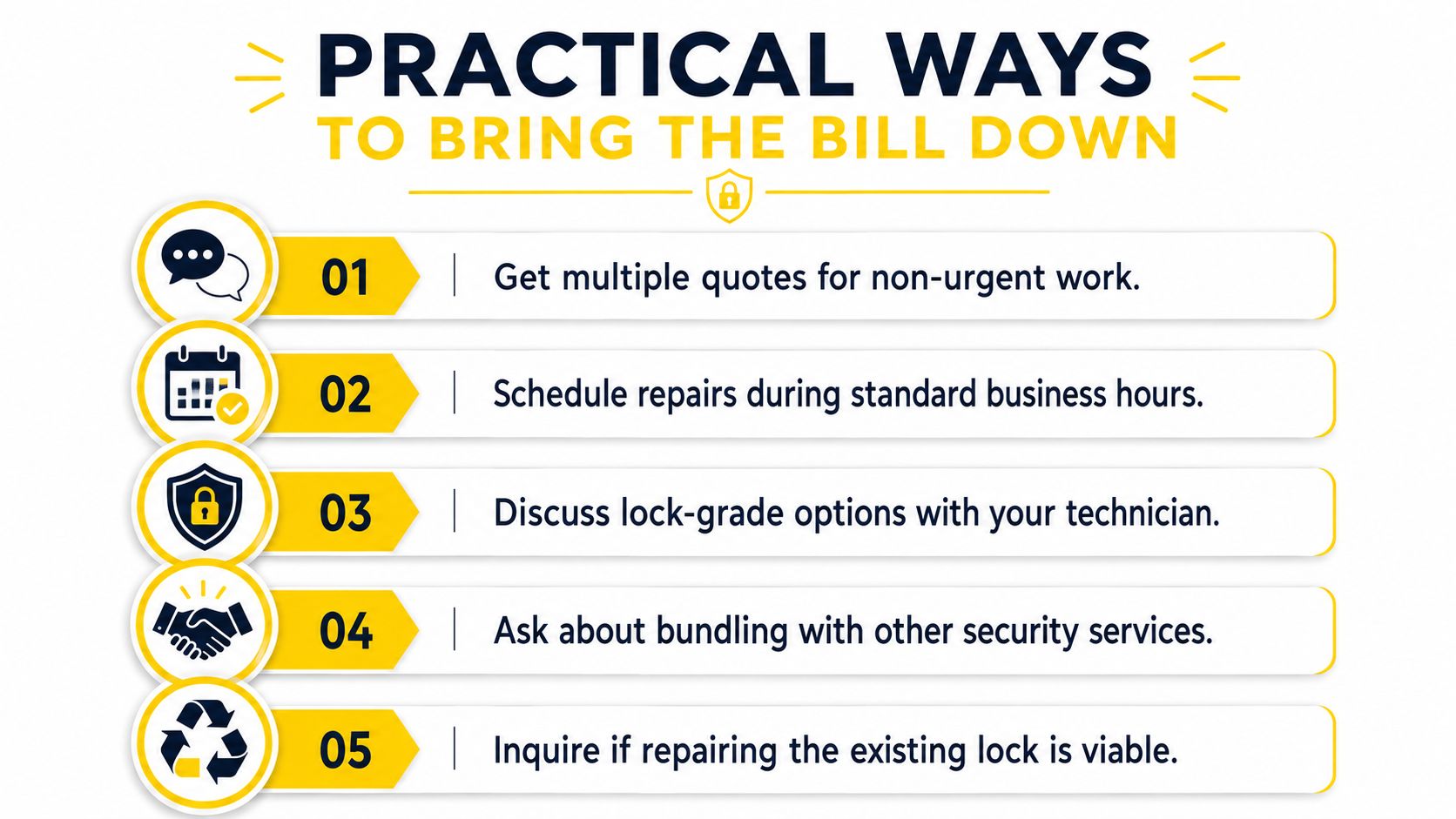
Putting It All Together and What to Do Next
Door lock repair cost isn't a single number. It's the sum of the fault, the hardware, the urgency, and whether the job is a straight repair, a rekey, or a full replacement. A photo of the lock, the suburb, and a clear note on whether the door still secures properly will usually get a far better quote than a guess over the phone.
For North Shore homes, the sensible next step is to get the hardware looked at before the problem gets worse. That way, the bill is based on the actual fault, not on panic.
Lock, Stock & Barrel Locksmiths handles door lock repairs, rekeying, and replacement work across Sydney's North Shore, with on-site service for homes, strata, and commercial properties. If the lock is sticking, damaged, or no longer secure, visit Lock, Stock & Barrel Locksmiths and send through a photo for a proper quote, or call to book a locksmith who can assess the fault on site.