- 24 Hour Emergency Services
- Servicing Sydney's North Shore
- View On Map

-
Mail Us On
info@lsblocksmiths.com.au
-
Make a Call
0411 700 072
- View On Map
- 24 Hour Emergency Services
- Servicing Sydney's North Shore
- View On Map
-
Mail Us On
info@lsblocksmiths.com.au
-
Make a Call
0411 700 072
- Contact Us
High Security Locksmith: North Shore Protection

Lock, Stock & Barrel Locksmiths
On August 2, 2026
A North Shore homeowner usually doesn't think about locksmithing until something feels off. A key goes missing after a school run, a side gate won't settle properly, or a tenant hands back a key set that's been copied too many times to count. At that point, the question isn't whether the lock still turns, it's whether the whole opening still deserves trust.
That's where a high security locksmith earns their keep. The trade isn't just about swapping cylinders. It covers key control, door hardware, entry-point assessment, safes, master key systems, and the kind of compliance work that matters in Sydney's North Shore building stock, from older houses to strata units and small commercial sites. Australia's locksmith market was valued at A$380 million in 2023, which shows there's already a substantial base for this kind of work, and the broader locksmith market is projected to grow from US$12.1 billion in 2022 to US$15.3 billion by 2026 at a 5.8% CAGR (world market figures).
Why North Shore Properties Need More Than a Standard Lock
A Turramurra homeowner might think a new deadbolt solves the problem after a key goes missing. Then the back door drags on the frame, the strike is loose, and the side access to the garden has a weak latch that never quite sat right from day one. A stronger cylinder helps, but it does not fix a weak opening.
What changes after a scare
A high security locksmith looks at the property the way an intruder would. The cylinder matters, but so do the hinges, the frame, the strike, the door material, and any other way into the building. Locksmith industry guidance is blunt about this, a stronger lock on a vulnerable door assembly does not carry the whole load, and selling high security should start with the entire opening (whole-opening guidance).
Practical rule: If the frame flexes, the strike is poor, or the door has other weak spots, the lock upgrade alone will not deliver real protection.
That is why this work often feels less like a product sale and more like a field assessment. The job can involve restricted keyways, compliant hardware, master key planning, safe installation, and advice on access points that do not even look like doors at first glance. High-security locks are meant to resist the main attack methods used by criminals and insiders with access already in hand, which makes the trade about control, not just resistance (high-security definition).
The North Shore setting makes that especially relevant. Properties change hands, strata committees change policies, and small businesses need a cleaner way to manage who can open what, and when. A standard locksmith can get a door working again. A high-security specialist helps decide whether the property is secure.
After a break-in, the opening itself often needs more than a quick fix. A Thornleigh homeowner dealing with the aftermath of a forced entry knows how much damage a weak frame, a bent strike, or a poor latch can leave behind, as outlined in this Thornleigh burglary recovery example. The lock may still turn, but the door set may no longer hold its line or resist pressure the way it should.
Why moving into a place changes the equation
A new owner or tenant often inherits unknown key copies, old hardware, and a lock set that has been patched together over time. That is the moment where rekeying might be enough, or it might just be the first step. If the opening itself is weak, a proper upgrade needs to account for the full door set and the way the property is used day to day.
Property turnover also raises key control issues. Keys may have been lent out, copied for cleaners, trades, neighbours, or previous occupants, and the paper trail is often thin or missing. In those cases, the problem is not just who holds a key today, but who may still have access from months or years ago.
The practical takeaway is simple. If the concern is only a jammed key or a single worn lock, routine service may be enough. If the concern is broader, like lost key control, repeated access by different people, or a door that clearly has not been assessed as a system, the job belongs with a high security locksmith who thinks in terms of the whole property.
Core Technologies Behind High Security Locksmithing
A high security lock is more than a label on a box. In the field, we look for restricted keyways, patented key profiles, anti-manipulation design, and tighter control over who can get copies made. Industry references note that high-security locks commonly use restricted keyways, patented key profiles, and secondary locking systems, with some platforms offering over 9 million to 380 million key combinations depending on the system (key-control overview).
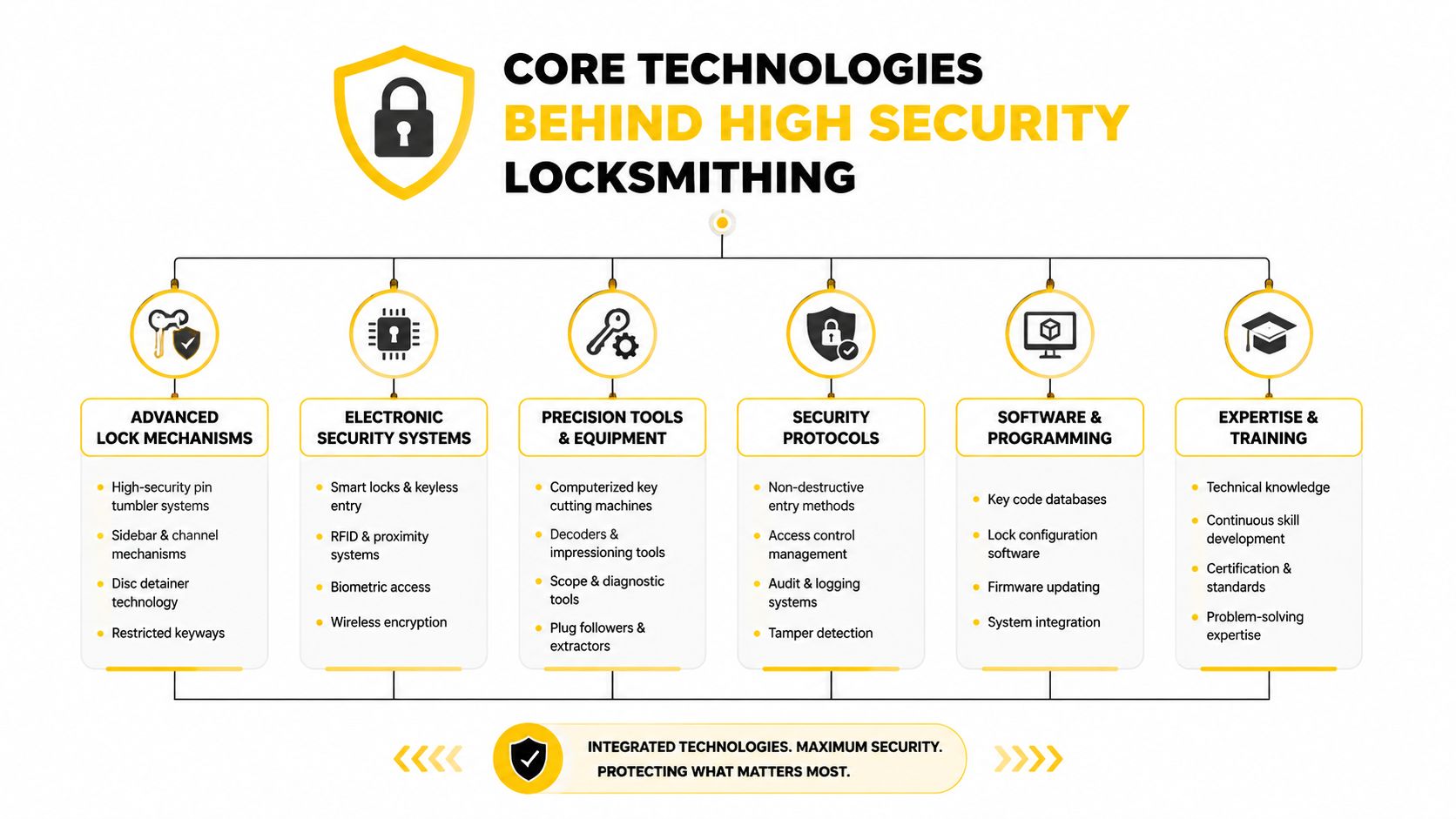
Restricted keys and patented profiles
A restricted keyway limits where a blank can be obtained and where a copy can be cut. That matters on the ground. If a key can be duplicated at any kiosk or counter, key control becomes weak fast. A restricted system puts a real barrier in the way, which is the point.
Patented key profiles add another layer. They restrict who can legally cut copies and keep the duplication process tied to authorised holders. For a homeowner, strata committee, or business manager, that control matters as much as the lock body. If copies are easy to make, the rest of the security work starts to unravel.
Restricted key systems also connect neatly with access planning. In larger homes, offices, and shared properties, that usually means pairing the lock hardware with access control system installation so key issuance, entry rights, and user changes stay under control. The hardware and the permissions need to match the way the property is used.
Anti-manipulation design and mechanical strength
Good high-security hardware also resists picking, impressioning, drilling, and brute force. The mechanical benchmark matters here. VdS security-lock testing requires an extended bolt to resist at least 1 kN applied laterally at a 4 mm offset and 1 kN in the locking direction, with backset pressure limited so the bolt can't be pressed back more than 2 mm, and the bolt throw must be at least 8 mm (VdS technical benchmark).
That sounds technical because it is. In plain terms, the lock has to hold under stress, not just look solid. If the cylinder can be picked but the rest of the system is soft, or the bolt can be shoved back too easily, the hardware is not doing its job.
Workshop note: Mechanical strength, key control, and attack resistance have to work together. If one part is weak, the system does not hold up.
A useful way to judge a product
A proper high-security platform usually gives the owner things standard hardware does not, controlled duplication, better resistance to manipulation, and a clearer access structure. It also helps when the same system can support the wider opening, not just the cylinder in the middle. If the door, frame, strike, or access rules are out of step, the product is only part of the answer.
A real high security locksmith will talk about what the hardware blocks, who can duplicate keys, and how the lock fits into the rest of the opening. That is the practical test. If the conversation stops at the cylinder, the assessment is incomplete.
The Whole Opening Matters Not Just the Cylinder
A client can fit an excellent cylinder to a poor door and still end up with a weak result. That is the part many consumer guides miss. The lock gets all the attention, while the frame, hinges, strike, and other access points stay exposed.
Why the frame and strike deserve attention
A secure cylinder will not make up for a loose strike plate or a frame that gives way under load. The opening has to be treated as one system. If the lock engages properly but the door can still be forced, lifted, or spread at the edges, the upgrade is only partly useful.
The same logic applies to bolt geometry. Bolt throw, how the bolt seats, and how the door meets the frame all matter. The VdS technical benchmark is useful here because it shows that security is about how the parts behave under force, not just the strength of the metal.
A high-security cylinder cannot save a weak door assembly. The weakest component sets the standard.
Non-traditional openings that get missed
Mainstream security advice usually stops at the front door. That leaves a lot out. SDM Magazine has highlighted glass doors, roof hatches, trash chutes, refrigeration units, machine cabinets, server rooms, and other atypical openings as security points that often get overlooked in access planning (atypical openings).
That matters on the North Shore because mixed-use buildings and older homes often have side entries, utility access, and service points that were never built for modern security expectations. A garage side door, a pool gate, a storage room, or a cabinet on the business side can become the easiest point of entry if nobody has checked it properly.
What to audit first
A practical audit starts with the following:
- Hinges and mounting: Check for play, missing security features, or wear that changes how the door sits.
- Strike and frame: Look for movement, looseness, or signs the latch is not meeting the frame cleanly.
- Alternative access points: Assess side doors, hatches, cabinets, and service entries with the same seriousness as the front entry.
- Door material: A better lock on a weak door still leaves a weak door.
The point is not to over-engineer every opening. It is to stop pretending the cylinder is the whole story. Once the whole opening is inspected properly, the right hardware choice becomes clear.
Standard Locksmith Work Versus High Security Specialist Services
A general locksmith and a high-security specialist can both be useful, but they're not the same service. One usually handles everyday hardware faults and quick access jobs. The other is brought in when key control, structured access, and stronger resistance are part of the brief.
The difference becomes obvious in properties with multiple users. A newly moved-into Wahroonga home might only need a rekey. A Hornsby retail site with staff access, storage, and after-hours security needs a proper hierarchy, not a bag of spare keys floating around in drawers.
| Criteria | Standard Locksmith | High Security Specialist |
|---|---|---|
| Key control | Basic duplication and simple rekeying | Restricted keyways, controlled duplication, documented access |
| Attack resistance | Suitable for routine use | Designed to resist picking, drilling, and forced entry |
| Property types | Simple residential jobs | Homes, strata, retail, offices, safes, and sensitive areas |
| Compliance focus | Limited | Better suited to regulated hardware and access planning |
| Access structure | Usually one key per lock | Master key systems and key hierarchy design |
Where the specialist work shows up
High-security work often includes master key systems, restricted key system implementation, safe supply and anchoring, and compliant window safety devices. That's a different workload from basic lock replacement. It also requires a different way of thinking, because the locksmith has to balance convenience, control, and the practical use of the property.
A home in a quiet street may only need one restricted system for exterior doors. A small office or strata site may need layered access so staff, cleaners, managers, and trades can each open only what they should. If the wrong key turns up in the wrong pocket, the whole system loses value.
Lock, Stock & Barrel Locksmiths works as a mobile North Shore service for this kind of field-based job. That fits the work because high-security upgrades are often decided on-site, after the doors, frames, and access points are inspected in person.
A quick way to sort needs
If the issue is a broken latch, a standard locksmith is usually enough. If the issue is who can enter, who can duplicate keys, or how different people access different parts of a property, the job belongs in high-security territory. That's where structured access planning stops being a luxury and starts being common sense.
Licensing and Certifications That Protect North Shore Clients
A front door can look solid and still be vulnerable if the person fitting the hardware does not know the trade. In New South Wales, locksmithing is not just a casual label. The NSW Police issue a Master Licence for locksmith work, and Lock, Stock & Barrel Locksmiths holds NSW Police Master Licence No. 408 659 677 (licensing record). For a North Shore homeowner, that matters because high-security work depends on correct fitting, proper key control, and a clean understanding of how the whole opening holds together.
Why the licence matters in practice
A poor installation can spoil an expensive lock very quickly. If the cylinder sits badly, the strike plate is out of line, or the key system is left unmanaged, the client ends up with problems that should never have been there. Licensing gives the customer a clear checkpoint before anyone starts cutting, drilling, or rekeying.
The trade also has a long technical history. Locksmithing's modern roots are tied to Linus Yale Sr.’s lock shop in the 1840s, then Linus Yale Jr.’s cylinder lock patent in 1848 and pin tumbler lock patent in 1868 (locksmith history reference). That history shows the work has always depended on precision and method, not guesswork. The tools are better now, the tolerances are tighter, and the expectations from clients across the Upper North Shore are higher.
What a North Shore client should verify
Before hiring for high-security work, the checks are straightforward.
- Master Licence number: Ask for it and verify it matches the business.
- Scope of work: Make sure the locksmith handles restricted systems, master keying, safes, or access control, not just emergency openings.
- Professional membership: MLAA membership is a useful sign that the locksmith stays connected to professional standards and ongoing development.
- On-site approach: For high-security upgrades, a proper inspection beats a quote based on a quick guess.
A locksmith should also be able to talk through the door, frame, strike, hinges, and any side access points without drifting back to the cylinder alone. A practical master key system case study shows why that wider view matters on real jobs, because access planning only works when the hardware and the users are both considered.
Plain test: If the provider cannot explain key control, door hardware, and compliance in simple terms, the client probably should not hand over the keys yet.
Licensing, training, and documentation do not sound glamorous, but they protect the client from sloppy work. In high-security jobs, that is the difference between a lock that only looks upgraded and a system that actually controls access.
High Security Solutions for North Shore Homes and Businesses
A family home in Turramurra with a missing key needs a different answer from a retail shop in Gordon, a strata complex in Killara, or a small office in St Ives. High-security locksmithing gives each site a different mix of hardware, key control, and access planning. The right setup comes from matching the opening, the users, and the risk.
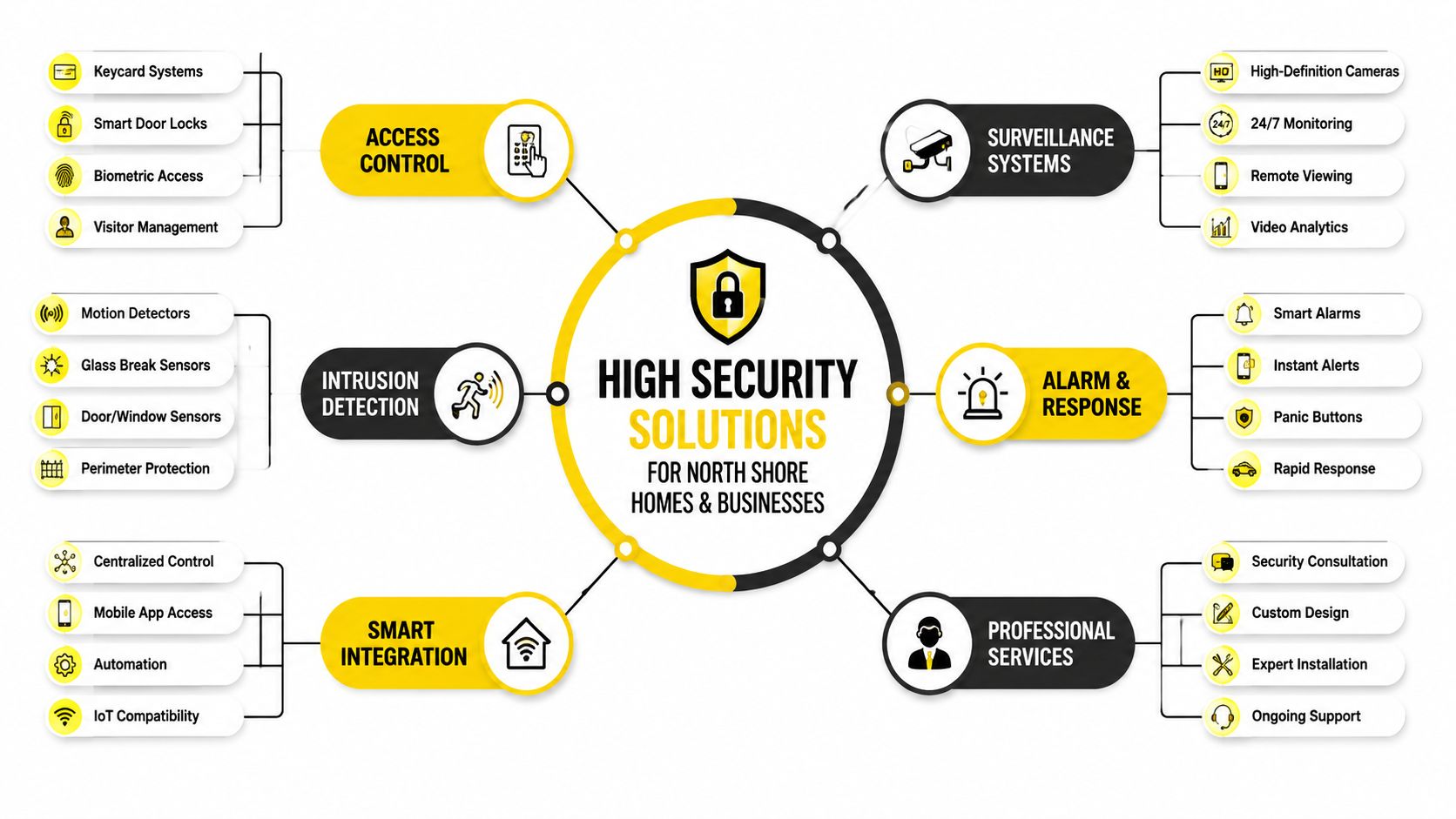
Homes, shops, strata, and small offices
A restricted keyway suits a homeowner who wants to stop casual copying after a move, a separation, or a key loss. A master key system suits a shop owner or office manager who needs different staff to open different areas without carrying a ring full of keys. A compliant window safety device matters in strata settings where child safety and by-law expectations come into play.
Safes belong in the same discussion. A floor safe or wall safe changes the security plan for documents, cash, or sensitive items because it removes the temptation to hide valuables in obvious places. That is not a luxury feature. It is a control measure that affects how the whole property is used.
| Property type | Typical need | Practical high-security response |
|---|---|---|
| Family home | Lost or copied keys | Restricted key system and door assessment |
| Retail shop | Multiple staff access | Master key hierarchy |
| Strata complex | Safety and shared access | Compliant window safety devices and key control |
| Small office | Documents and cash protection | Safe installation and anchoring |
Why demand stays steady
The market for this work is tied to property turnover, strata compliance, and commercial access control, not only break-ins. That is why the demand stays steady rather than appearing only after an incident. A North Shore locksmith who works mobile can make that practical because the value is usually in on-site assessment, specification, and installation, not simple key cutting alone. For a broader view of the work across the trade, market context helps show why these services keep showing up in everyday property management.
For clients who want a plain-English view of how these systems come together, local examples on master key system success stories show the planning involved in multi-user properties. The same principle applies whether the site sits in Pymble, Berowra, or anywhere else on the North Shore, control has to match the number of people using the property.
What works best in real jobs
The strongest outcome usually comes from combining the right hardware with a clear access plan. A good lock on its own can help. A good lock with restricted duplication, proper door hardware, and a sensible key hierarchy does much more. On the jobs that hold up, we look at the door assembly as a whole, not just the cylinder, because the frame, strike, hinges, and any side access points decide how well the system performs once people start using it every day.
Next Steps to Upgrade Your Property Security
The practical answer is rarely a single product. It's a whole-of-opening assessment, a decision on whether restricted keys or a master key system fit the property, and a check that the person doing the work is properly licensed. That combination matters far more than a flashy cylinder on its own.
For North Shore homes, strata sites, and small businesses, the sensible next move is an on-site review that starts at the door and works outward. A proper visit checks the frame, strike, hinges, and any non-traditional access points that may need attention. It also gives the client a clear recommendation in plain English, without forcing a one-size-fits-all answer.
Lock, Stock & Barrel Locksmiths handles that kind of assessment across Sydney's North Shore, from Thornleigh to Wahroonga. If the property needs a better key system, stronger door hardware, or safe installation, the next step is straightforward.
Lock, Stock & Barrel Locksmiths can assess your doors, keys, and access points on-site, then recommend a practical high-security setup for your North Shore property. If you're ready to stop guessing and want a clear plan for your home, strata site, or business, visit Lock, Stock & Barrel Locksmiths to call or request a quote.