- 24 Hour Emergency Services
- Servicing Sydney's North Shore
- View On Map

-
Mail Us On
info@lsblocksmiths.com.au
-
Make a Call
0411 700 072
- View On Map
- 24 Hour Emergency Services
- Servicing Sydney's North Shore
- View On Map
-
Mail Us On
info@lsblocksmiths.com.au
-
Make a Call
0411 700 072
- Contact Us
How Much Does It Cost to Rekey a Commercial Lock in NSW

Lock, Stock & Barrel Locksmiths
On August 19, 2026
A single commercial rekey in NSW typically costs around A$70–A$180 per lock, while a small-office rekey covering 10–15 locks commonly lands between A$700 and A$1,400 or more, depending on lock type, master key setup, and call-out timing. Those figures are a starting point, not a fixed national rate.
A shop manager may be dealing with a lost key, a staff member who has left, or a tenant turnover that has happened faster than expected. The immediate question sounds simple, how much does it cost to rekey a commercial lock? In practice, the answer depends on the number of doors, the condition and type of each cylinder, the key system already in place, and whether the work can happen during ordinary business hours.
For a North Shore business or strata manager, the useful figure is usually the total site cost, not just the price of one cylinder. Australian pricing guides show that commercial rekeying can range from standard per-lock work to substantially higher totals where restricted keyways, master key hierarchies, travel, labour, or urgent attendance are involved. Australian commercial rekeying pricing guidance explains why several locks on one visit can produce a lower effective cost per lock than a single-cylinder call-out.
Where This Cost Question Usually Comes From
The call usually follows a specific access problem. A shopfront manager on Pittwater Road discovers that a former employee still has a key. A strata manager finds that a tenant left without returning the master. An office owner misplaces a key ring, or a contractor's copy disappears after work at the premises.
The immediate concern is access and control. Staff may need to enter safely, a vacant tenancy may be due for handover, or the old key may need to stop working before opening time. To scope the job, the locksmith needs the number of affected doors, the hardware type, the existing key system, and confirmation of who can approve the work.
One entry cylinder may be a straightforward rekey. The scope changes once the site includes a rear door, storeroom, office, alarm cupboard, or common-area door. A master key system or restricted cylinder brings different checking, key-control, and ordering requirements, so the job is no longer a simple like-for-like pin change.
Practical rule: A commercial rekey quote should describe the whole access problem, not just one lock.
Per-lock pricing is only the starting point. The final quote depends on the number of doors, whether several locks can be handled on one visit, the condition of the cylinders, required keys, travel, and any after-hours attendance. Commercial rekey cost information for Australian customers explains why the lock charge and the travel or call-out components can affect a small job differently.
That distinction matters on a commercial site. A single-cylinder call-out carries the visit cost across one lock, while a site-wide rekey spreads some work across several doors but may introduce system design, access coordination, and additional keys. A modest per-lock figure can therefore produce a much larger total once the complete premises and access requirements are included.
What Rekeying a Commercial Lock Actually Means
Rekeying changes the internal combination of an existing lock cylinder so a new key operates it and the old key no longer does. The lock body, door, handle, faceplate, and strike generally remain in place.
Inside a conventional pin-tumbler cylinder, small pins sit at heights that match the cuts on a key. A locksmith removes the cylinder, takes out the existing pin arrangement, and installs a new set that matches the replacement key. Once assembled correctly, the old key can enter the keyway but won't lift the pins into the operating position.
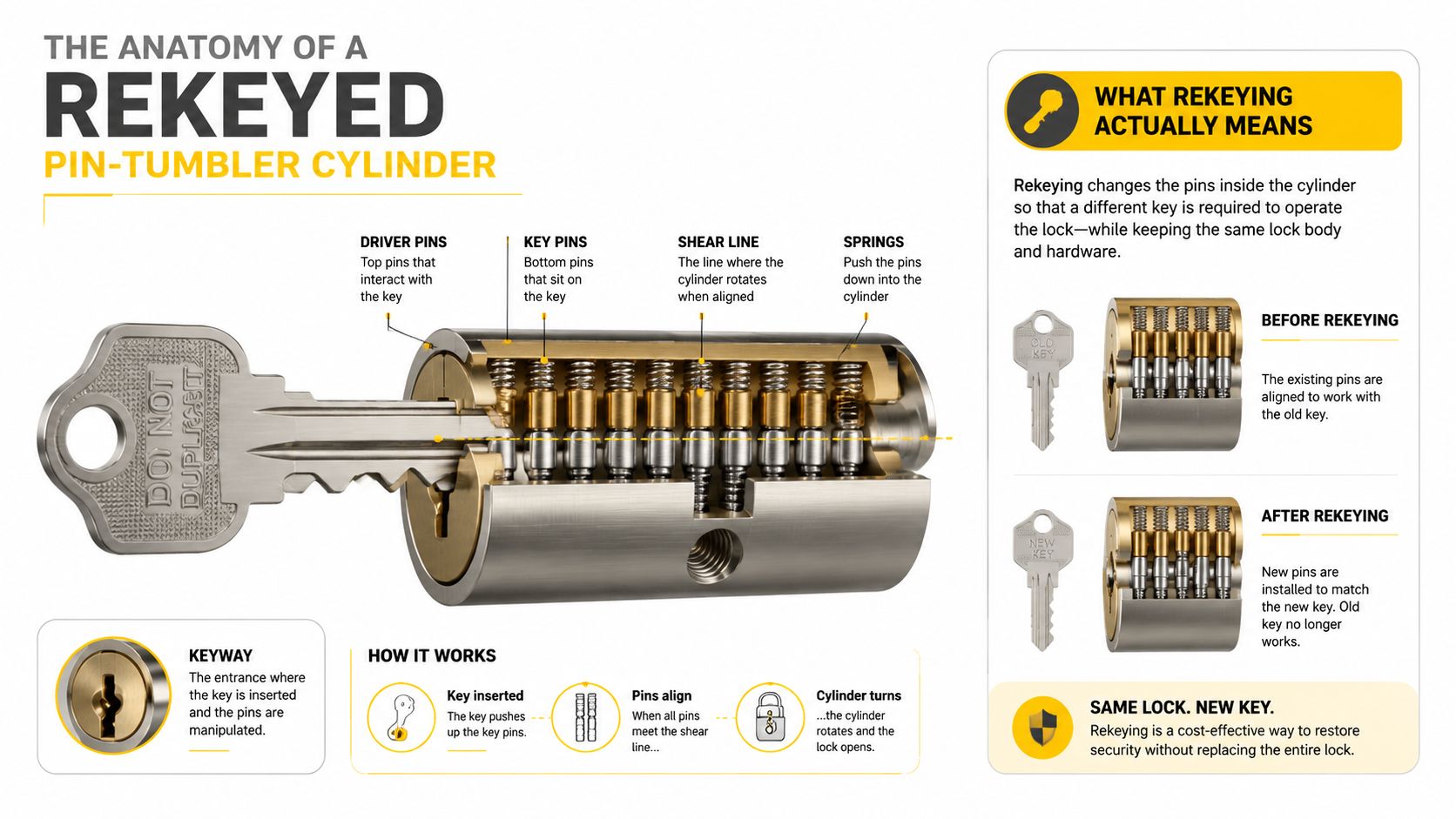
The practical advantage is that the existing hardware stays on the door. That's normally cheaper than removing and replacing the entire lock, particularly when the door, frame, and lock furniture are in sound condition. A routine cylinder can often be serviced on site in under fifteen minutes per lock, although the total visit can take longer when the locksmith must identify cylinders, organise keys, test a system, or deal with access issues.
Rekeying compared with replacement
Full replacement removes the existing lock hardware and installs new equipment. Depending on the door, that can involve the lock body, faceplate, strike, lever set, mortice case, or other associated parts. Replacement makes sense when the hardware is damaged, worn, obsolete, unsuitable for the door, or no longer appropriate for the required security level.
Rekeying isn't universal. Some high-security cylinders, restricted systems, interchangeable-core arrangements, and electronic locks require a different process or can't be re-pinned in the same way as a standard pin-tumbler cylinder. A locksmith should confirm the brand and cylinder profile before treating a commercial job as standard work.
What Drives the Price Up or Down on a Commercial Job
A commercial rekeying quote has two figures to assess: the per-lock price and the total cost for the site. The call-out or site fee may cover travel and a minimum labour allocation. On a single-cylinder visit, that fixed charge can form much of the invoice. Across several doors, it is spread over more work, so the average cost per lock usually falls.
The cylinder itself is the next variable. Standard commercial cylinders are generally more predictable than restricted keyways, high-security dimple cylinders, mortice cylinders, and other non-standard hardware. A Northern Suburbs locksmith FAQ separates standard and non-standard locks, with complexity affecting the price.
The line items that matter
- Cylinder type: Standard oval, rim, or similar cylinders are usually straightforward. Specialised hardware may need different parts, tools, or testing.
- Key quantities: Confirm how many operating keys are included. Extra copies, master keys, and sub-master keys increase the total.
- Lock condition: A seized, corroded, forced, or internally worn cylinder may need repair or replacement rather than a simple rekey.
- System requirements: A master hierarchy requires every cylinder to work with the correct key level while maintaining the rest of the system.
- Timing and access: Night work, weekends, urgent attendance, difficult parking, restricted loading areas, and staged access can add labour and attendance costs.
Read the inclusions beside the price. One Australian price list gives A$160 including GST, parts, labour, and the service call fee for re-keying a standard lock. This all-inclusive locksmith price list illustrates why a higher per-lock figure may still be better value when travel, parts, labour, and keys are included.
A ten-lock standard rekey during business hours can therefore cost less per lock than four urgent cylinders attended in the early hours. The site total still depends on the installed hardware, key schedule, access, and timing. A locksmith should inspect or confirm those details before promising a firm figure.
Realistic Price Scenarios for Sydney Commercial Sites
A useful way to assess a quote is to place the property into a recognisable job category. These examples use the available Australian pricing guidance as a guide, but the final amount still depends on the hardware, key quantities, access arrangements, and timing.
One retail tenancy
A small shop with an entry cylinder and a rear door is usually a limited scope job. During business hours, a two-lock visit may sit around A$140–A$280, depending on the cylinders and the included keys. The total can move higher if one door has a non-standard cylinder, the hardware is damaged, or the locksmith has to resolve a door alignment problem at the same time.
The manager should identify every key-controlled opening before booking. Rekeying only the front door won't solve the problem if the former key also operates the storeroom or rear entry.
A small office
A small office with 10–15 locks commonly falls between A$700 and A$1,400 or more in Sydney pricing examples. Sydney commercial rekey pricing guidance notes that office rekeys of this size can vary with the type of system, the cylinders involved, and whether discounts apply to larger jobs.
The quote should state whether internal offices, filing rooms, plant areas, and the main entry are all included. It should also list the number of staff keys and identify whether the existing arrangement is master-keyed.
Strata and multi-tenant buildings
A strata or multi-tenant site is less likely to have one simple per-lock price. Common entries, individual unit doors, meter rooms, garages, and plant areas may sit within a master key hierarchy. The locksmith must preserve the intended access levels or rebuild them after a key loss.
A commercial door lock installation service may become relevant if some doors need hardware changes before the rekey can be completed. Existing cylinders may also belong to different brands or profiles, which can prevent a clean system-wide result.
Urgent and after-hours attendance
An urgent night, weekend, or lockout-related call is priced differently from planned daytime work. Australian guides identify after-hours attendance as a factor that can materially increase the total, especially when only a small number of locks are involved. Sydney locksmith cost guidance also highlights the difference between an apparently low cylinder rate and the job total once call-out and labour are added.
Travel time matters, but the labour involved after arrival is usually the more useful comparison. A Manly job and a Parramatta job may involve similar on-site work once the technician has reached the property, while parking, access restrictions, and urgent timing can alter the attendance cost.
How Master Key Systems and Restricted Keyways Change the Cost
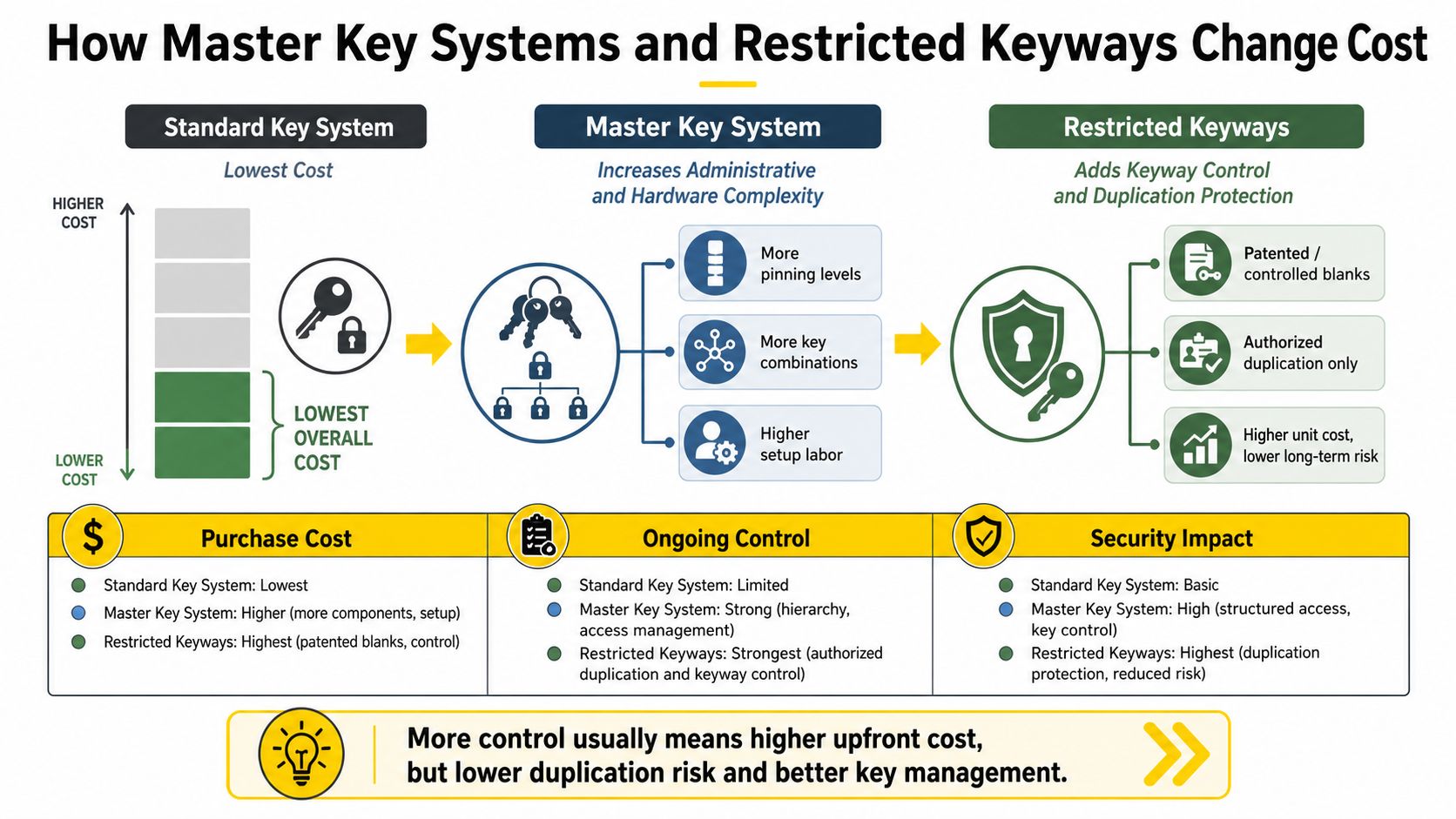
A standard master key system allows one master key to open several doors while each door still accepts its own individual key. That arrangement is useful in offices, strata buildings, retail premises, and commercial sites where cleaners, managers, tenants, and contractors need different access.
A locksmith working within an existing hierarchy must pin every cylinder to the correct position and test the result against the relevant master and individual keys. The job isn't a matter of making all doors accept the same key. Australian master key system guidance explains the underlying structure, where one master key opens multiple locks and each lock retains its own unique key.
The extra planning and testing are why a master-keyed rekey usually costs more than a basic cylinder reset. Australian guidance places smaller master-key projects around A$300–A$1,200, while higher-security cylinder choices can range from A$80–A$200 or more per cylinder. Master key system cost and planning information also outlines the trade-off between stronger key control and higher initial project cost.
Restricted keyways
Restricted systems add control over who can obtain duplicate keys. Products such as Abus, Bilock, ASSA, and dormakaba may use controlled profiles, registered key systems, or manufacturer-specific procedures. The cylinder, key blanks, authorisation process, and testing requirements can all differ from a standard commercial lock.
That added control can be worthwhile where many people handle keys or where a lost master would create a broad security problem. It can also prevent casual duplication and make the key register easier to manage. The drawback is that a restricted system costs more to establish and may require authorised ordering rather than immediate copying at a local key-cutting counter.
A master key system can reduce daily key clutter, but it creates a system that must be documented and maintained properly.
The right question isn't whether a master system is cheaper. It's whether the building needs controlled levels of access. For a small shop with two doors, a standard rekey may be enough. For a strata complex or office with shared facilities, a properly designed hierarchy can reduce repeated confusion and unnecessary key changes, even though the initial rekey is more involved. Commercial master key system services can be considered when access levels need to be planned rather than handled as isolated lock changes.
Rekeying Versus Full Lock Replacement
A shop manager may face a simple choice: the locks still work, but former staff, contractors, or tenants may still hold keys. Rekeying keeps the existing hardware and changes its internal combination, so the old keys no longer operate the cylinder. It suits sound locks where the problem is access control rather than mechanical failure. Australian rekeying service information explains this distinction.
Replacement removes the existing lock and installs new hardware. It may be necessary when the lock body is worn, damaged, obsolete, or unsuitable for the door. It can also make sense when the site needs a different security platform, a restricted system, or hardware that meets an insurer or building requirement.
Retaining sound hardware through rekeying avoids the hardware and labour cost of full replacement. That is why rekeying is commonly priced per cylinder, while replacement is assessed as a complete door set. The per-lock figure is only one part of the decision. A site-wide total also depends on the number of openings, keys, access levels, and any difficult or non-standard hardware.
The decision in practical terms
| Situation | More suitable option | Reason |
|---|---|---|
| The cylinder works smoothly and old keys must stop working | Rekeying | The access problem is addressed while usable hardware remains |
| The cylinder is seized, damaged, or previously forced | Repair or replacement | A new pin combination will not fix failing mechanical parts |
| The business needs controlled key duplication | Restricted or upgraded system | The requirement extends beyond cancelling old keys |
| Door hardware is obsolete or mismatched | Replacement | New hardware may improve reliability and compatibility |
A standard rekey may be economical, but a worn lock can turn that saving into a short-term fix. If the cylinder binds, the lock case is damaged, or replacement parts are unavailable, fitting new hardware may be the sounder job. Australian pricing information on commercial lock rekeying also supports treating non-standard cylinders as separate quote items rather than applying one figure to every opening.
The security result differs as well. Rekeying changes who can use the existing lock. Replacement can change access while improving the hardware's condition, format, or security level. For broader background on the choice, rekeying versus replacing locks is useful, although commercial sites often involve more doors and access levels than residential openings.
What to Ask a Locksmith Before You Accept a Quote
Two quotes can show different totals while covering different work. One may include the call-out, keys, testing, and GST. Another may show a low per-cylinder rate and add those items later.
A commercial manager should ask for a written scope that names each door or opening. That avoids the common problem where the main entry is rekeyed but a former key still works on a rear door, office, or common area.
Questions that make quotes comparable
- Is the call-out included? Ask whether travel, site attendance, and the minimum labour charge are separate or absorbed into the quoted total.
- What is the per-cylinder rate? The quote should identify the number of cylinders and the amount assigned to each one.
- Which keys are included? Confirm the number of standard keys, master keys, sub-masters, and additional copies.
- Is the system standard or restricted? A restricted keyway, high-security cylinder, or existing master hierarchy should be itemised.
- What happens if the hardware is non-standard? Ask whether the locksmith will seek approval before changing the price or recommending replacement.
- Are testing and documentation included? Master-keyed premises need more than a key that turns once. Each access level should be checked.
- What warranty applies? The manager should understand whether the warranty covers workmanship, parts, or both.
The business should also ask whether keys are cut on site or supplied later, and whether worn hardware will trigger a replacement recommendation. Those details affect both timing and the final invoice.
A low headline price isn't necessarily the cheapest job. Once call-out fees, key quantities, restricted hardware, damaged cylinders, and after-hours attendance are aligned, the more detailed quote may offer the clearer value.
Common Questions Commercial Clients Ask About Rekeying
How long does a commercial rekey take?
After the locksmith confirms the cylinders and new key plan, a straightforward rekey usually takes 10–20 minutes per cylinder. The full visit can take longer when the site has several doors, a master-key system, testing requirements, or difficult access.
Do tenants need to be present?
Usually not. A property manager or authorised representative can provide access and approve the work. The locksmith still needs clear authority before changing a commercial lock or key system.
Do old keys stop working immediately?
Yes. Once the cylinder is correctly re-pinned and tested with the new key, the previous key should no longer operate that lock. If it still works, report it before the locksmith closes the job.
Does a locksmith need proof of authority?
That is normal for commercial rekeying. The locksmith may request identification, property management details, a lease or ownership connection, or confirmation from the responsible manager. The documents required depend on the site and circumstances.
Is insurance documentation supplied?
Ask before booking. The locksmith can confirm whether the invoice, work description, or service record will be provided. Requirements vary between insurers, property managers, and building owners.
How many keys come with the job?
The quote should state the quantity and type. Standard operating keys, master keys, sub-masters, and extra copies are separate parts of the order, especially where a master or restricted system is involved.
What should a commercial rekey quote show?
Compare the per-cylinder rate with the actual site-wide total. Check call-out and labour charges, key quantities, testing, documentation, after-hours attendance, and any allowance for damaged or non-standard hardware. A low per-lock figure can be misleading if those items are added later.
The key technical question is whether the cylinders are standard pin-tumbler locks or restricted-profile hardware. That detail can determine whether the work is a simple rekey, a system reconfiguration, or a replacement project.
Lock, Stock & Barrel Locksmiths provides commercial rekeying, key cutting, master key planning, and on-site lock work for businesses, offices, retail premises, and strata properties across Sydney's North Shore. For a site-specific figure, call for a quote or visit Lock, Stock & Barrel Locksmiths with the affected doors, suburb, and existing key-system details.