- 24 Hour Emergency Services
- Servicing Sydney's North Shore
- View On Map

-
Mail Us On
info@lsblocksmiths.com.au
-
Make a Call
0411 700 072
- View On Map
- 24 Hour Emergency Services
- Servicing Sydney's North Shore
- View On Map
-
Mail Us On
info@lsblocksmiths.com.au
-
Make a Call
0411 700 072
- Contact Us
Pick Resistant Locks: A North Shore Buyer’s Guide

Lock, Stock & Barrel Locksmiths
On August 3, 2026
A tenant on the Upper North Shore loses a key, the strata committee starts worrying about copies floating around, and the first question usually becomes, “Should the lock be pick resistant?” That's the right instinct, but it's only part of the decision. A lock can slow a quick manipulation attack and still leave the door frame weak, the keys uncontrolled, or the whole setup unsuitable for the way the property is used.
A practical buyer in Sydney needs a wider lens. Pick resistant locks matter, but so do the door, the strike, the keys, the standard behind the hardware, and who's allowed to hold copies. For a townhouse in Turramurra, a unit in Chatswood, or a small office in St Ives, the question is whether the hardware suits the risk, not whether the box uses a fashionable label.
What North Shore Homeowners Get Wrong About Pick Resistant Locks
A common call goes like this. Someone has had a move-in, a tenancy turnover, or a missed key handback, and they want a quick answer that restores confidence. They've heard the term pick resistant and assume the label itself tells the full story, but it doesn't.
What matters first is the threat. For a family home, the concern might be opportunistic entry through a front door. For a strata building, the bigger headache can be key copies and access drift over time. For a shopfront, the lock needs to survive more than a quiet picking attempt, because forced entry, drilling, and rough handling are usually more relevant than the neat theory of lock manipulation.
The label only describes one part of the job
A lock marketed as pick resistant is not the same thing as a lock that is secure in every sense. The term is useful, but it's incomplete. The better question is whether the lock resists manipulation, resists forced entry, and fits the way the property is managed.
That's where the North Shore context matters. Older residential hardware is common, strata sites often have mixed door types, and rental properties can cycle through occupants quickly. A cylinder that looks impressive in a brochure won't help much if the door flexes, the frame is weak, or spare keys are uncontrolled.
Practical rule: if the buyer can't explain who holds the keys, how the door is protected, and what standard the lock meets, the purchase is usually being made too early.
The quickest way to sort good advice from sales talk is to ask what problem the lock is solving. If the answer is only “picking”, the conversation is too narrow. If the answer includes the door condition, key control, and the property's use, the discussion is heading in the right direction.
What Pick Resistant Means
A standard pin-tumbler lock works by lining up spring-loaded pins at the shear line so the cylinder can turn. That sounds simple, which is exactly why ordinary cylinders can be manipulated with basic tools when the tolerances are loose and the internal geometry is predictable. The lock is not bad, it is built for everyday use rather than active resistance.
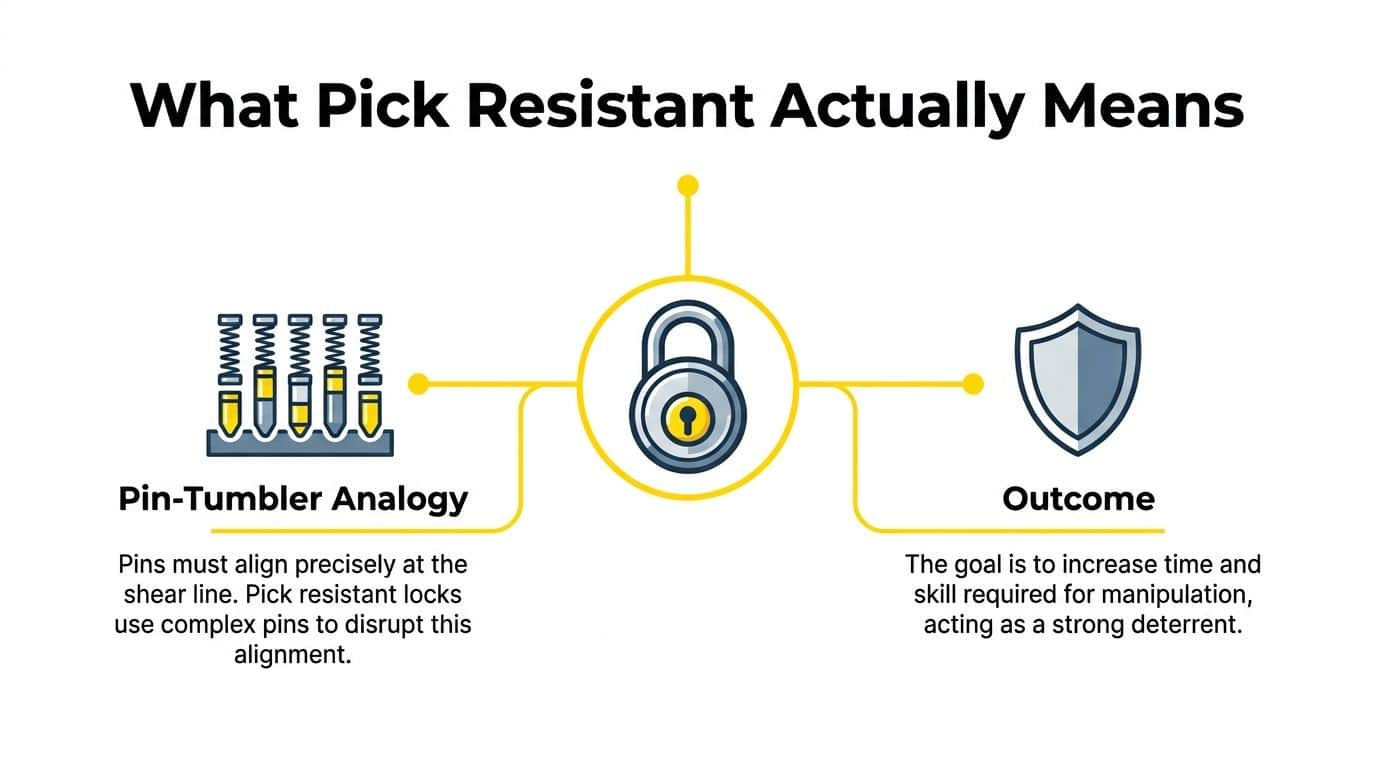
How the internal parts frustrate manipulation
Pick resistant pin-tumbler designs use countermeasures such as spool or mushroom driver pins, serrated pins, and paracentric keyways. Those parts create false sets, which makes the lock feel as though it's opening before the pins are where they need to be. Security references note that spool-shaped pins are resistant to picking because their thin middle section creates that false set during manipulation, which is the basic reason the lock becomes harder to work by hand.
That does not make the lock magic. It means the person attacking it has to read more misleading feedback and work against tighter geometry. Standard hooks and rakes lose their easy rhythm, and the attacker needs more patience, better touch, and often more time than a casual intruder will have.
Pick resistant is not pick proof
The distinction matters. Pick resistant means harder to manipulate, not impossible to manipulate. Security references treat high-security cylinders as resistant rather than unpickable, and that is the honest framing for buyers in Australia and everywhere else.
No consumer lock should be treated as unpickable. The honest goal is to make the attack slow enough, awkward enough, and uncertain enough that it stops being worth the effort.
That is why the better locks combine geometry, tight tolerances, and key complexity. A lock that only looks secure from the outside still will not impress anyone on the bench. A lock that is resistant changes how long an attacker needs to keep working at it, which is the point.
The Four Main Anti-Pick Mechanisms Explained
On a lot of North Shore jobs, the first question is not whether a lock is branded as pick resistant. It is what the cylinder is doing inside the door, and whether that hardware suits the way the property is used. A terrace in Turramurra, a strata entry in Chatswood, and a garage padlock on the same site do not need the same internal setup.
Different hardware families deal with manipulation in different ways. Some rely on pin design, others on sidebars, others on more complex key systems, and some combine resistance to picking with tighter key control in the same body. The right choice depends on the door, the user group, and how much administration the site can handle.
| Mechanism | Best For | Key Control | Resistance |
|---|---|---|---|
| Security pin tumblers | Homes and standard upgrades | Low to moderate | Good against casual picking |
| Sidebar and extra pin rows | High-security residential and commercial doors | High | Strong against manipulation |
| Disc detainers | Sheds, garages, padlocks, higher-security outbuildings | Moderate to high | Strong against picking tools |
| Restricted keyways | Strata, offices, rentals, managed sites | Very high | Strong plus controlled duplication |
Security pin tumblers
These are the most familiar upgrade path. Spool pins, serrated pins, and tighter tolerances improve resistance without forcing the whole building into a specialised key system. On a standard residential cylinder, that is often the most practical step up when the main concern is opportunistic manipulation rather than a broader access-management issue.
The trade-off is simple. You get better resistance, but you are still working within a normal pin tumbler format, so the lock can be easier to administer and easier for everyday users to live with than a more specialised system.
Sidebars and extra pin rows
Some high-security designs use a pin and sidebar arrangement with multiple pin rows. BiLock-style systems are a familiar example in the Australian market. That changes the whole feel of the lock because the attacker has more to solve at once, and the feedback is less forgiving than a basic cylinder.
For a homeowner who wants serious mechanical resistance, this is a solid option. The cost is usually a more specialised key and a setup that is less universal than a common residential cylinder, so it suits owners who are comfortable with that trade-off.
Disc detainers
Disc detainer locks show up often in high-security padlocks and external applications. They suit garages, sheds, and exposed points where the user wants strong physical resilience and a different internal mechanism from the everyday house cylinder. They are also useful where a site wants to separate the outside hardware from the internal door system.
They are not a one-size-fits-all answer. For a front entry on a North Shore home, they are not always the neatest fit, but on a padlock or outbuilding they can make good sense.
Restricted keyways
Restricted keyways pair pick resistance with control over duplication. That makes them especially relevant in strata and offices, where the issue is not only whether a lock can be manipulated, but who can get another key cut later. For managed sites, the mechanism matters as much as the metal.
A local cylinder replacement job can also be a practical route here, because the existing door hardware can stay in place while the cylinder itself is updated. That is often the cleaner option when the frame and lock body are still serviceable, and the upgrade question is really about the cylinder rather than the whole set.
How to Read Pick Resistance Claims and AU Ratings
Marketing language can be slippery. A box saying high security or pick resistant doesn't tell a buyer enough on its own, because those phrases don't explain what was tested, what else the lock resists, or whether the hardware suits Australian conditions. The better benchmark in Australia is the Master Locksmiths Association of Australasia Security Products Directory, which lists products tested against the AS 4145.2 hardware performance standard used in Australasia. That gives buyers something practical to compare instead of a slogan.
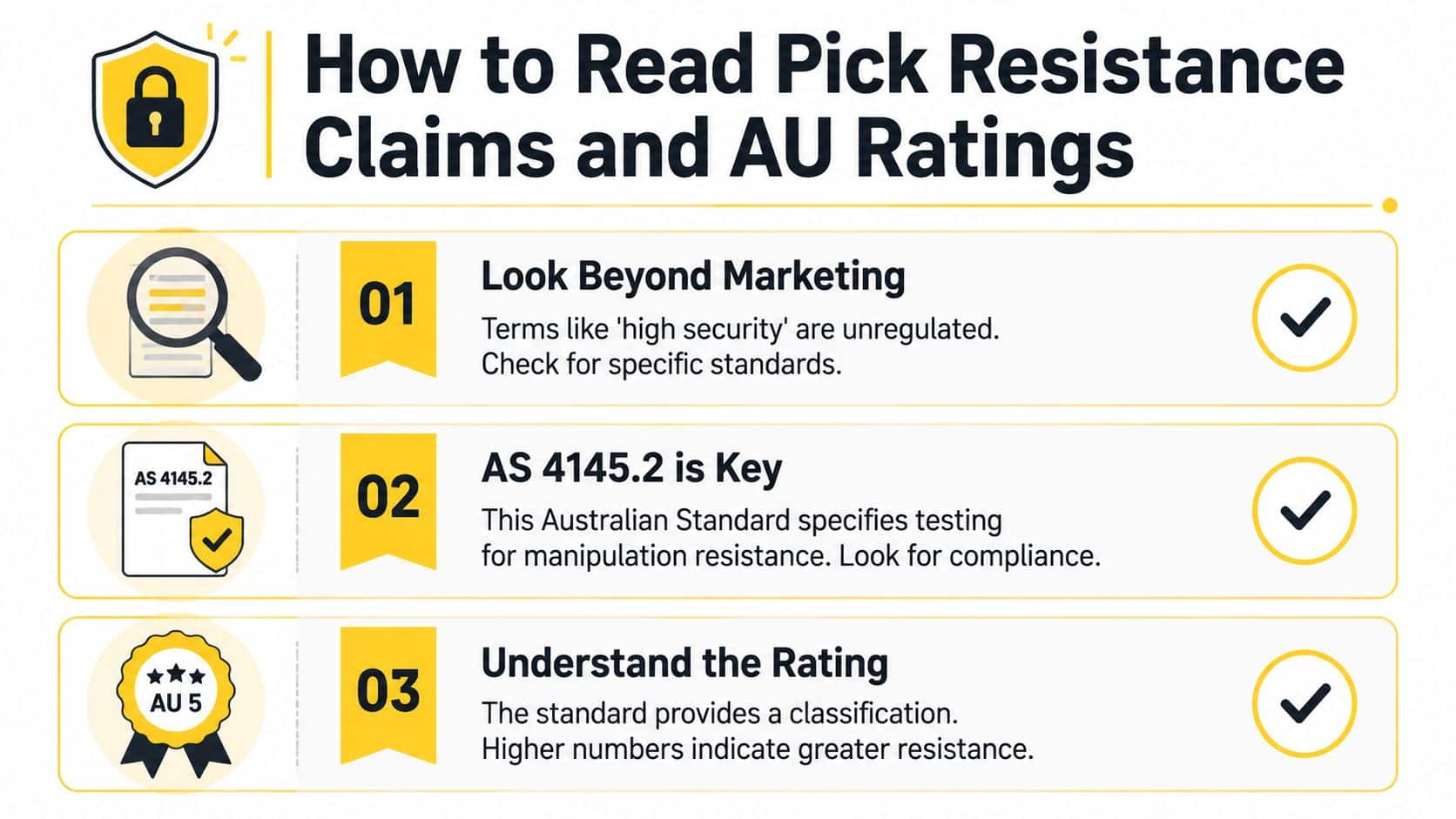
What to look for on the product sheet
A serious product description should say more than “hard to pick”. One AU-source high-security line lists evaluation against manual picking, electric picking, gun picking, torque resistance, extraction, drilling resistance, and chisel resistance, and it describes drilling tests with three drills up to 12 mm diameter plus a 2.5 Nm torque requirement. That's the kind of language that shows the maker is measuring more than one threat.
The same logic appears elsewhere in the market. A radial pin tumbler cam lock is sold with 10,000 key combinations and a double anti-drill feature as standard, which tells the buyer the lock isn't relying on one tactic alone. Another AU-market option advertises 1,000,000 possible keycode combinations and six pick-resistant levers, again showing that manipulation resistance is only one layer.
A simple buyer checklist
A North Shore buyer can sort most claims with three questions:
- Is it listed in the MLAA directory? If not, the buyer is relying more on marketing than on a standards pathway.
- Does it refer to AS 4145.2 or an equivalent recognised test basis? If the answer is vague, the claim is weak.
- Does it also address drilling, extraction, torque, and chisel resistance? If it doesn't, the lock may be resistant in theory but vulnerable in actual use.
The reason this matters is simple. A lock is rarely beaten only by picking. The rest of the attack chain counts too, especially on doors that are old, light, or poorly reinforced. The strongest product is the one that has been assessed as part of a wider hardware standard, not the one with the flashiest label.
Choosing the Right Upgrade for Your North Shore Property
On the North Shore, the right upgrade depends on the door in front of you. A freestanding house, a strata unit, and a small business all put different demands on the hardware. A front entry in a timber-framed home may need a stronger cylinder and better strike reinforcement. A unit door in a managed block may need tighter key control first. A shopfront usually needs the hardware to handle manipulation and physical attack together.
Match the hardware to the door, not the brochure
A premium cylinder fitted to a weak frame is wasted money. If the strike area splits or the door flexes, someone will go around the cylinder instead of through it. A proper upgrade usually includes the frame, strike plate, and fixing points, not just the part you can see from the hall.
For houses, a sensible path often starts with upgrading the cylinder on the existing lockset, then checking the deadbolt and the hardware around it. For apartments and strata doors, the decision often turns on whether a rekey is enough or whether the whole cylinder should be changed to improve access control. For business doors, the value comes from combining pick resistance with physical hardening and sensible key management. If the existing hardware is tired or mismatched, cylinder lock replacement can sit inside that wider assessment.
Work through the common upgrade paths
A local locksmith can usually approach the problem in layers. Sometimes the right move is rekeying the existing hardware to a new key. Sometimes it is a cylinder swap. Sometimes the lock, the strike, and the door condition all need attention together, because one weak point will drag the rest down.
A lock change that ignores the frame is only half a job.
For North Shore properties with mixed door stock, the main mistake is choosing hardware first and asking about fit later. Door material, hinge quality, and strike strength all change what makes sense. A mobile assessment is usually more useful than guessing from product photos alone.
Some owners also end up pairing the entry upgrade with window safety devices, especially where strata rules or family safety concerns are involved. That keeps the security conversation on the whole opening, not just the front door.
When Key Control Matters More Than Pick Resistance
For strata, rentals, and small businesses, the bigger issue is often not whether someone can pick the lock. It's whether someone can get another key cut without approval, or whether the number of copies slowly turns into a management headache. That's why restricted keyways matter so much in shared-access environments.
Australian standards guidance makes the point clearly enough, door hardware selection should follow the application, not just the label, with the National Construction Code and AS 4145 framework distinguishing performance and security requirements by door use, while AS 5039 covers security-screen and window hardware requirements in specific settings. In practice, that means a strata committee, a landlord, or a manager should choose hardware based on how the building is used, not only how secure the cylinder sounds in sales copy.
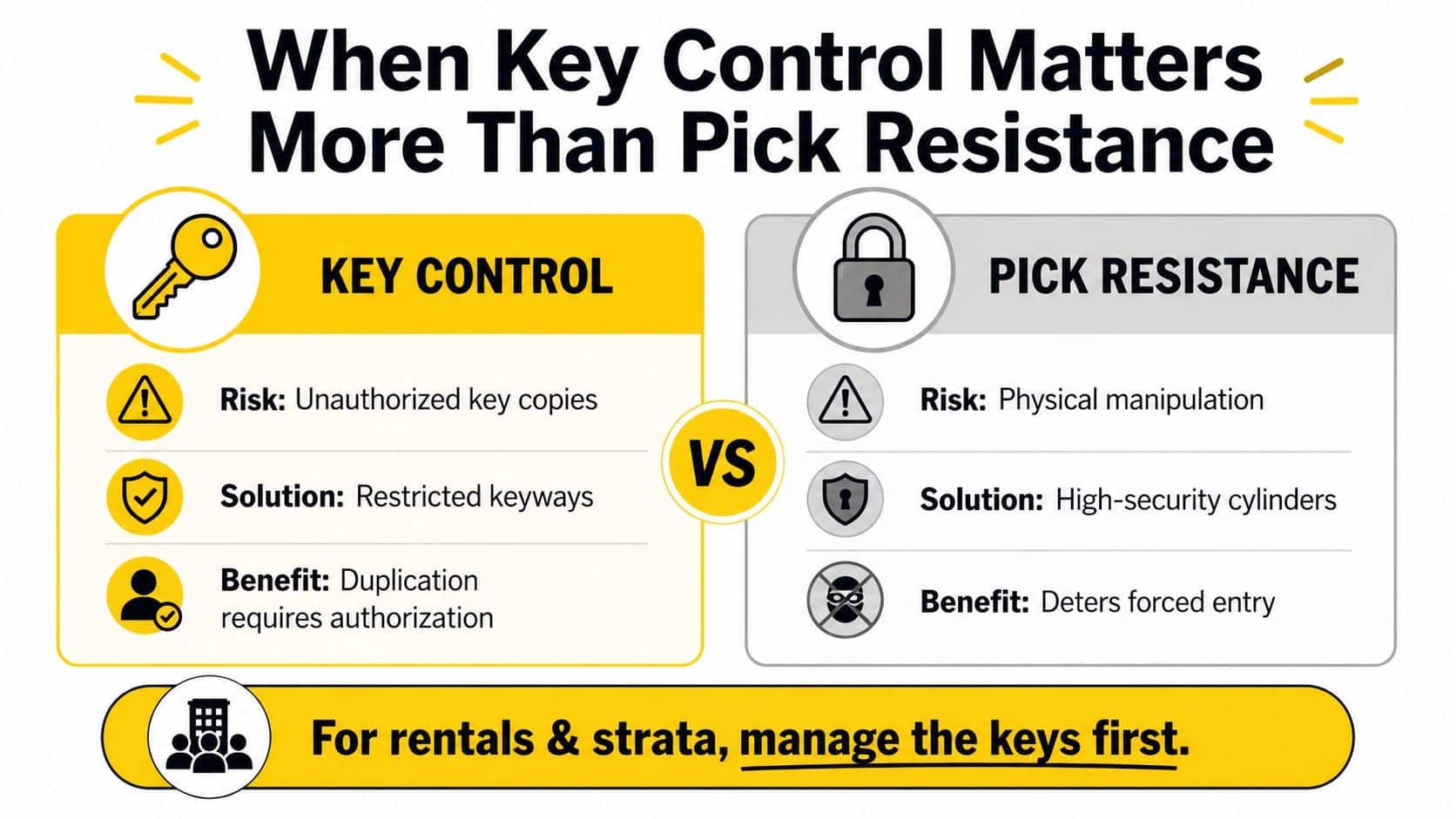
Why restricted keys change the whole problem
Restricted key systems use controlled blanks and authorised cutting channels so duplicate keys aren't handed out casually. That helps when tenants move, cleaners rotate, contractors come and go, or committee members change. The lock body may still be pick resistant, but the bigger win is that the key itself is controlled.
Master keying matters too. It lets different people have different access levels without carrying a full ring of identical keys. Owners, tenants, cleaners, supervisors, and managers can all be given the access they need, while the register keeps track of who should have what.
A practical example is a strata turnover. A committee can spend energy worrying about picking, or it can solve the more likely problem, which is uncontrolled duplicates from a past tenancy or contractor handover. Once the key register is clean, the building is easier to manage and the hardware choices make more sense.
For sites that need that kind of administration, restricted key systems usually belong in the conversation before anyone talks about premium cylinders. A good mechanical lock is useful. A controlled key system is often more useful.
Working With a North Shore Locksmith and Upgrading Existing Hardware
A proper assessment starts with the door that's already there. The locksmith checks the lock type, cylinder condition, strike plate, frame strength, and whether the current hardware can be rekeyed or should be replaced. A sensible phone conversation before booking should also cover whether the property is a home, strata unit, office, or shop, because the application changes the recommendation.
A local mobile locksmith can rekey existing hardware, swap in a stronger cylinder, add compliant window safety devices where needed, and reinforce weak hardware points. That's the kind of practical work that turns a pick resistant label into a usable security upgrade rather than a badge on a box. For readers who want a straightforward guide to choosing a tradesperson, what to look for in a reliable local locksmith is the kind of checklist worth using before anyone starts swapping parts.
What a sensible site visit should cover
- Verification of the door and keys, so the locksmith knows what's being protected and who should have access.
- Assessment of the frame and strike, because entry resistance depends on more than the cylinder.
- Discussion of rekey versus replacement, so the owner doesn't pay for more hardware than needed.
- Documentation if a restricted system is installed, so key control stays clean after the job.
Lock, Stock & Barrel Locksmiths works as a mobile North Shore service for residential and commercial sites, and that kind of on-site assessment is usually the right way to decide whether a pick resistant cylinder, a restricted keyway, or a broader hardware upgrade is the better fit.
If the door, keys, or hardware on a North Shore property need a straight assessment, Lock, Stock & Barrel Locksmiths can look at the actual setup, not just the label on the lock. For homes, strata sites, and small businesses across the Upper North Shore, Hills District, and Lower North Shore, visit Lock, Stock & Barrel Locksmiths to arrange an on-site quote and get the hardware matched to the way the property is used.