- 24 Hour Emergency Services
- Servicing Sydney's North Shore
- View On Map

-
Mail Us On
info@lsblocksmiths.com.au
-
Make a Call
0411 700 072
- View On Map
- 24 Hour Emergency Services
- Servicing Sydney's North Shore
- View On Map
-
Mail Us On
info@lsblocksmiths.com.au
-
Make a Call
0411 700 072
- Contact Us
What Is Key Cutting in Pymble, NSW?

Lock, Stock & Barrel Locksmiths
On July 31, 2026
Key cutting might sound like a technical term, but it’s really just the craft of copying a key. Think of it like getting a spare made for your house, car, or office — it’s that straightforward.
How Key Cutting Actually Works
At its core, key cutting takes a blank piece of metal and shapes it to match the grooves and notches of your original key. If you’ve ever lost your house key after a busy school drop-off and needed a fast solution, you know the relief a freshly cut spare can bring. For us at Lock, Stock & Barrel Locksmiths — a father-and-son team serving Sydney's Upper North Shore — this is the kind of everyday trade work we handle. It’s not a mystery, just a skilled process done right.
Life on the North Shore keeps this service in constant demand. You see it when:
- Parents panic after misplacing the house key during the afternoon school rush.
- New tenants in Pymble need extra sets or a rekey for peace of mind.
- Small businesses in Hornsby need to reissue access when staff leave.
- Families in Wahroonga want a spare set ready for visiting relatives.
What You’ll Find in This Guide
We’ll walk through how keys are cut, step by step. Then we’ll cover the different types of keys and the machines used to cut them. We’ll also talk about why quality matters — a poorly cut key can cause real damage — and what you should expect to pay. Finally, we’ll compare doing it yourself versus calling a pro, and help you figure out when it’s time to bring in a mobile locksmith on the North Shore.
A few things to keep in mind:
- A key is really just a coded piece of metal. Cutting it means transferring that exact code onto a blank.
- Not every blank works with every lock. Using the wrong one can ruin both the key and the lock.
- Mobile locksmiths can cut keys right at their van or in a workshop, depending on what’s needed.
A key is essentially a coded strip of metal, and key cutting is the act of translating that code onto a fresh blank.
Common Reasons North Shore Residents and Businesses Request Key Cutting
Here’s a quick look at the situations we see most often and what usually makes sense.
| Situation | Best Response | Why It Works |
|---|---|---|
| Lost your only house key | Call a mobile locksmith for an on-site cut | You get back inside without damaging the door, and a new key is made while you wait. |
| Need a spare for a family member | Have a duplicate cut from the original | It’s fast, cost-effective, and works every time. |
| Moving into a new home | Request a rekey and fresh cuts | You control who has access, and any old copies become useless. |
| Office key lost by a former employee | Reissue keys and update the system | Prevents unauthorised access and keeps your workplace secure. |
| Want a single key for multiple locks | Ask about a master key setup | Simplifies access while maintaining different permission levels. |
What to Do Next
For a simple spare, many hardware kiosks can cut a standard house key in minutes. But if you’re dealing with restricted keys, laser-cut designs, or anything involving security, it’s safer to stick with a licensed locksmith. They’ll ensure the job is done correctly and your lock isn’t compromised.
You can learn more about what we offer by visiting our key cutting page, or check out the areas we cover, such as our Turramurra locksmith location page. If you need a quote or an on-site visit, call us — we’re always happy to help.
How Key Cutting Actually Works Step by Step
When someone asks what key cutting is, they're usually talking about the practical job of transferring a key's code from an existing key or lock onto a fresh blank. Think of it as photocopying a precise shape rather than drawing freehand — the accuracy is everything.
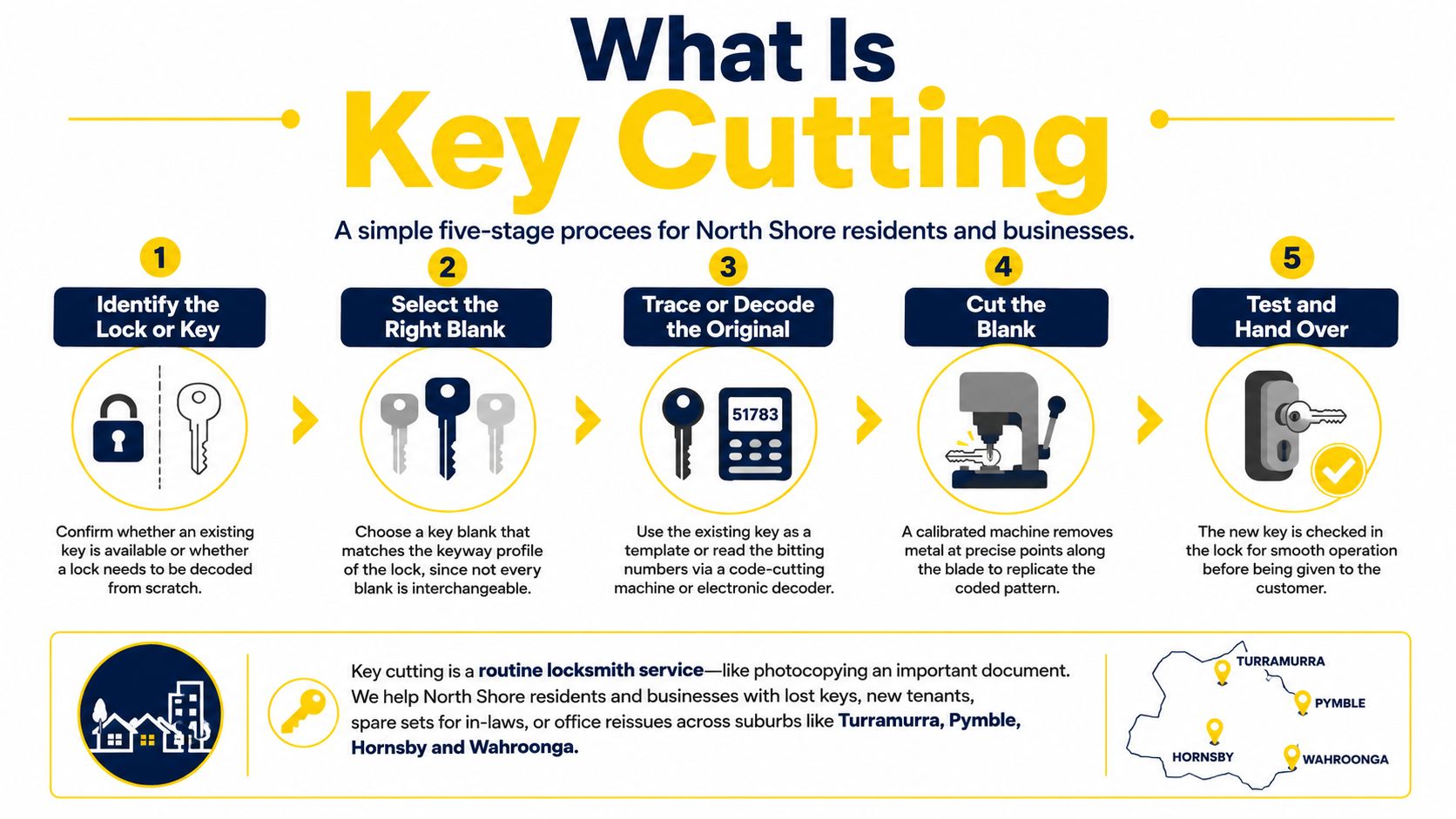
This infographic walks you through the five-stage flow a locksmith follows when cutting a key for a North Shore home or business. It helps you see each step clearly, from identifying the right key type to testing the finished copy.
A key is essentially a coded strip of metal, and key cutting is the act of translating that code onto a fresh blank.
Select The Right Blank
The process starts by matching the keyway profile. Not every blank fits every lock, so we pick one that sits correctly in the lock barrel. Getting this wrong can mean a damaged blank or a key that jams halfway in.
- A Yale-style household key needs a completely different blank to a modern euro profile cylinder.
- Looking at the original key's shoulder and groove pattern usually points you straight to the correct blank.
Trace Or Decode The Original
If you've got the original key, a duplicating machine uses a guide to trace it while a cutter removes metal from the blank. When there's no key to work from, we can impression the lock or use a code-cutting machine to decode the bitting numbers electronically.
- Duplication from an original — fast and reliable for most house keys you'd find in a typical North Shore home.
- Originating from a code or impression — this is what you need for lost keys or restricted key systems where no copy exists.
Cut The Blank Precisely
Workshop-grade machines use calibrated cutters or milling bits to remove metal at exact depths and spacings. Hand-cutting or those cheap shopping centre kiosks might get you through the door with a basic key, but they simply don't have the tolerance control of a proper locksmith's van setup.
- Numbered depth tolerance matters enormously — a tiny deviation changes how the pins align inside the lock.
- A sharp, well-mounted cutter gives cleaner cuts and a key that lasts longer before wearing down.
Test And Hand Over
Every key gets test-turned in the lock before it leaves our hands. We check for smooth operation, make sure there's no binding or sticking, and give you a heads up on how long you can expect it to last.
For North Shore customers, a mobile locksmith from Lock, Stock & Barrel Locksmiths will often cut the key right on your doorstep using a van-mounted machine. For more complex jobs — think restricted systems or antique locks — the work moves to the workshop where code-cutting tools and a wider stock of blanks are kept.
Here's a practical way to think about it: duplicating is like photocopying an existing page, while originating is like transcribing a document from notes. Both get you a working key, but they need different skills and equipment.
Read also: Learn more about what happens when you call a locksmith in our detailed guide What Happens When You Call a Locksmith
Types of Keys and the Machines Used to Cut Them
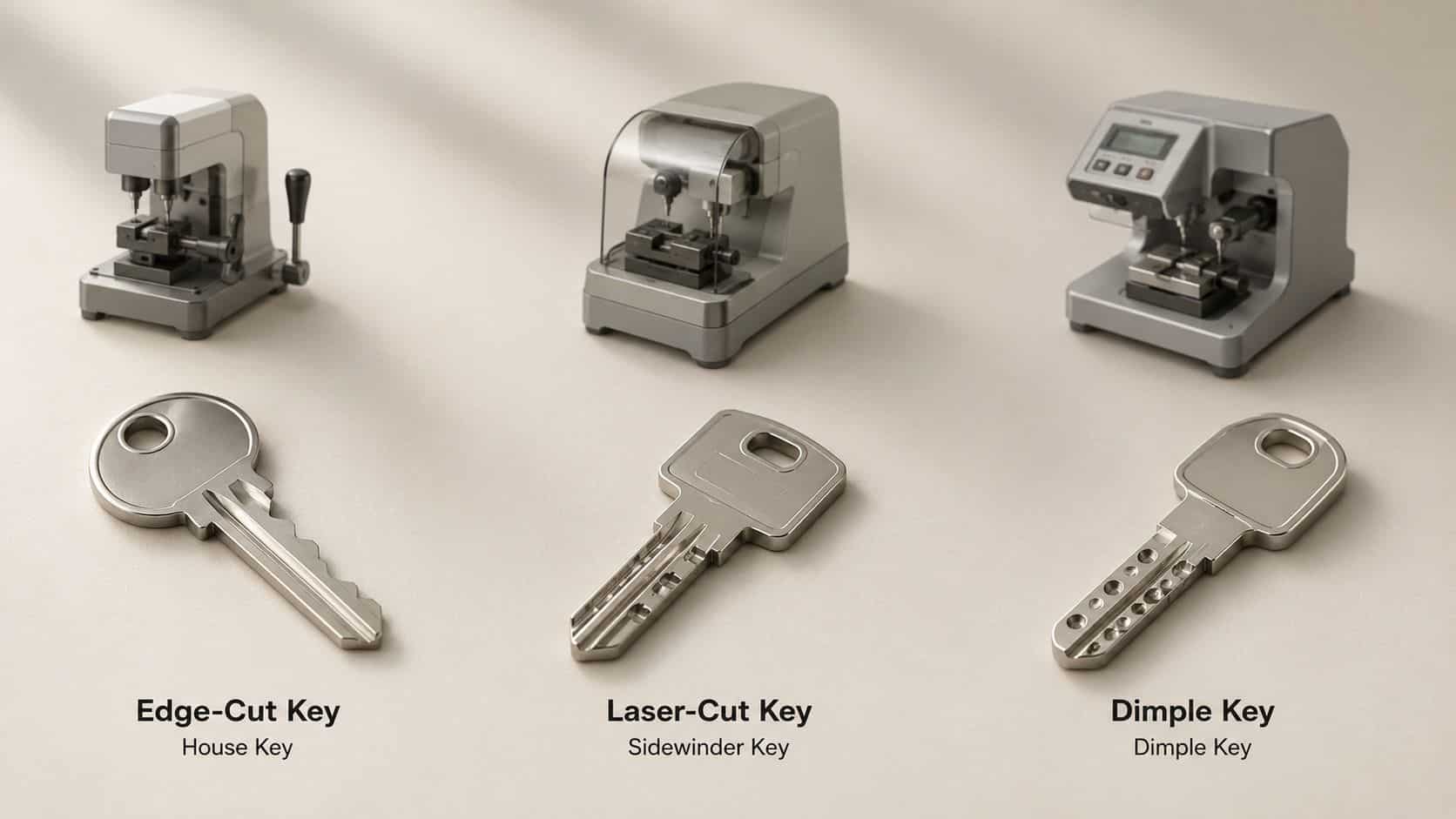
Household edge-cut keys are what most people picture when they think about getting a key cut. They have notches along one or both edges and are typically duplicated on a straightforward machine that traces the original against a guide. It's quick, it's reliable, and for older federation homes around Turramurra with traditional cylinder locks, it's perfectly adequate.
But not all keys work that way, and that's where things get interesting.
Key Types You'll See Locally
- Standard edge-cut house keys — you'll find these on older residential doors and basic cylinders. They're cut on bench-mounted or van-mounted duplicators using a tracer system, nothing too complicated.
- Laser-cut or sidewinder keys — common in modern apartments and plenty of newer cars. Because the cut runs down the centre of the blade rather than along the edge, these need a milling machine or a dedicated automotive cutter. A hardware-store duplicator simply can't handle them.
- Dimple keys — some high-security cylinders use these. Instead of edge notches, they have dimples pressed into the surface, which means they require a precision dimple-cutting machine.
- Tubular keys — those round, hollow-shaft keys you see on vending machines, older commercial furniture, and some bike locks. They need a tubular cutter with a circular milling head to get the profile right.
- Skeleton and warded keys — if you've got antique furniture or older commercial fittings, you might run into these. They're often hand-finished after the initial cut to get things just right.
Not every blank is interchangeable. Using the wrong one is a fast way to ruin both the key and the lock.
Machines and How They Differ
Hardware-store duplicator
- Best for standard edge-cut house keys
- Works by tracing the original and guiding a cutter along the blank
- Handy for quick spares, but limited by blank availability and how tightly the machine holds tolerances
Code-cutting and workshop-grade machines
- Read the bitting numbers directly or pull cutting depths from a database
- Ideal when you don't have the original key, or when you need to originate restricted blanks
- Offer greater accuracy and put less wear on your lock over time
Specialist automotive and high-security machines
- Mill laser-cut keys and handle dimple patterns
- Often paired with programming tools for transponder-equipped vehicle keys
- Necessary for modern apartment keys and most car keys made in the last decade
Key Types and the Equipment Used to Cut Them
Different keys demand different tools. This table gives you a realistic sense of what a hardware store can handle versus when you'll need a locksmith.
| Key Type | Typical Location | Cutting Method |
|---|---|---|
| Standard edge-cut | Older homes, basic cylinders | Bench or van-mounted duplicator |
| Laser-cut / sidewinder | Modern apartments, newer cars | Milling machine or automotive cutter |
| Dimple keys | High-security residential and commercial | Precision dimple-cutting machine |
| Tubular keys | Vending machines, older commercial furniture | Tubular cutter with circular milling head |
| Skeleton / warded keys | Antique furniture, older commercial fittings | Duplicator with hand-finishing |
Practical Examples From the North Shore
- A renter in St Ives with a laser-cut apartment key will usually need a locksmith with a milling cutter rather than a mall kiosk
- A Hornsby small business with a tubular cash-box lock gets a specialist cutter to match the circular profile precisely
- A Turramurra homeowner with older brass keys can often use a duplicator, but if the key is worn we'll recommend originating from the lock or rekeying
When a key must match a master key system or a restricted profile, workshop-grade cutting and correct blanks are essential. Read also our guide to commercial setups for more on matching key systems and equipment Commercial Key Cutting Explained.
Practical takeaway — think of key types as different musical instruments: the player (machine) and the sheet music (blank/profile) both must match for the tune (lock operation) to sound right.
Quality Accuracy and the Security Implications of a Bad Cut
A key that's cut with real precision slides into a lock and turns smoothly — like a well-tuned guitar string hitting the right note every time. A sloppy cut, though, can bind, skip teeth or wear pins down far too quickly, turning what should be a simple spare into a genuine security headache.
Depth tolerances are where good key cutting really lives or dies. If a cutter takes away too much metal at any given notch, the pin stack won't sit right. That might make the lock easier to manipulate, or it might just fail sooner than it should. Either way, small errors in cutting or manufacturing add up to real functional problems down the track.
Cutter sharpness and machine calibration matter just as much as the measurements themselves. A blunt cutter tears through metal instead of shearing it cleanly, leaving rough edges that speed up wear inside the lock. And a machine that's even slightly out of alignment shifts the whole pattern by a fraction — often the exact difference between a key that works smoothly and one that jams.
A precision key is to a lock what a correctly tuned string is to a guitar — tiny mistakes change how the whole system behaves.
What separates a key that merely opens a door from one that actually respects the manufacturer's tolerances comes down to attention to detail. A duplicate from a quick-cut kiosk might get you inside, but it probably won't match the original's exact depths and spacings. A locksmith's workshop-grade setup reads or uses the correct bitting depths and holds blanks securely for repeatable accuracy every single time.
For homeowners, the practical consequences are pretty straightforward. A poorly cut key can:
- Cause binding that makes your door hard to open and eventually damages the lock itself
- Increase wear on pins and springs so the lock needs servicing sooner than it should
- Undermine restricted or master-key systems when copies are made from the wrong blank
Short checklist for quality you can inspect
- Look for smooth insertion and removal with no scraping or resistance
- Test the key several times from different angles to check consistency
- Ask whether the cutter used was van-mounted workshop equipment or a retail kiosk
Table comparing outcomes
| Cut Quality | Usual Source | Security Effect |
|---|---|---|
| Precision cut | Mobile locksmith workshop | Preserves lock life and system integrity |
| Quick duplicate | Mall or hardware kiosk | Works short term; higher wear risk |
If you're on the North Shore, it pays to think long term. Investing in a properly cut spare now saves you from a damaged lock or a forced entry later on. For restricted profiles, master key systems or whenever you're unsure about what you need, call a licensed mobile locksmith like Lock, Stock & Barrel Locksmiths to get an accurate cut and some honest, informed advice. Call us or request a quote for on-site key cutting and lock recommendations.
DIY Key Cutting Versus Calling a Professional Locksmith
Grabbing a quick spare at a hardware kiosk can be tempting — it's fast, cheap, and often done while you wait. For basic edge-cut house keys, a mall or DIY service will usually get you back in minutes.
But there are real limits to that convenience. Kiosk machines trace an original against a guide and rely on having the right blank on the shelf. If the blank doesn't match the keyway or the machine isn't well calibrated, the result can bind or wear the lock over time.
Take a tenant in Killara who needs a third spare after the kids lose theirs — that's a perfect DIY scenario. Standard edge-cut key, original in hand, quick visit to the kiosk. Problem solved without spending much.
On the other hand, a small business owner in Gordon who needs old keys cancelled after a staff change should call a locksmith. This isn't about cutting alone — it's about judgement, rekeying, and the option to upgrade to restricted blanks or a master key arrangement.
What DIY Services Do Well
- Speed and convenience for standard spares — ideal when you have the original key.
- Lower immediate cost for single, non-restricted keys.
- Handy for simple household needs like a spare for a neighbour or in-law.
When DIY Risks Costlier Problems
- Wrong blank or poor calibration can jam a lock or increase wear.
- No advice on whether the lock itself is deteriorating or compromised.
- Restricted, dimple, laser or master-key systems usually aren't supported by retail kiosks.
A well-cut key preserves lock life; a poor duplicate can be the start of real lock problems.
Practical Rule Of Thumb
- Use DIY for basic spares when you have the original and the key is a common edge-cut type.
- Call a licensed mobile locksmith for lost keys, restricted profiles, master-key setups, rekeying after staff changes, or whenever security is a concern.
Numbered steps for choosing the right path
- Identify your key type and whether you have the original.
- If it's a restricted or modern laser-cut key, contact a locksmith.
- If you're unsure about lock wear or need access control, call a pro for advice and on-site service.
A locksmith brings judgement as much as tools — we can rekey, recommend higher-security upgrades, or cut on-site with van-mounted equipment. If you'd like a reliable on-site cut or to discuss rekeying and master keys, call Lock, Stock & Barrel Locksmiths or request a quote via our Key Cutting Services page.
When to Call a North Shore Mobile Locksmith for Key Cutting
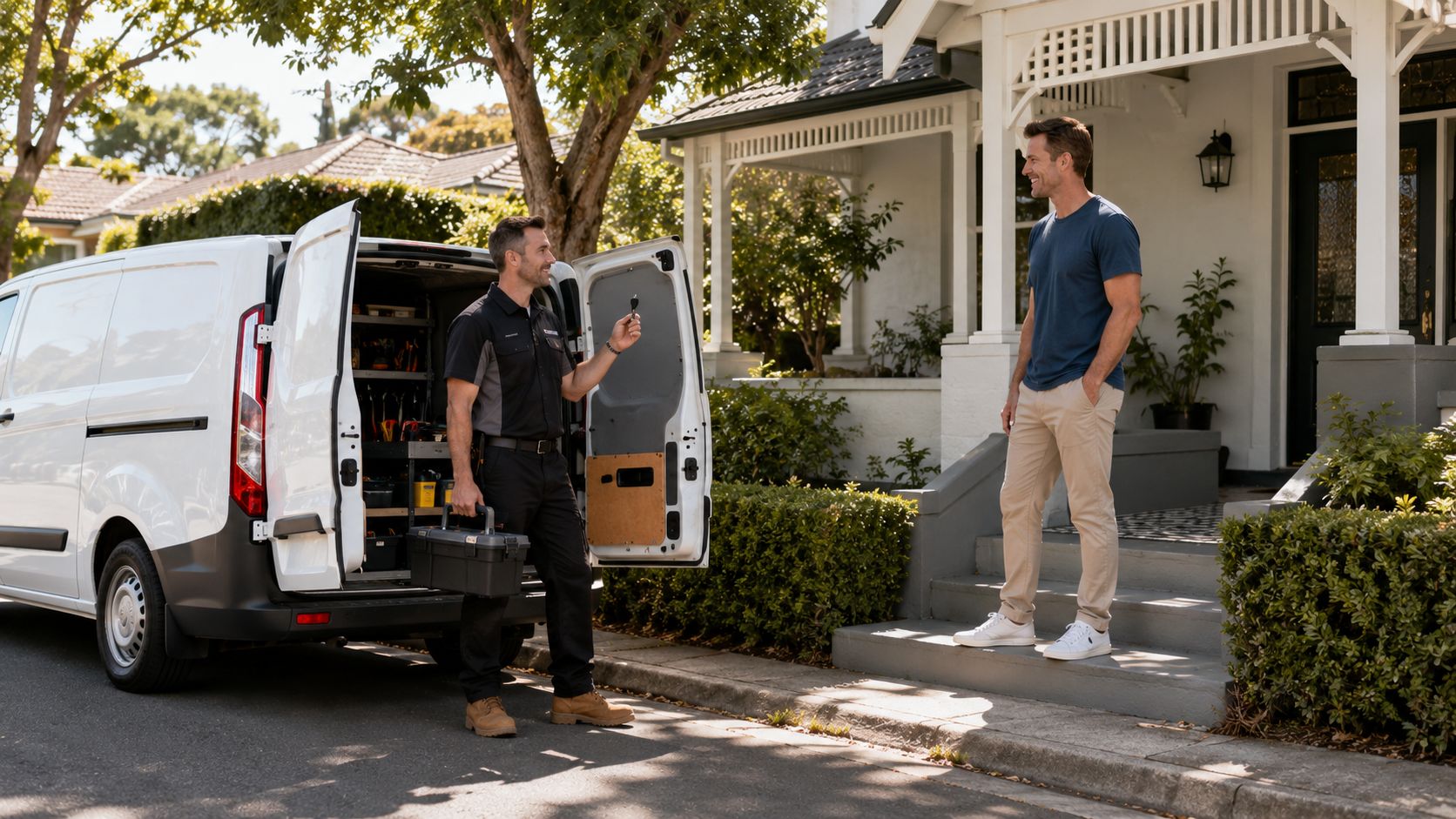
Everyday key problems on the North Shore often need more than a quick trip to the mall. If you're locked out after hours, have lost your only copy, or moving into a place where who-knows-how-many keys are floating around, a mobile locksmith brings the right tools and judgement straight to your door. That usually means a faster, safer fix than a self-service kiosk ever could.
Think about it — an after-hours lockout in Hornsby or Turramurra isn't just about cutting a new key. It's about getting someone there who can handle the entry safely and cut a working key on the spot, no shop visit required. And if a key has been lost or stolen, you're not just replacing it — you're rekeying the lock so those old copies become useless metal. That's a job that really wants a licensed locksmith's hands.
If security matters, get the job done properly on-site rather than hoping a quick duplicate will be enough.
Buying a home anywhere on the North Shore? Rekeying before you move in is one of those things that removes any nagging doubt about who else might still have a key. Same goes for strata or multi-tenanted buildings — managers often need a master key setup so they can control access without handing the same key to every tenant.
When Mobile Service Works Best
- Emergency lockout after hours — the locksmith attends with van-mounted equipment and cuts a working key on-site
- Lost or stolen key — includes rekeying so old keys no longer open the door
- New home purchase — rekey and fresh keys for total peace of mind
- Master key setups — design and implement access hierarchies for multi-tenant sites
- Compliance-driven work for strata — window safety devices and common-area keying done during the same visit
What We Do On Site
- Assess the lock and key type, then select the correct blank
- Use calibrated van-mounted or workshop-grade machines to cut or originate the key
- Test the new key in the lock and advise on any further security improvements worth considering
For local readers, Lock, Stock & Barrel Locksmiths run a mobile service across suburbs including Turramurra, Hornsby, Gordon, Killara, St Ives, Pennant Hills, Thornleigh, Berowra, Pymble and Wahroonga. We handle master key systems, rekeying, safe installation and window safety devices as part of the same on-site workflow. All work is carried out under NSW Police licensing and our Master Locksmiths credentials.
Calling a licensed mobile locksmith protects both your property and your insurance position when security changes are needed.
Read also: Learn more about our emergency mobile service and why it helps North Shore residents in our guide Emergency Locksmith Services And Mobile Benefits
If your situation fits any of the examples above, call Lock, Stock & Barrel Locksmiths for an on-site key-cutting visit or request a quote for rekeying and master key work.
Frequently Asked Questions About Key Cutting on the North Shore
How long does a typical key cutting job take when a locksmith attends your North Shore home?
For a standard edge-cut house key, a mobile locksmith can usually cut and test a key on-site in a few minutes once the correct blank is chosen. More complex jobs — think laser-cut keys, dimple keys, or originating a key from scratch — take longer and may be completed in the van or returned to the workshop for final finishing. The takeaway? Simple spares are fast, but specialised work needs extra time for accuracy.
Can every key be copied by a locksmith or a kiosk?
Most common house and padlock keys are easily duplicated. Restricted keys, manufacturer-only profiles, and many modern automotive keys may be protected or require specialist equipment. If a key is part of a restricted system, you'll often need a licensed locksmith with the correct blanks and paperwork rather than a mall kiosk.
What does rekeying mean and how does it differ from cutting a new key?
Rekeying changes the internal pinning of an existing lock so old keys no longer work. Cutting a new key simply creates a duplicate for the current pinning setup. Rekeying is a security measure you'd use after losing a key or moving into a new place; cutting a key is just convenience when you need spares.
Can a locksmith come to my home or business or do I need to travel to a shop?
Licensed mobile locksmiths serve North Shore suburbs and will cut many keys on-site using van-mounted, workshop-grade machines. For jobs needing specialist machines or a wider stock of blanks, the locksmith may finish the work in the workshop and return the finished key. This flexibility keeps downtime low for households in Turramurra, Pymble or St Ives, and for businesses in Hornsby or Gordon.
Will a newly cut key damage my lock if it's not perfect?
A poorly cut key can bind and increase wear on a lock's pins and springs over time. That's why precision, cutter sharpness, and correct blank selection matter — a properly cut key preserves lock life and system integrity.
When should I call a mobile locksmith instead of using a DIY service?
Call a locksmith for lost or stolen keys, rekeying after tenancy changes, master-key setups for multi-tenant buildings, or when dealing with restricted or laser-cut keys. A kiosk is fine for single, common edge-cut spares when you have the original and security isn't a concern.
For reliable, on-site key cutting and informed advice, call a licensed mobile locksmith who understands North Shore hardware and access needs.
If you want an accurate on-site cut or a quote for rekeying and master-key work, call Lock, Stock & Barrel Locksmiths or request a quote at https://lsblocksmiths.com.au.