- 24 Hour Emergency Services
- Servicing Sydney's North Shore
- View On Map

-
Mail Us On
info@lsblocksmiths.com.au
-
Make a Call
0411 700 072
- View On Map
- 24 Hour Emergency Services
- Servicing Sydney's North Shore
- View On Map
-
Mail Us On
info@lsblocksmiths.com.au
-
Make a Call
0411 700 072
- Contact Us
Door Lock Cylinder Repair on the North Shore

Lock, Stock & Barrel Locksmiths
On August 1, 2026
A front door that only plays nice when the key is jiggled, pulled halfway out, or turned with the door open is never just an annoyance. On Sydney's North Shore, that usually means someone is standing at the door after work, groceries in hand, wondering whether the key is bad, the cylinder is tired, or the door has shifted a few millimetres and thrown the whole lock out of line.
That distinction matters. Door lock cylinder repair is often a straightforward component job, but the wrong diagnosis can send good money after the wrong fault. A clean cylinder can still feel rough if the key is worn, and a perfect cylinder can still bind if the latch and strike plate no longer meet squarely.
When a Cylinder Starts Playing Up on the North Shore
A common North Shore call-out starts the same way. A homeowner in Wahroonga turns the key in the front door, it moves part way, then stops. In Hornsby, a tenant might report that the lock was fine in the morning, but by evening the key feels gritty and the deadbolt won't return cleanly.
The first instinct is often to blame the cylinder itself. Sometimes that's right. Sometimes the issue sits in the door, the frame, the latch, or even the key that's being used every day.
The three places the fault usually lives
Most ordinary cylinder complaints fall into three buckets, the key, the cylinder, or the door and frame. A bent or worn key can mimic a broken lock. Dirt or light corrosion can make a healthy cylinder feel seized. Misalignment between the door, latch, strike plate, and frame can make the whole assembly act faulty when the cylinder itself is still serviceable.
That's why this job starts with triage, not tools. If the problem is the door or frame, cylinder work won't fix it. If the key is the problem, a new cut key can solve it far more cheaply than disturbing the lock hardware.
Practical rule: if the key turns only when the door is open, treat alignment as the first suspect, not the cylinder.
For homeowners and strata managers, that split is the whole game. Cylinder repair is usually a component-level fix, while frame or door damage moves the job into a very different repair band. Mobile locksmiths on the North Shore commonly try to restore function on site before the issue gets escalated to a carpenter or builder, because that keeps the fault targeted and the repair sensible.
The rest of the job only makes sense if the symptom points to the cylinder or the key. If the door is visibly dragging, the latch misses the keeper, or the lock only behaves with the door open, the cylinder may be innocent.
Reading the Symptoms Before Touching the Lock
A good diagnosis saves time, parts, and frustration. A bad one usually means someone sprays the wrong product into the lock, forces a key, and makes the fault worse. The first check is simple, close the door, then test the lock again with the door open.
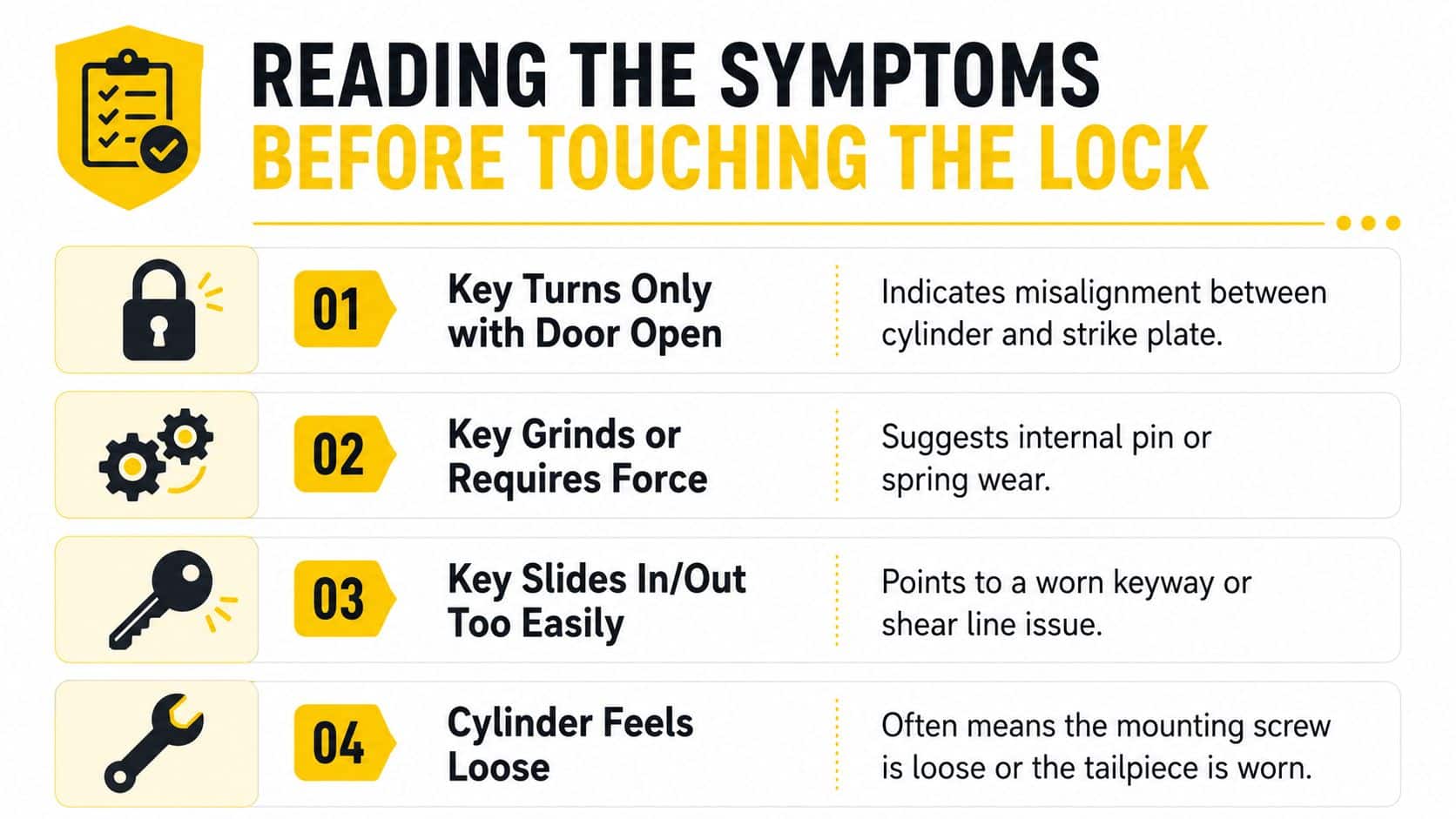
What the symptoms usually mean
A key that only turns when the door is open usually points to misalignment between the latch, strike plate, and frame. The cylinder may still be fine, but the door is putting it under stress. A gritty or sticky key more often suggests dirt or light corrosion inside the cylinder, while a key that won't withdraw cleanly after turning usually points to worn pins or a tired cylinder body.
A key with visible wear is its own warning sign. If the cuts are rounded off, uneven, or obviously damaged, the lock may be doing exactly what the worn key is asking it to do. In that case, the cylinder can look faulty when the key is really the weak link.
The door-open test matters
The door-open test is the quickest screen available. If the key works smoothly with the door open but binds when the door is closed, that's a strong sign the issue sits in the door geometry, not the cylinder. A quick tidy-up of the lock won't solve that.
Spraying lubricant into a misaligned door only hides the real problem for a short while, then leaves residue where it doesn't belong.
That's where misdiagnosis gets expensive. A homeowner can waste time chasing a cylinder fault that isn't there, or keep using a key that's chewing up a healthy lock. When the symptoms point cleanly to one of those three causes, the next step becomes obvious, and the repair path gets much simpler.
Tools and Parts Worth Having on Hand
Basic cylinder servicing doesn't need a workbench full of specialist gear. For a straightforward residential job, the practical kit is small and familiar, a Phillips driver, a flat driver, a 2.5 mm or 3 mm Allen key where the hardware uses one, a torch, a soft keyway brush or a strip of cut plastic card, a clean lint-free cloth, and dry graphite or PTFE-based lock lubricant.
The lubricant choice matters more than you might think. Do not use oil-based products in the keyway. Oil tends to hold dust and grime, then the pins start dragging again. A dry lubricant leaves less residue and suits the kind of cleaning work that belongs in a lock cylinder.
What pushes the job beyond DIY
Once the job starts needing pinning kits, follow-up tools, calipers for measuring cylinder backset, or original-spec replacement pins, it has crossed into locksmith territory. Those are the tools that let a tradesperson measure, repin, and match hardware properly. They're not the same thing as a quick service wipe and lube.
A homeowner can do the first layer of maintenance with a small bag of hand tools. A locksmith arrives with the parts and measuring gear to decide whether the cylinder is worth saving, whether it needs rekeying, or whether the safer call is a straight swap.
For a North Shore home, that's the difference between a basic service and a proper trades response. Lock, Stock & Barrel Locksmiths offers lock repair and lock installations and repairs, which is the kind of work that covers cylinder faults without pretending every sticky lock needs a full replacement.
A simple readiness check
Before starting, make sure these are on hand:
- Dry lubricant only: graphite or PTFE, not WD-40, not engine oil, not cooking spray.
- Cleaning supplies: alcohol, a cloth, and a brush that won't shed.
- Suitable screwdrivers: the right driver prevents stripped screws and damaged escutcheons.
- Light source: lock faults hide in poor light more often than they should.
If those items aren't enough to resolve the problem, the cylinder is probably telling a deeper story.
Cleaning, Lubricating and Key Fit Checks
The safest, highest-payoff work happens before any disassembly. Start with the key itself. Wipe it with a cloth dampened with a quick-drying solvent such as isopropyl alcohol, then dry it fully before it goes back into the lock.
The right cleaning sequence
The keyway gets the same calm treatment. A small amount of solvent into the cylinder, then the key goes in and out and turns gently to work loosened debris free. After that, apply dry lubricant, not oil, then cycle the lock again so the powder or PTFE reaches the moving parts. A reputable maintenance guide recommends cleaning the keyway with a quick-drying solvent, blowing out debris, then relubricating with a lock-specific dry lubricant rather than an oil-based product, which is the right order for a sticky cylinder. See the practical maintenance notes in this lock care guide.
Cycle the repaired or cleaned lock 5 to 10 times before calling it done. That final test shows whether the pin and cam movement has settled properly, or whether the fault is still hanging around.
Checking the key, not just the lock
A worn key can fool even a healthy cylinder. Lay the key flat against a ruler and look for uneven cut depth or rounded shoulders. Hold it beside a known good copy if one exists, and look for daylight where the cuts should match.
If there's a spare key, try it. If the spare works cleanly and the original doesn't, the problem isn't the cylinder. That's the sort of thing that saves a homeowner from paying for hardware that didn't need changing.
A key that's slightly worn can feel like a broken lock long before the cylinder is actually tired.
This is also where small parts decisions matter. A key cut is a minor fix. A cylinder swap is a hardware decision. Treating them as the same job leads to unnecessary cost and, in some cases, a lock that still doesn't feel right after the repair.
Removing, Servicing and Reassembling the Cylinder
Once the symptom points to the cylinder rather than the door, the euro-style workflow is fairly orderly. Open the door fully, insert the key, and rotate it slightly, often around 45 degrees, so the cam aligns and the cylinder can be withdrawn. Then remove the edge-retaining screw on the door face and slide the cylinder out from the side. One practical guide on cylinder changes describes that same basic sequence, key in, slight turn, retaining screw out, cylinder out from the outside, which is the standard approach for many euro profiles. The same kind of step-by-step hardware advice is set out in this cylinder removal guide.
What the bench inspection should show
Once the cylinder is out, the assessment begins. A bench-strip should reveal whether the pins are scored, the springs are flattened, the body is pitted with corrosion, or the cam feels loose. Light dirt and mild corrosion can sometimes be cleaned. Flattened springs, cracked components, or repeated sticking after cleaning usually point toward replacement.
A cylinder that has a damaged internal stack often doesn't deserve a long argument. If the keyway has wear but the body is sound, a rekey or repin may be enough. If the body itself is damaged, replacement is cleaner and usually more dependable.
Reassembly details that matter
On the way back in, fit matters. The replacement cylinder should sit flush or no more than 2 to 3 mm proud of the escutcheon so the lock isn't left exposed. That small gap also helps preserve the correct fit at the door face.
After the screw goes back in, test the cylinder several times before handover. Turn the key, lock, and check that the cam and pins are engaging smoothly. If the action is rough at the bench, it'll still be rough in the doorway.
For a broken key that has snapped inside the lock, the cylinder can need a different form of attention altogether, which is why a proper diagnosis matters before anyone starts forcing the hardware. This note on broken keys in locks is worth keeping in mind when the fault starts with the key rather than the body.
When Repair Stops Making Sense and Replacement Wins
Not every cylinder is worth nursing back. Age is the first filter. Common residential hardware often lasts 7 to 10 years, and a typical cylinder service life benchmark is 10 to 12 years, which is roughly 10,000 locking cycles over about ten years at 2 to 3 cycles per day according to industry guidance on hardware lifespan (locksmith industry statistics). Once a cylinder is operating in that range, repeated faults usually mean the internal parts are wearing together.
The fault type tells the truth
Some faults are repairable. Dirt, mild corrosion, and simple sticking are the good candidates. Other faults are not. Snapped pins, a loose cam, a cracked cylinder body, or a fault that comes back after servicing are all signs that replacement is the smarter move.
That's especially relevant on rental doors and shared entries in places like Gordon, Killara, and Pennant Hills, where keys get used constantly and the cylinder may have seen more life than it first appears to have had. The lock can look fine from the outside and still be near the end of its useful service life.
Cost and risk need to be weighed together
Sydney pricing guides don't give one fixed national tariff, but they do show the shape of the decision. One current guide puts a lock cylinder replacement at $40 to $120 per lock, while another estimator places a door lock cylinder replacement at $266 to $308, with $89 to $131 attributed to labour and about $177 to parts (cost guidance). That range is often easier to justify than a second or third service call on a cylinder that keeps playing up.
If the lock has already failed twice in a year, replacement usually starts to look cheaper than repeated attention.
A clean way to decide is simple. If the fault is light contamination, try repair. If the cylinder is old, cracked, corroded, or keeps binding after service, replace it. A mobile locksmith can usually restore function on site without dragging the job out over a weekend, and that matters when the door still needs to be secure tonight.
Lock, Stock & Barrel Locksmiths' cylinder lock replacement service fits that sort of job when a repair no longer makes commercial sense.
Keeping Cylinders Healthy and Knowing When to Call
Good cylinder care is quiet and repetitive. Clean the keyway, use dry lubricant, cycle the lock, and keep an eye on the key before it becomes the thing that damages the lock. For doors that get heavy daily use, a longer check every couple of years makes more sense than waiting for a hard failure.
Why maintenance matters beyond convenience
On NSW properties, reliable hardware isn't just about comfort. Strata by-laws, building expectations, and insurer attitudes all tend to favour locks that have been maintained rather than ignored until they fail on a Saturday night. A cylinder that operates cleanly and a door that closes squarely are a better story than an emergency-only maintenance record.
The practical habit is simple:
- Clean regularly: wipe the key and clear the keyway.
- Lubricate lightly: use dry lubricant only.
- Cycle the lock: check for smooth engagement before it sticks.
- Watch the key: replace worn keys before they chew the cylinder.
When a locksmith should take over
The handover point is usually obvious. If the diagnosis points to misalignment, if the key is visibly damaged, if the cylinder has failed twice in 12 months, or if there's no correct pin kit on hand, the job is out of DIY territory. That's when a licensed North Shore locksmith earns the call-out fee by fixing the actual fault instead of guessing at it.
Lock, Stock & Barrel Locksmiths covers Turramurra, Hornsby, Gordon, Killara, St Ives, Pennant Hills, Thornleigh, Berowra, Pymble and Wahroonga, and the work includes cylinder repair, replacement, rekeying, and the kind of lock servicing that keeps ordinary doors working as they should.
If the front door key is sticking, turning roughly, or only working when the door is open, Lock, Stock & Barrel Locksmiths can sort the diagnosis and tell the difference between repair, rekeying, and replacement. For a straight answer and a quote on a North Shore cylinder fault, visit Lock, Stock & Barrel Locksmiths and book a mobile locksmith who knows the local hardware and the local building stock.