- 24 Hour Emergency Services
- Servicing Sydney's North Shore
- View On Map

-
Mail Us On
info@lsblocksmiths.com.au
-
Make a Call
0411 700 072
- View On Map
- 24 Hour Emergency Services
- Servicing Sydney's North Shore
- View On Map
-
Mail Us On
info@lsblocksmiths.com.au
-
Make a Call
0411 700 072
- Contact Us
Door Lock Replacement Parts: A Complete Reference Guide

Lock, Stock & Barrel Locksmiths
On August 9, 2026
The first sign is usually small. A front door starts needing a second push, a lever feels loose, or a keyed entry only works if the door is lifted slightly on the latch side. In apartments and strata buildings, the same problem often shows up as repeat call-backs, because one worn part keeps dragging the whole lockset out of alignment.
That is where door lock replacement parts matter. A lock is not one solid piece, it is a set of working components, and each one can fail on its own. The practical job is to find the failed part, measure it correctly, and replace only what still makes sense to keep, without turning a simple repair into a full lockset change for no reason.
Understanding Door Lock Replacement Parts
A typical call-out starts with a description, not a diagnosis. Someone says the handle is spinning, the key feels rough, or the door won't latch unless it's slammed shut. The fault is often smaller than the symptom, and that's why a proper check matters before any parts are ordered.
Door hardware is built from discrete components that fail independently, including the cylinder, latch, strike plate, handle or doorknob, spindle, and keyhole. The spindle is the rod that links the handle or knob to the lock mechanism, so a handle that turns without moving the latch often points to a spindle-related issue rather than a failed lock body. That difference saves time, money, and a lot of avoidable drilling.
A repair job starts with the symptom, not the brand
A worn latch can make a perfectly serviceable lock feel broken. A bent strike plate can make the key seem at fault. A stripped screw in the frame can mimic deeper hardware failure.
Practical rule: if the door still fits the frame properly, the failed part is often local to the hardware, not the whole opening.
For homeowners, that usually means a targeted repair. For strata managers and facilities teams, it means one site visit can often restore function without replacing every part on the door. The difference is in diagnosis, not guesswork.
The basic maintenance approach also matters. Lock, Stock & Barrel Locksmiths' door lock maintenance guide is relevant because regular inspection tends to catch loose fixings, worn latches, and alignment issues before they become security problems. That is especially useful in occupied homes, rentals, and common property where downtime is a nuisance and a compliance risk.
Common Door Lock Components and Their Functions
A lot of confusion starts because the visible parts are only half the system. The lever, rose, and key cylinder may be what people notice first, but the working security comes from the way those parts move the latch and engage the frame. If any one of them is out of shape, the whole door can feel unreliable.
What the main parts actually do
- Cylinder: This is the keyed part. If the key sticks, grinds, or turns inconsistently, the cylinder may be worn, contaminated, or damaged.
- Latch: This is the spring-loaded piece that keeps the door shut. A sticky or slow latch usually points to wear, dirt, or poor alignment.
- Strike plate: This is the metal plate fixed to the frame that receives the latch. A bent or cracked strike can stop clean engagement and weaken the door's resistance to force.
- Handle or doorknob: This is the user interface. A loose lever can hide internal wear, but it can also need tightening.
- Spindle: This rod connects the handle to the lock mechanism. When the handle turns but the latch doesn't move, the spindle is a likely suspect.
- Escutcheon: This is the trim plate around the lock or cylinder area. It's often overlooked, but it matters for fit, concealment, and finish consistency.
- Deadbolt: This adds a separate locking action from the latch. If the bolt throws poorly, the problem may be in the bolt edge, the strike, or the lock case itself.
A strike plate isn't decorative. If it's cracked, bent, warped, or stripped at the screws, the latch can't be trusted to seat properly.
Visual inspection helps, but it shouldn't stop there. Wear often appears as polishing on the latch face, screw holes that no longer hold, or a lever that feels sloppy even before failure becomes obvious. The point is to catch the part that's failing, not just the part that looks worst.
What symptoms usually point to which part
- Handle turns freely: often spindle or internal coupling wear.
- Key works only after jiggling: often cylinder or key wear.
- Door bounces open: often strike alignment or latch depth.
- Latch won't spring back cleanly: often latch body wear or dirt.
- Metal is visibly bent or cracked: usually a replace-now sign, not a repair candidate.
Critical Measurements for Replacement Part Compatibility
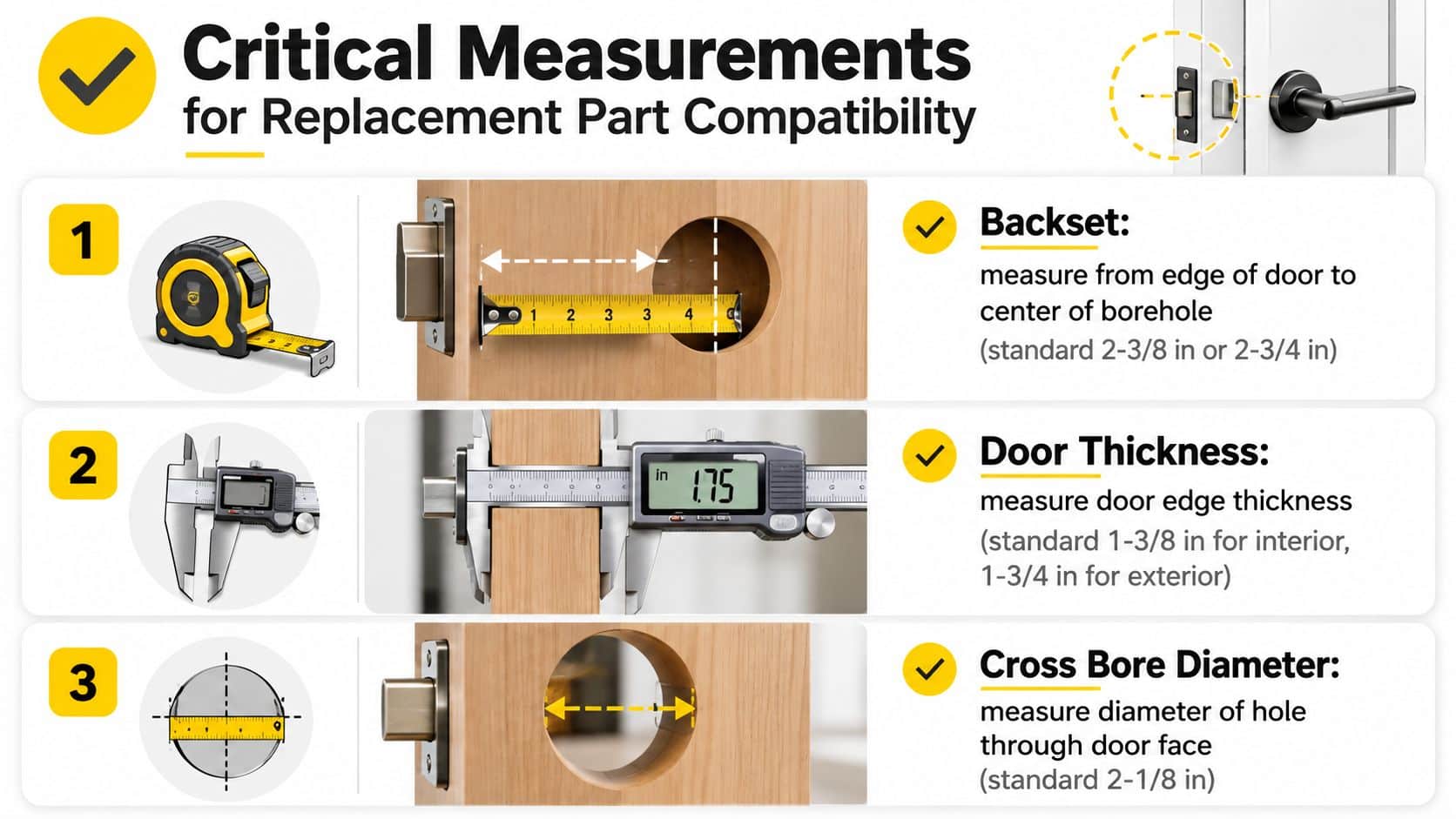
The wrong part usually looks right until it's on the door. That's why replacement work starts with measurements, not a shopping cart. In Australia, fitment depends on the prepared opening, the lock case, and the geometry of the hardware, not just the name on the handle set.
The three measurements that matter most
Backset is the distance from the edge of the door to the centreline of the lock. Industry documentation commonly refers to 2-3/8 inch or 2-3/4 inch backsets, and many locksets also need a 1 inch latch bore to suit the mechanism (Schlage's door hardware terms guide). If the backset is wrong, the latch won't meet the strike correctly, even if the lock looks close enough to fit.
Door thickness matters because the spindle, screws, and trim need to span the door properly. A part that works on a slim internal door can fail badly on a heavier external leaf. That's where installers check the door before they check the catalogue.
Centre-to-centre spacing matters on mortice and lever hardware. Australian product catalogues also reference EN 12209-aligned hardware and 85 mm centre-to-centre spacing for some mechanical lock families, which helps match the case and trim as a tested set. When those dimensions are ignored, installers often end up with binding, misalignment, and premature wear.
What goes wrong when measurement is skipped
- Poor bolt retraction: the part is close, but not aligned enough to move freely.
- Latch drag: the strike or bore geometry is off, so the latch scrapes instead of entering cleanly.
- Excess wear: parts keep hitting at an angle, which chews through springs and edges faster.
- Handing mismatch: the lever or trim is oriented the wrong way for the door.
The best practice is simple. Verify the backset, door thickness, and centre-to-centre spacing, then confirm the lock case standard and lever handing before ordering anything. That order matters because a visually similar replacement can still be mechanically wrong at the point of install.
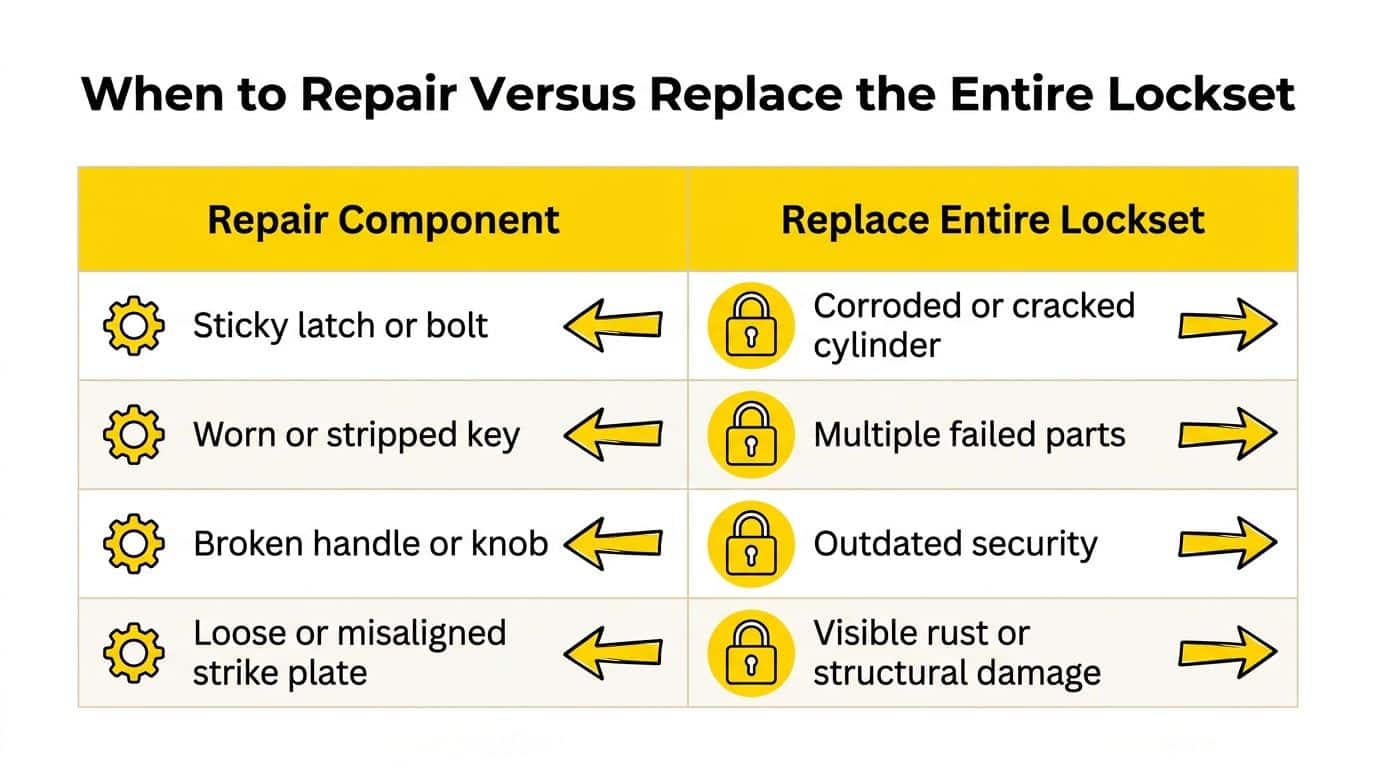
When to Repair Versus Replace the Entire Lockset
A lot of doors don't need a full lockset. They need one worn part, one adjustment, or one alignment fix. The harder question is knowing when the hardware has crossed the line from repairable to tired enough that replacement is the safer decision.
Repair makes sense when the failure is local
A sticky latch, a loose handle, or a misaligned strike plate usually points to a specific component rather than the whole lock. Those faults are common in occupied homes and apartments where doors move, screws loosen, and parts wear at different rates. If the lock case is sound and the key function is still clean, component replacement usually preserves more of the existing setup.
The same applies when the part is easy to isolate. A worn spindle, for example, can be swapped without disturbing the rest of the door furniture if the model is still supported. That is a better outcome than replacing a serviceable case because one small internal rod has fatigued.
Replace the full lockset when the fault is systemic
Corroded cylinders, cracked bodies, and visible structural damage are different. So are multiple failed parts on the same door. When several components are worn together, the repair starts costing security, not just money.
A coastal or weather-exposed property often shows this earlier, especially where salt air, frequent use, and settling frames all stack up. Suburban homes can have the same issue after years of heavy door movement, particularly on entry doors used all day.
If the cylinder, latch, and strike are all tired at once, the lockset is usually telling a bigger story than any single part can fix.
For a homeowner or property manager, the decision comes down to three questions. Is the failure isolated? Does the remaining hardware still offer proper security? Will the repaired setup stay reliable for normal use, or does it just postpone the same call-out?
Some jobs sit right on the line. In those cases, Lock, Stock & Barrel Locksmiths' cylinder replacement page is a useful reference point because cylinder wear is one of the first signs that a repairable lock is turning into a replacement case. The key is to keep the answer mechanical, not sentimental.
Compliance Requirements for Strata and Rental Properties
In strata and rental work, the lock isn't just hardware. It's part of a building's safety and access system, and the wrong replacement can create a compliance problem even if the door still closes. That's why property managers need to think about more than finish and price.
NSW has had a major compliance driver in place since 13 March 2018, when residential strata schemes were required to fit compliant window safety devices for opening windows above a prescribed height (NSW compliance timeline reference). The practical effect is ongoing demand for replacement parts in apartments and strata buildings, because devices, locks, restrictors, and related safety hardware need servicing when parts wear out, are damaged, or no longer pass checks.
Why this changes the replacement decision
A landlord or strata committee can't treat hardware like a cosmetic upgrade. If the part affects child safety, access control, egress, or documented building compliance, the replacement has to preserve the original function. That makes the primary question, “Can this exact part be changed and still keep the door compliant?”
For apartments and managed premises, the answer often depends on record-keeping. A part change should be documented clearly enough that the next inspection can confirm what was installed, where, and why. That matters for insurance, maintenance logs, and handover between owners or managers.
What property managers should verify before approving work
- Safety function: confirm the part still supports the required use of the opening.
- Fit and form: check that the replacement matches the prepared opening and the existing lock case.
- Servicing history: look at whether the same fault has already appeared more than once.
- Documentation: keep the part reference, the location, and the date of replacement on file.
Australian building practice treats hardware as part of the life-safety picture, not a simple swap of broken pieces. In North Shore apartments, where strata oversight is common, that distinction matters every time a cylinder, latch, strike, or restrictor is replaced.
Sourcing the Correct Replacement Part Number
A part can look right and still be wrong at the counter. That's why replacement lock parts are ordered by more than style, and why the part number matters so much. Two components with similar profiles can still belong to different case families.
Start with the exact lock model
The lock case model is the cleanest anchor point. Once that's known, the matching parts become easier to narrow down, especially for latches, strikes, and spindle assemblies. If the model isn't visible, the old part usually tells more than the handle trim does.
Part numbers should be specified when ordering replacement parts, because visual similarity doesn't guarantee mechanical compatibility (part-number reference). That becomes important on mortice hardware, where the case geometry and trim stack-up need to stay matched.
Match the part to the lock's tested geometry
A quality replacement job keeps the original system intact. That means the strike family stays the same, the spindle section and length suit the lever set, and the replacement latch belongs to the exact case model rather than a universal range. Universal-fit parts often create more filing, more adjustment, and more wear than they solve.
Australian commercial hardware catalogues also reference EN 12209-aligned mortice locks, which is a useful sign that the hardware is meant to live inside a defined ecosystem rather than a mixed bag of parts. The same logic applies to strike geometry, where the part has to match the door and frame prep instead of being forced into place.
Good sourcing saves the installation twice, once at the bench and again on the door.
That's why a locksmith will usually check the old part, the opening, and the case model before placing an order. It's slower than guessing, but much faster than revisiting a door that was fitted with the wrong hardware.
Strike Plate Selection and Installation Best Practices
The strike plate does more work than many realise. It catches the latch, strengthens the frame side of the opening, and helps stop the door being forced open through the latch edge. If the strike is damaged, the whole lock feels unreliable even when the main case is fine.
When a strike plate needs replacement
A strike plate should be replaced if it's cracked, bent, warped, or has stripped screws. Those faults usually mean the part no longer holds the latch in the right position or no longer anchors securely to the frame. A compromised strike can make the door feel sticky, noisy, or loose, and it can also reduce the lock's resistance to force.
The strike plate also needs to match the latch shape and size. It's not a universal part. If the opening is too tight, the latch drags. If it's too loose, the door can rattle or fail to latch cleanly.
Getting the lip offset right
For retrofits, strike depth and lip offset matter just as much as the plate face. A major manufacturer's specification notes that strike geometry is supplied to ANSI A115.1 standards and that the lip-to-centre length should be calculated from door thickness using door thickness ÷ 2 + 0.375 inch (10 mm), rounded to the nearest available size (Baldwin strike specification). That formula matters because the wrong offset creates latch drag and accelerates failure.
What good installation looks like
- Tight fixing: screws bite firmly into sound timber or reinforced substrate.
- Clean alignment: the latch enters the strike without scraping the edges.
- Matched profile: the strike suits the latch shape, not just the door colour.
- Stable depth: the plate sits flush enough that the latch can seat consistently.
A well-set strike extends the life of the latch and the spindle because the door stops fighting the hardware. A poor strike does the opposite, it turns every close into a small impact test.
Quick Reference Guide for Common Replacement Scenarios
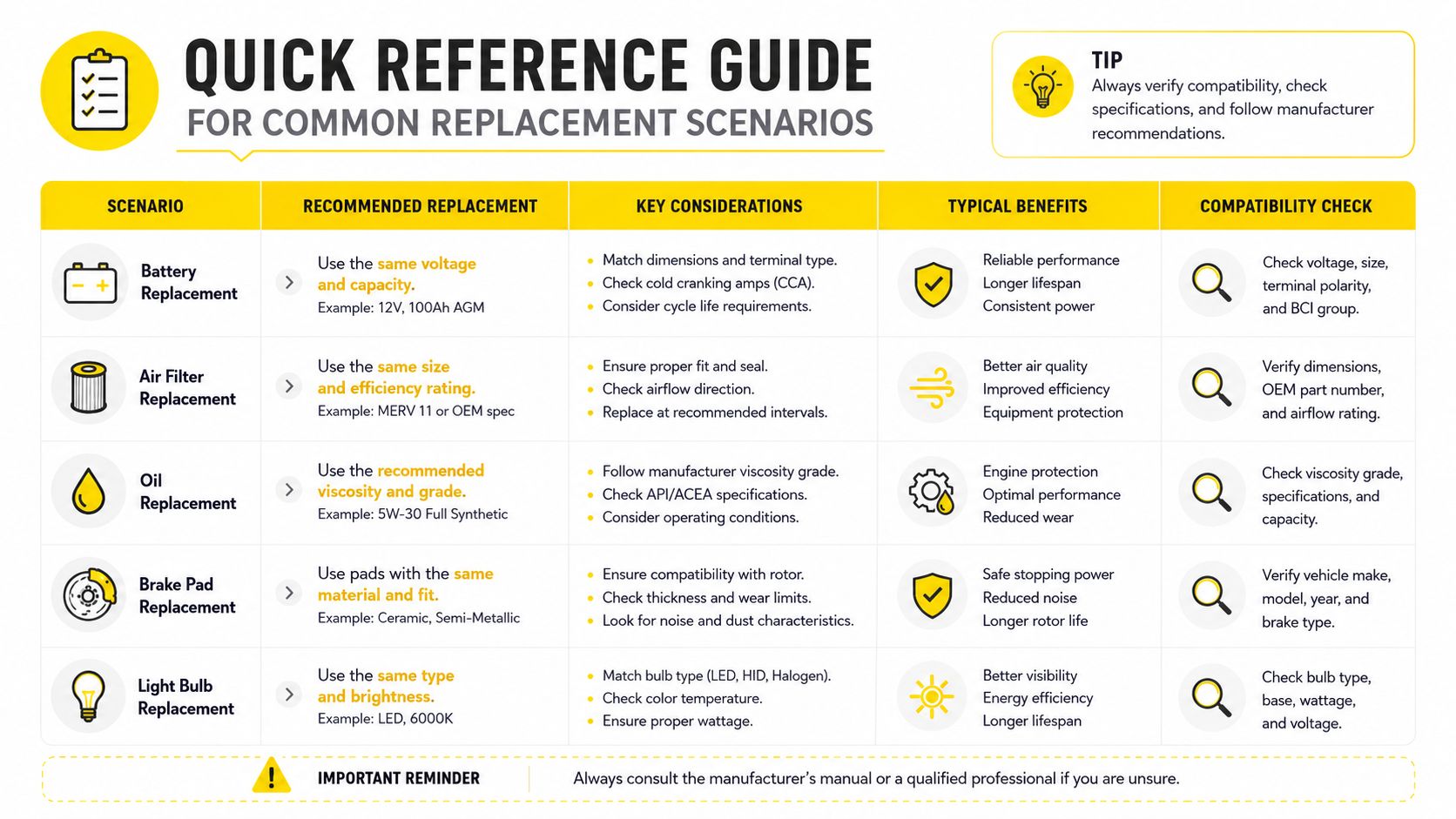
A lock problem is easier to sort out when the symptom points to one part, one adjustment, or one full replacement. That saves time on site, and it reduces the chance of buying hardware that looks right but fails in the door.
Quick diagnosis by symptom
- Handle turns, latch doesn't move: the spindle or handle fixing is the first place to check.
- Key is stiff or inconsistent: inspect the cylinder, the key, and any debris in the keyway.
- Door won't close smoothly: check the strike, latch position, and door alignment together.
- Lever feels loose but still works: tighten fixings before assuming the whole set needs replacing.
- Visible damage on the frame side: treat the strike, screws, and surrounding timber as the priority.
- Door latches only if lifted or pushed: the issue is usually alignment or worn internal parts, not the trim.
Quick decision matrix
- One part has failed, the rest is sound: repair the failed component.
- The lock works, but operation is rough: correct the alignment, then reassess wear.
- Multiple parts are worn or corroded: replace the lockset rather than chase one fault at a time.
- The door opens and closes, but security feels weak: inspect the full set, including strike engagement and cylinder condition.
- The door needs repeated force to latch: replace the worn hardware if adjustment does not hold.
- The opening must meet strata or rental expectations: choose the part that keeps the door secure and the installation defensible on inspection.
This matrix is the fastest way to avoid false economy. A cheap part swap on a badly worn lock can keep the symptom alive, while a full replacement on a single loose fixing wastes good hardware.
Quick measurement check before ordering
- Handing and orientation: confirm before ordering trim or levers.
- Part number: confirm before final purchase, because visual similarity is not enough.
- Latch style and faceplate shape: confirm the replacement matches the existing case and door prep.
- Finish and fixing pattern: check that the new part will cover the old holes cleanly.
- Compliance needs: if the door is in a rental or strata setting, check that the chosen hardware suits the required use and record it with the job notes.
For Australian housing stock, the practical question is not just whether the part fits. It is whether the part can be fitted cleanly, held securely, and accepted by the building manager or owner once the job is complete.
Repair or replace
If the fault is isolated and the case is still sound, repair usually makes sense. If the mechanism is worn across more than one point, the finish is failing, or the lock no longer throws and latches with confidence, replacement is the better call. That split helps avoid repeat callouts and leaves less room for a lock that looks fixed but still performs badly.
For strata and rental work, the decision also has a paperwork side. Keep the part description, note the symptom, and record whether the hardware was repaired or replaced, so the next inspection starts with a clear history.
For homeowners, the process is the same without the formality, inspect first, confirm the part, then decide whether the lock is still worth repairing. If the answer is no, choose a replacement that matches the door and the job, not just the old hardware.
When to Call a Professional Locksmith
A competent DIYer can replace some handles, strikes, and cylinders. Once the job involves restricted keys, master key changes, fire-rated doors, or complex mortice repairs, the risk of getting the fit or the compliance wrong rises quickly. At that point, the job stops being a parts swap and becomes a security decision.
Situations that usually need professional handling
- Restricted key systems: these need controlled duplication and proper record-keeping.
- Master key system changes: one mistake can affect multiple doors and access levels.
- Fire-rated hardware: the replacement must suit the door's tested purpose.
- Complex mortice lock repairs: case geometry and spindle alignment can get tricky fast.
- Compliance-sensitive strata work: documentation and correct part selection matter as much as function.
A professional locksmith also knows when to stop repairing a tired lock and recommend a broader replacement. That judgment matters in buildings where one bad fitting can create repeat failures across tenancies or common property.
What to look for in a reliable local locksmith is a useful read for anyone deciding who should do the work, because the important traits are licensing, record-keeping, and consistent hardware knowledge, not just availability. Lock, Stock & Barrel Locksmiths, for example, supplies and services locks, master key systems, and window safety devices across North Shore Sydney, so this kind of work sits within normal trade practice rather than a one-off experiment.
A clean lock job should leave the door quieter, easier to use, and easier to maintain. If the hardware is complicated, the compliance stakes are high, or the door has already had more than one failed part, a licensed Master Locksmith is usually the safer path.
If a door is sticking, a cylinder is wearing out, or a strata property needs compliant replacement hardware, Lock, Stock & Barrel Locksmiths can assess the opening, match the right parts, and carry out the work on site across North Shore Sydney. Visit Lock, Stock & Barrel Locksmiths to request a quote or book a locksmith who can sort the hardware properly and keep the job compliant.