- 24 Hour Emergency Services
- Servicing Sydney's North Shore
- View On Map

-
Mail Us On
info@lsblocksmiths.com.au
-
Make a Call
0411 700 072
- View On Map
- 24 Hour Emergency Services
- Servicing Sydney's North Shore
- View On Map
-
Mail Us On
info@lsblocksmiths.com.au
-
Make a Call
0411 700 072
- Contact Us
Key Duplication Service for Sydney Homes and Businesses

Lock, Stock & Barrel Locksmiths
On August 21, 2026
You're down to the last house key, a tenant is moving in, or an office key has snapped inside an older lock. A basic copy may solve the problem, but not every key can be treated as a simple retail cut. In Sydney's North Shore, the right key duplication service needs to identify the key system, confirm who is authorised to receive a copy, and test the finished key properly.
Lock, Stock & Barrel Locksmiths is a father-and-son Master Locksmith business based in Turramurra, serving homeowners, tenants, strata managers and businesses across the North Shore. The practical question isn't only whether a key can be copied. It's whether the new key is accurate, appropriate for the lock, and produced in a way that protects control over the property.
What a Key Duplication Service Covers
A spare key becomes a different job when access, responsibility or security is involved. A North Shore homeowner may need another key for a family member, while a property manager may be preparing a handover with an original that is worn, damaged or missing. An office manager may need additional access without issuing a key that opens every door.
A professional locksmith first identifies the key system and the condition of the lock. The job may involve a standard residential key, mortice key, restricted key, coded replacement or a key within a master-key arrangement. That identification determines the blank, cutting method, authority checks and testing required.
More than tracing an existing key
A sound ordinary key can often be used as the pattern for a duplicate. If it is missing, the locksmith may read the lock, decode its configuration or use a manufacturer's code when that information is available. A broken key can still reveal its profile, although severe damage or a fragment that cannot be read may require a different replacement process.
Mobile service changes where the work takes place, not the standard expected of it. The key may be made at a home, office, strata building or vehicle. The locksmith can inspect the lock, confirm the person requesting access is authorised, and test whether the finished key turns the cylinder without binding.
Practical rule: A key that turns roughly, needs force or works only at a particular angle should not be copied without checking the lock and original. Tracing a worn key can reproduce the fault rather than solve it.
For ordinary residential use, duplication is often a direct trade service. Restricted and master-key systems involve controlled access management, with compliance and record-keeping considerations that a retail copy counter may not address. That distinction matters for anyone responsible for tenants, employees, contractors or shared entrances. A correct duplicate must work reliably, while the service must also respect who is permitted to receive it.
Types of Keys You Will Encounter
Sydney properties use several key styles, and the visible blade doesn't always reveal the security arrangement behind it. Identification comes first because the wrong blank or cutting method can produce a key that looks correct but won't operate smoothly.
Common residential keys
Standard cylinder keys are found on many house, unit and internal door locks. Once the profile and blank are confirmed, a mechanical duplicator can trace the original cuts and reproduce them on a new blank.
Mortice keys are common in older North Shore homes and traditional commercial doors. Their cuts can be deeper and more complex, so the original needs to be positioned accurately and the finished edges checked carefully.
Worn keys need caution. A machine can faithfully follow a worn key, but that doesn't guarantee the duplicate will work better. If the original has lost material through years of use, decoding the lock or cutting from a known code may produce a more reliable result.
Higher-security and controlled systems
High-security platforms can use dimple patterns, angled cuts, sidebars or other features that ordinary duplicators can't reproduce. Systems such as Mul-T-Lock and EVVA may require specialised equipment and an authorised supply path.
Restricted systems are tied to a property, organisation or registered key profile. The holder may need to provide identification and written authority before an additional key is produced. The restriction isn't decorative. It limits uncontrolled copying and helps the system owner maintain a record of issued keys.
Commercial master-key systems add another layer. A site may have individual keys for separate rooms, a supervisor key for several areas, and a higher-level key for broader access. Cutting an extra key requires the locksmith to preserve that hierarchy rather than just copy a blade.
Vehicle and electronic keys
Automotive keys range from mechanical blades to keys containing a transponder or remote component. Cutting the blade alone may not restore vehicle operation where electronic programming is required. The correct service depends on the vehicle, the key type and whether the original is available for identification.
A quick visual check helps, but it isn't enough for unusual systems. The locksmith should confirm the profile, security status and intended use before selecting the blank.
How Professional Key Cutting Works
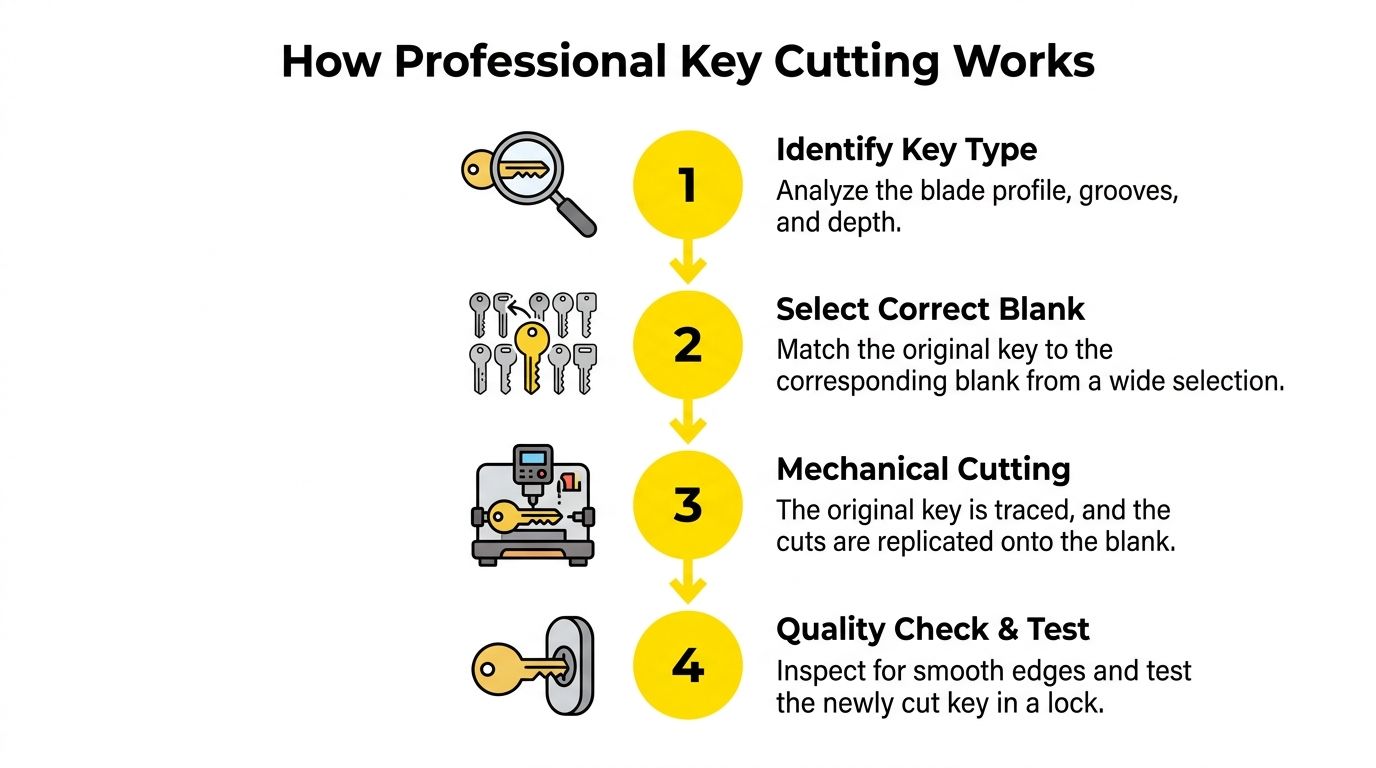
Professional duplication begins with identification, not the cutter. The locksmith checks the key profile, condition, markings and, where relevant, the lock or system documentation. That prevents a common mistake, selecting a similar-looking blank that sits in the cylinder but has the wrong shoulder, groove or profile.
For a standard key, a mechanical duplicator uses the original as a guide while a cutter forms the matching pattern on the blank. Correct alignment matters. So does the condition of the original. A damaged key can transfer its defects to the copy, which is why a locksmith may recommend decoding or another replacement method instead of tracing.
Where equipment makes a difference
More complex keys may require dedicated machinery for dimples, laser-style cuts, angled grooves or registered profiles. The equipment must match the key system, and the operator must know how the resulting cut relates to the lock's access hierarchy.
Self-service machines use similar basic cutting principles for suitable keys, but they don't provide the same hands-on assessment when the original is worn, the lock is difficult, or the key fails after cutting. A professional can identify whether the problem is the duplicate, the original, the cylinder or the door alignment.
The wider trade process is outlined in how professional key cutting is carried out, including the distinction between duplicating an existing key and producing one through another method.
After cutting, the key should be deburred and checked for rough edges or metal fragments. Testing involves insertion, rotation and withdrawal. If the key is for a door that has sagged or shifted, the locksmith can also identify whether the lock is being placed under pressure by the door itself.
A good duplicate should operate cleanly. A key that needs force isn't a successful job simply because it enters the lock.
Restricted Keys and NSW Compliance Rules
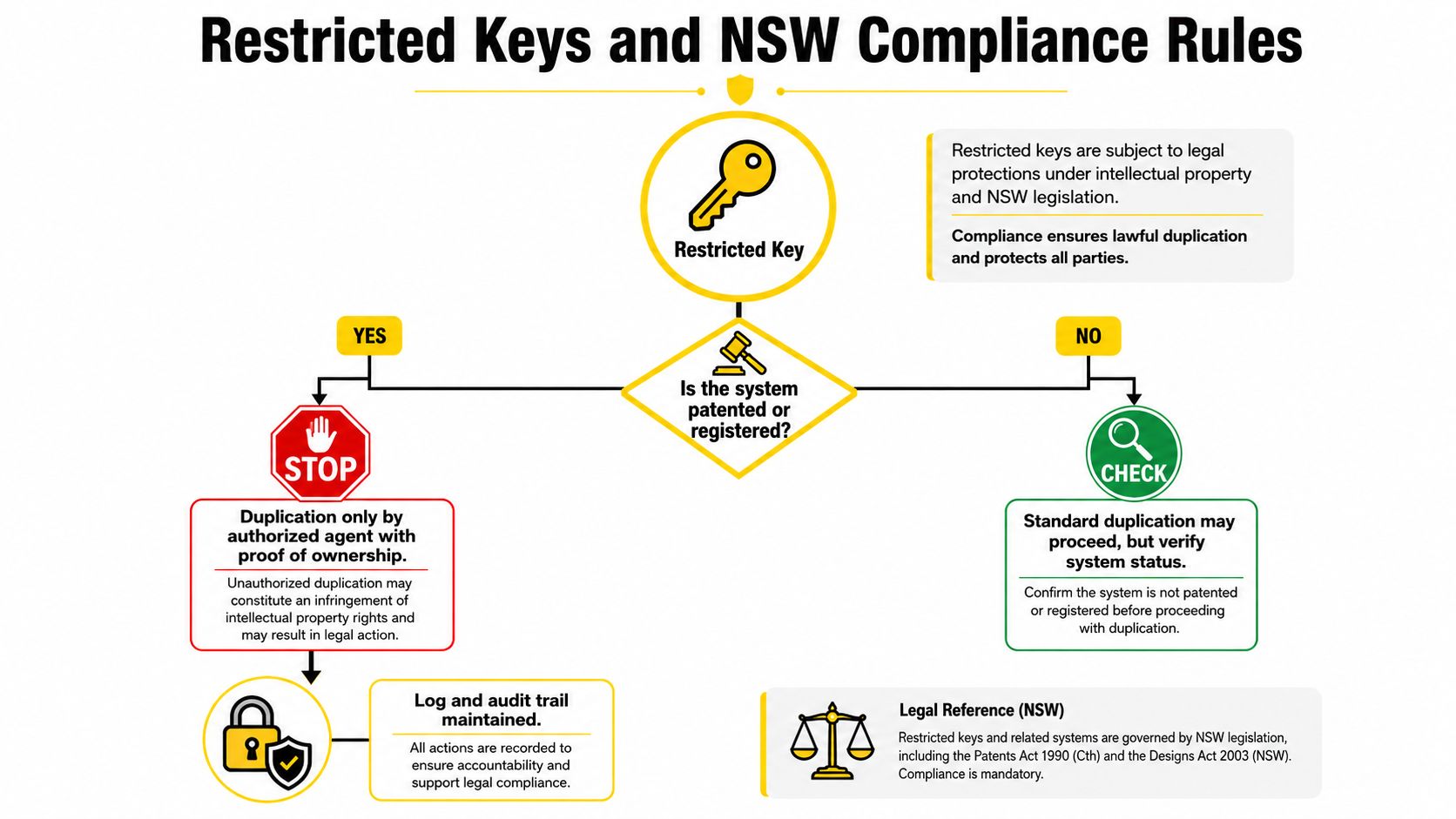
A restricted key request can involve a regulated security activity, not a routine retail copy. In New South Wales, the Security Industry Regulation 2007 classifies duplication of restricted keys as a prescribed security activity requiring a class 2C licence. The duplication process must also follow procedures approved by the Security Industry Council and published with the Commissioner's approval. The applicable framework is set out in the NSW restricted-key compliance reference.
For North Shore homes, strata buildings, offices and commercial premises, the reason is practical. Owners and managers need to control who receives a key, which doors it opens and whether the issue can be checked later. A locksmith is managing authorised access and records, rather than just cutting metal.
The restricted-key process is explained further in this guide to restricted key systems and their administration, including the checks used before another key is produced. Australian restricted platforms may use legally protected or design-registered keyways. Depending on the system, the locksmith may need written or signed authorisation, identity documents and confirmation from the owner, system holder or responsible organisation. These controls reduce unauthorised key production across buildings with residents, staff, contractors and service providers.
Some AU/NZ systems use multi-profile, six-pin in-line designs, anti-pick features and dedicated profiles that limit unauthorised broach sharing. ML20 and IP9 are examples of systems in which authorised dealers control additional key production. Manufacturer or supplier information may describe design registration through future dates such as 2030 to 2034, but those dates apply to particular products and do not establish the status of every restricted system. For a broader explanation of these systems, see restricted key systems and NSW compliance requirements.
The keyway's appearance does not settle the legal position. An ordinary key and a restricted key can look similar, while the required duplication pathway differs.
What property managers should prepare
A request may require:
- Identity verification: The locksmith confirms who is requesting the key.
- Authority checks: The requester provides authority from the owner, registered system holder or responsible organisation.
- System confirmation: The key profile and restriction status are checked before production.
- Records: The job is recorded and handled under the applicable controlled process.
For strata committees and businesses, these steps preserve control after staff changes, tenancy turnover or the end of contractor access. Compliance is part of the security function that restricted systems are designed to provide, not paperwork added after the job.
Professional Locksmith Versus Self-Service Kiosk
A kiosk can be a reasonable shortcut for a plainly identified, standard residential key when the original is in good condition. It becomes a poor fit when the key is restricted, worn, broken, connected to a master-key system, or needed for a security-sensitive site.
The main trade-off is not just convenience versus price. It's limited self-service copying versus a service that includes identification, authority checks, diagnosis and testing.
| Criteria | Professional Locksmith | Self-Service Kiosk |
|---|---|---|
| Accuracy and condition | Can assess whether the original is worn, damaged or unsuitable for tracing, then test the finished key in the lock. | Can copy suitable keys, but the user must identify the problem if the result doesn't work. |
| Key types supported | Can handle standard residential work and assess restricted, coded, master-key and other specialist requirements. | Generally intended for supported key profiles and may not accept controlled systems. |
| Security verification | Can check authority and documentation where the key system requires it. | Doesn't replace a licensed locksmith's restricted-key authorisation process. |
| Fault finding | Can distinguish a poor cut from a worn cylinder, misaligned door or damaged original. | Usually provides no on-site lock diagnosis. |
| Complex or missing originals | Can investigate decoding, lock-based replacement or special-order options. | Requires a usable key or a supported digital process, depending on the machine. |
Situations that change the decision
A standard spare for a trusted household member is different from an office key that opens a secure storeroom. A snapped key in a deadlock needs extraction and assessment before anyone attempts a duplicate. A worn key may need decoding rather than tracing, because copying its defects can leave the property with another unreliable key.
The same caution applies to a restricted office key. If the system owner controls duplication, a kiosk isn't an alternative route. The request must go through an authorised process.
Choose the simplest safe option. Use a kiosk only when the key is ordinary, intact and clearly supported. Use a licensed locksmith when the key controls shared, valuable or restricted access.
Duplicating Keys When the Original Is Missing
A missing original doesn't automatically mean the lock must be replaced. The locksmith first confirms ownership or authority, then examines the lock, door and available information. The method depends on the cylinder, the condition of the hardware and whether a code or system record can be obtained.
The replacement path
Lock decoding reads the internal pin or wafer arrangement and translates it into a cutting code. This allows a replacement key to be produced without tracing the missing original, provided the lock and system are suitable for that method.
Impressioning uses a suitable blank inserted into the lock and manipulated so the internal components leave marks on the blank. Those marks guide the cutting process. It's a specialist technique and isn't appropriate for every lock.
Sometimes the lock must be removed and taken to a workshop for bench decoding. That may be the sensible option where the cylinder is damaged, the keyway is unusual, or the locksmith needs better access to inspect the mechanism.
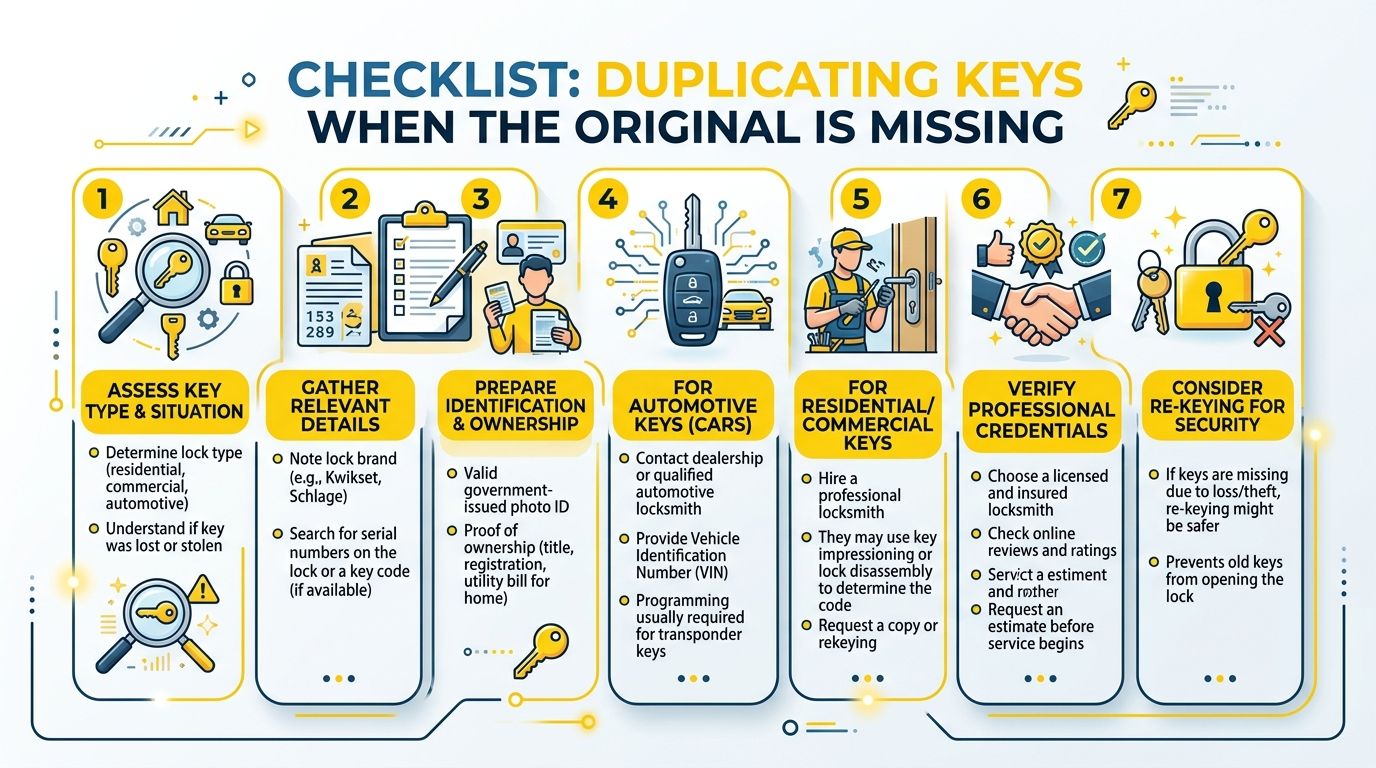
The finished key still needs testing in the lock. The locksmith checks insertion, rotation and withdrawal, then adjusts the cut or investigates the cylinder if operation isn't clean. Where a tenant, landlord, employee or contractor requests the work, authority checks remain part of responsible service.
For landlords and property managers, this process can be useful during a handover when a key has disappeared. NSW tenancy rules require each tenant named on a tenancy agreement to receive a copy of the key, fob or device needed to open locks or security devices at the property, as set out by NSW rental property access requirements.
Costs Turnaround and Next Steps
The cost and timing of a key duplication job depend on the key type, the blank, the cutting method, the need for programming, the condition of the original and whether authorisation is required. A standard key is a different job from a restricted key, a coded replacement or an automotive transponder key.
No responsible locksmith should promise a fixed price before identifying the key and the work involved. A clear quote should account for the actual service, including mobile attendance where required, rather than treating every request as a basic copy.
| Key Type | Estimated Cost Per Copy | Typical Turnaround |
|---|---|---|
| Standard house key | Confirmed by quote after identification | Confirmed by the locksmith |
| High-security or restricted key | Confirmed by quote, with system and authorisation requirements checked | Depends on the profile, blank availability and approval process |
| Automotive transponder key | Confirmed by quote, including any programming requirement | Depends on the vehicle and key system |
| Missing or broken original | Confirmed after assessing the lock, code or remaining key section | Depends on decoding, removal or replacement requirements |
Before booking, check whether the key is restricted, whether the original is worn or damaged, and whether the copy must preserve a master-key hierarchy. The practical difference between ordinary duplication and controlled replacement is explained further in this guide to key cutting costs.
Lock, Stock & Barrel Locksmiths provides mobile residential and commercial locksmithing across Sydney's North Shore, including key cutting, replacement keys, rekeying and master-key work. For a quote or advice about a missing, worn or restricted key, visit Lock, Stock & Barrel Locksmiths and request the appropriate service for the property.