- 24 Hour Emergency Services
- Servicing Sydney's North Shore
- View On Map

-
Mail Us On
info@lsblocksmiths.com.au
-
Make a Call
0411 700 072
- View On Map
- 24 Hour Emergency Services
- Servicing Sydney's North Shore
- View On Map
-
Mail Us On
info@lsblocksmiths.com.au
-
Make a Call
0411 700 072
- Contact Us
Safe Lock Replacement in Hornsby NSW Guide

Lock, Stock & Barrel Locksmiths
On July 23, 2026
A safe that won't open at the wrong moment can turn into a bigger headache than the lock itself. On the Upper North Shore, that usually means a homeowner in Hornsby standing in front of a safe with documents, jewellery, or keys inside, wondering whether a quick fix will work or whether the whole lock needs changing. The right call depends on the safe body, the lock type, and whether the issue is hardware, alignment, or simple power loss.
In Australia, safe lock replacement sits inside a broader compliance and risk framework, not just a hardware swap. The Master Locksmiths Association of Australasia is the peak industry body in the region, and replacements are expected to line up with insurer expectations and practical access-control needs according to the market overview. For Hornsby homes and businesses, that means the lock choice has to make sense for the safe, the building, and the way the safe is used. A cheap-looking fix can become expensive if it creates a lockout, damages boltwork, or leaves an insurer unhappy after the fact.
A better approach starts with diagnosis, then moves to replacement only when replacement is the real answer. That's how a father-and-son locksmith team works on the North Shore, keeping the decision practical instead of theatrical. For readers choosing a safe in the first place, this safe selection guide helps frame the question before the lock ever fails.
Introduction to Safe Lock Replacement
A Hornsby callout often begins the same way. The safe is there, the contents matter, and the dial or keypad suddenly refuses to cooperate. The pressure is immediate, but forcing the issue is how people turn a manageable repair into a locked-out safe.
The smarter read is that safe lock replacement is part of a wider access-and-risk decision. The lock is only one piece. The condition of the safe body, the mounting, the way the boltwork travels, and the insurer's expectations all matter, which is why the Master Locksmiths Association of Australasia matters so much in the Australian market as noted in the market overview. In plain terms, a safe lock has to fit the safe and the job, not just the cut-out on the door.
What usually changes the decision
A replacement makes sense when the lock is worn out, the electronics are failing, or the mechanical components no longer index cleanly. It also makes sense when the old lock no longer suits the user, such as a change from a single-user home safe to a shared office safe with tighter access control.
Practical rule: a safe should be judged as a system, not as a loose lock bolted to a door.
That's why local advice in Hornsby needs to be blunt. If the safe is old, damaged, or badly set up, replacement may be only part of the fix. If the safe itself is sound, the lock work can usually be planned rather than rushed. That planning is what keeps a small access issue from becoming a drilling job.
Diagnosing Safe Lock Issues Before Replacement
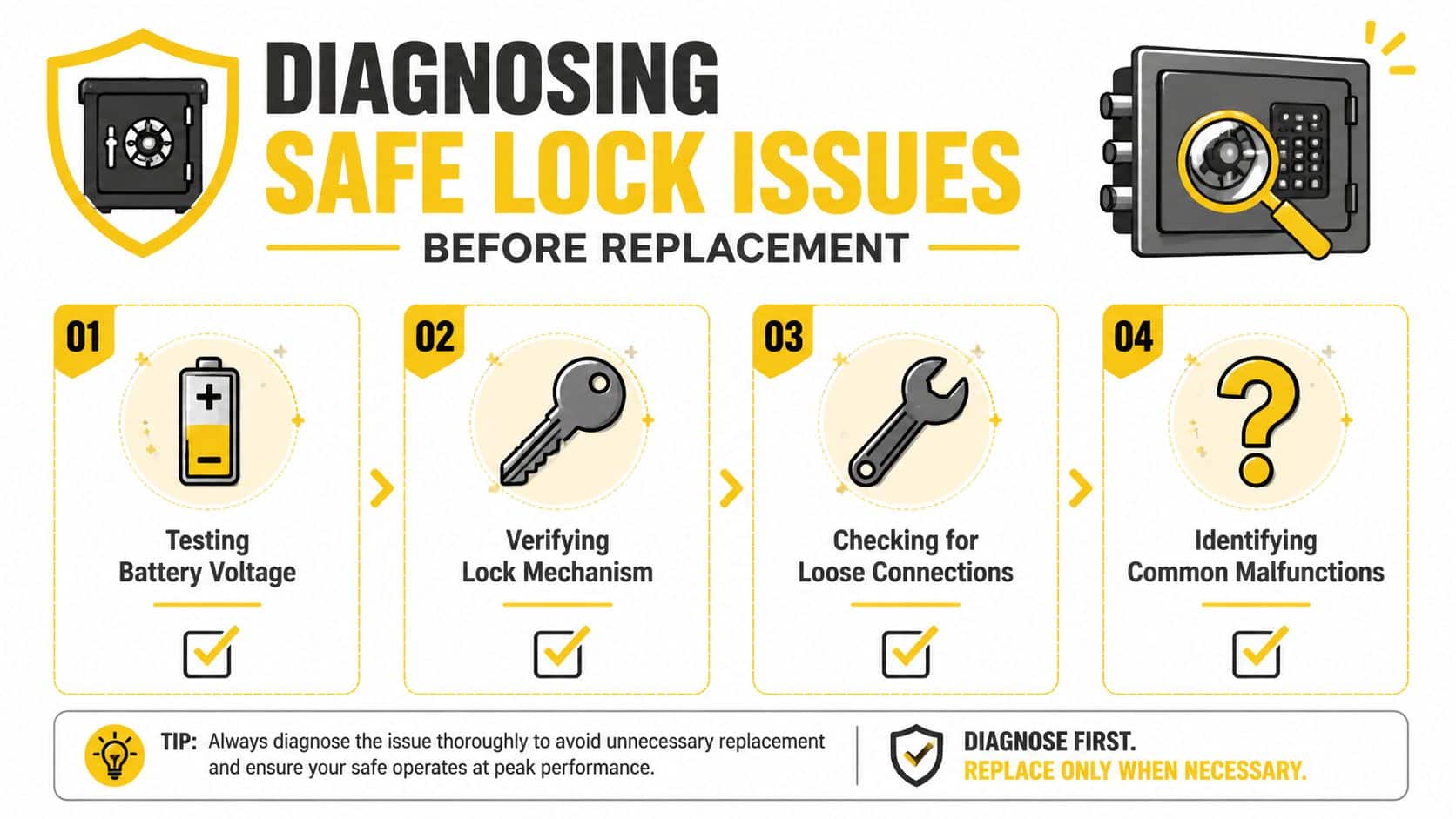
Most failed safes don't begin with a dead lock. They begin with a battery that's past its useful life, a bolt under pressure, a keypad that's been mistyped too many times, or contents pressing hard against the boltwork. One manufacturer's FAQ advises using a battery with an expiry five years ahead and replacing batteries every six months to reduce lockouts from power loss Cannonsafe FAQ. That gives a concrete maintenance habit, not a vague “change them occasionally” rule.
Check the easy failures first
Electronic safes deserve a calm check before replacement is even discussed. If the keypad is dark, sluggish, or inconsistent, the battery is the first suspect. If the keypad lights up but the safe won't release, the boltwork may be under load or something inside may be pressing against the door.
Mechanical safes need a different eye. A sticky dial, a lost combination, or a handle that won't move smoothly can point to an alignment problem as much as a failed lock. A lot of consumer guides stop at the symptoms, but the better question is whether the safe is failing or just resisting movement.
Signs that point away from replacement
A full swap is not always the right fix. If the safe works after fresh batteries, after the contents are shifted away from the bolts, or after the dial is carefully reset, the hardware may still be serviceable. That saves time, avoids unnecessary parts, and keeps the safe closed on its own terms instead of on a drill hole.
If the keypad wakes up after battery replacement, the lock may never have been the real problem.
The best local habit is simple. Try the obvious maintenance first, check for pressure on the boltwork, and only then move toward replacement. That approach matters on the North Shore because a needless service call is cheaper than a drill-out, but a confident diagnosis is cheaper still.
Replacing Electronic Keypad Safe Locks
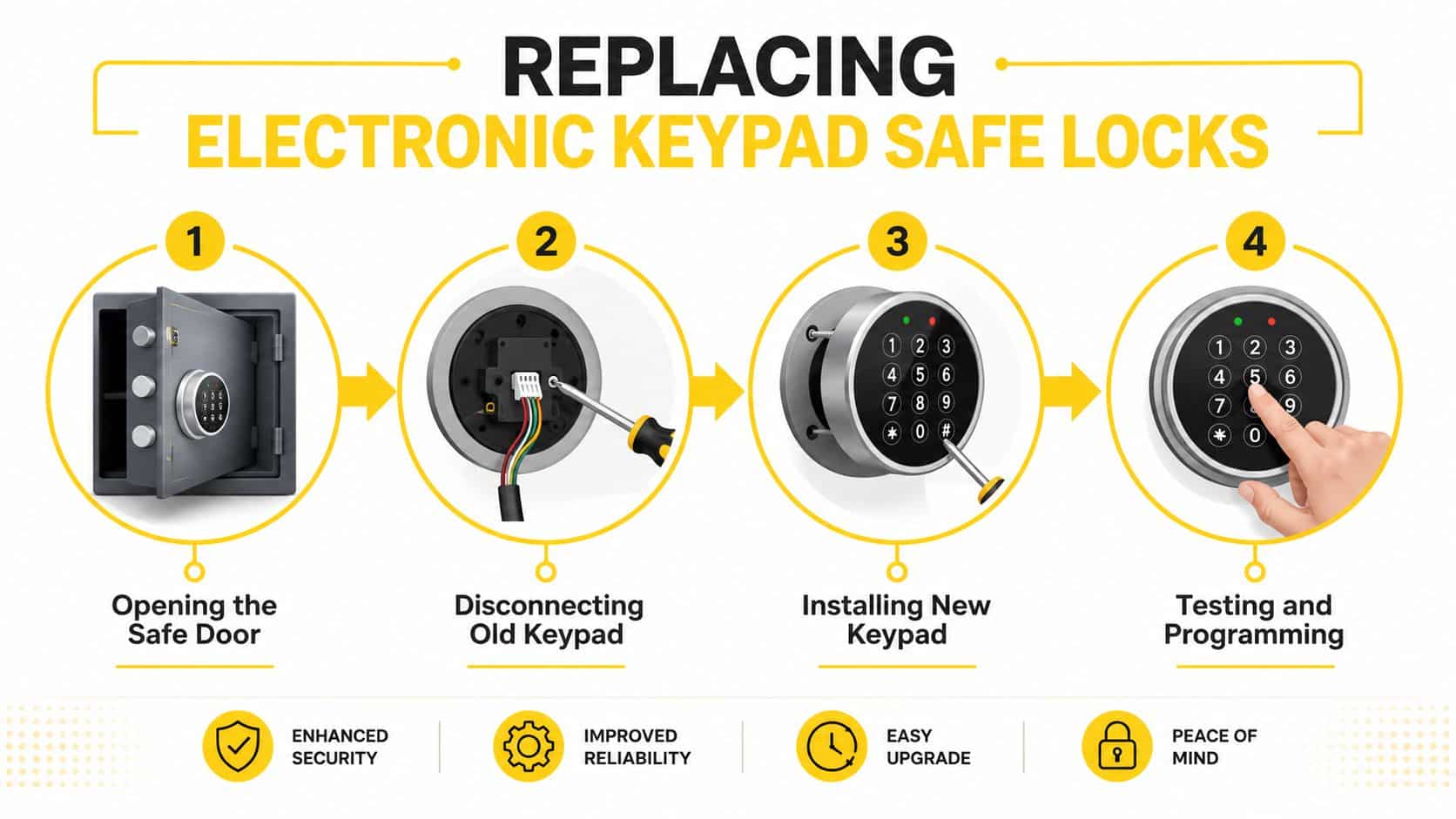
Electronic safe work needs a methodical hand. The door stays open, the cover comes off, and power is disconnected before anything is moved. That sequence matters because the safe has to remain open long enough to test the new lock and confirm the boltwork still behaves properly as set out in the operational benchmark.
The basic workflow
The old keypad or lock body is removed only after the safe is open and stable. The new unit is then dry-fitted into the existing mounting holes to check that it sits where the old one sat. If the new body doesn't line up, forcing it is a bad move, because a small mismatch can create a dead safe and an unnecessary lockout.
Wiring comes next, but only after the fit is right. The lock has to be connected, tested, and programmed before the cover goes back on. That test phase is where many DIY jobs go wrong, because the safe can look finished while the lock still hasn't proved it will open twice in a row.
Why testing before reassembly matters
A safe that has not been function-tested is still unfinished work. The door must stay open while the new keypad responds, the motor or solenoid cycles, and the boltwork releases cleanly. Only then should the cover go back on and the safe be closed.
For Hornsby homes and small businesses, this is the point where shortcuts cost more than labour. If the lock is a poor match, or if the mounting dimensions differ, the job can stop there instead of turning into a panic call after dark. That's also why digital lock options should be weighed against how the safe is used, not just on the look of the keypad.
Replacing Mechanical Dial and Key Locks
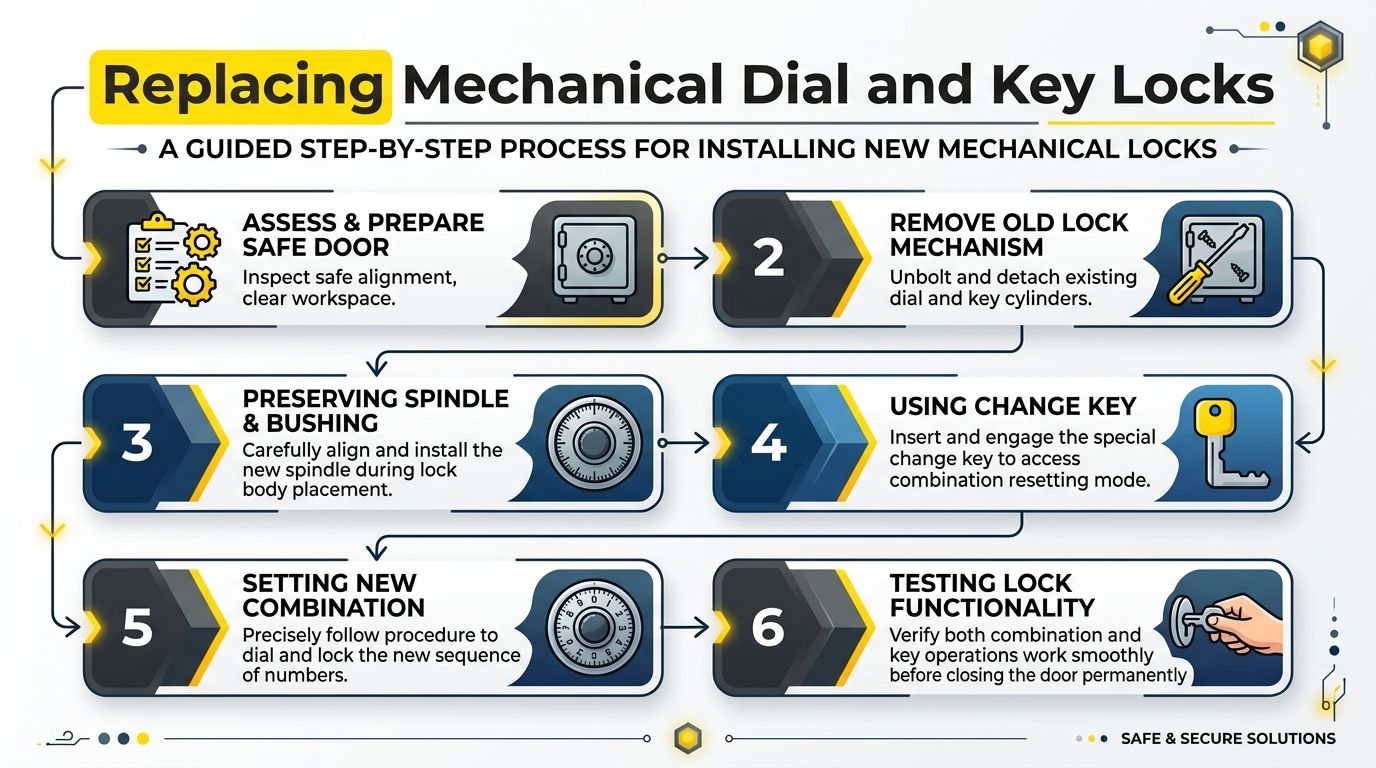
Mechanical safes punish sloppy alignment. The spindle, bushing, drive cam, and change-key setup all need to sit exactly where the lock expects them to sit. A correct replacement depends on preserving those parts and then running repeated open-close tests to catch indexing errors before final assembly as shown in the mechanical lock reference.
Fit matters more than force
The common mistake is assuming the new dial or barrel will fit directly into the old unit's place. In practice, the spindle length and cam position have to suit the safe body. If the spindle is too long, too short, or left under tension, the boltwork can bind and the safe won't open cleanly.
That's why technicians check the factory combination, use the change key where required, and then test the new combination several times before the job is closed up. One failed test is a warning. Multiple failed tests mean the indexing or fit still isn't right.
What gets checked before final tightening
The following points usually separate a neat job from a frustrating one:
- Spindle alignment, because even a small offset can stop the bolt from retracting.
- Bushing condition, because worn support parts create drag the lock has to fight.
- Drive cam seating, because the cam needs to sit snugly without side tension.
- Combination response, because a dial that almost works is still not reliable.
A mechanical safe should feel smooth before the door is shut. If it doesn't, something still needs correcting.
That process sounds fussy because it is fussy. Mechanical locks have very little tolerance for guesswork, which is exactly why a careful replacement is cheaper than opening a safe that was put back together too soon.
DIY Versus Professional Safe Lock Replacement
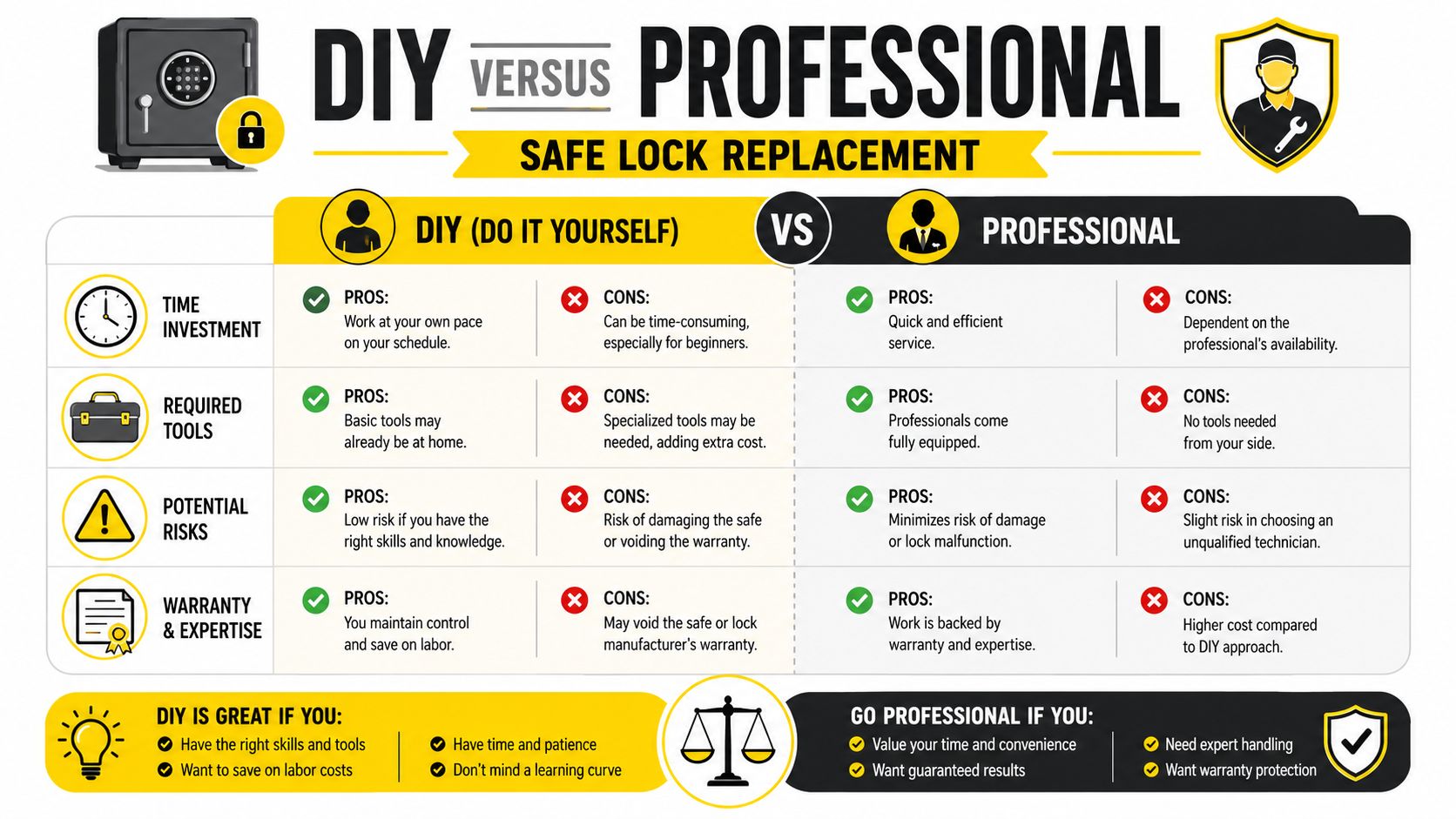
A safe lock job looks tempting as a DIY task until the door refuses to close again. That's the real divide. A confident owner can change batteries, inspect the obvious, and sometimes swap a compatible unit. A wrong move can turn a straightforward job into a drilled safe, and safe work is materially more expensive than ordinary lock replacement. A 2017 locksmith price survey reported USD 170 for safe installation and USD 350 to open an in-floor safe by drilling, while cylindrical deadbolt installation sat at USD 60 and cylindrical lever lock installation at USD 65 survey results.
What DIY suits
DIY makes sense when the issue is simple and visible, such as changing electronic batteries or checking whether the safe has shifted against the boltwork. It also suits owners who already know the lock model, the mounting dimensions, and the reset process. The risk stays lower when the safe door is already open and the work is limited to maintenance rather than internal replacement.
Where professional help pays for itself
Professionals earn their keep when the lock and the safe body no longer match neatly, when a mechanical dial needs precise indexing, or when the safe has to stay secure through the whole process. That's the point where a father-and-son team brings value through sequencing, not just tools. On jobs like that, the difference is often whether the safe stays open while the work is tested or gets closed before anyone knows it works.
For North Shore property owners comparing options, this rekeying-versus-replacing guide is a useful way to think about replacement logic more broadly.
A simple decision check
- Choose DIY when the fault is clearly maintenance-related and the safe is already open.
- Choose a locksmith when mounting, spindle length, programming, or boltwork alignment is uncertain.
- Avoid guessing when the safe contains documents, cash, or anything that can't sit outside for a few more hours.
Lock work is one of those trades where the cheapest-looking option can cost the most if it goes wrong. On a safe, that risk is amplified because the mistake can lock the owner out of the very thing they're trying to protect.
Choosing a Local Locksmith in Hornsby NSW
Hornsby jobs reward locksmiths who know the local building stock, the access conditions, and the difference between a real emergency and a poorly diagnosed one. A sensible first filter is licensing and professional membership, because safe work should sit inside a proper compliance framework. The other filter is whether the locksmith asks diagnostic questions before talking about replacement.
Look for clear quoting, plain explanations, and a service vehicle that looks set up for mobile safe work. A technician who asks about the safe type, the lock type, and whether the door is currently open is usually thinking in the right order. A technician who jumps straight to drilling is probably skipping steps.
For a Hornsby homeowner or office manager, the useful questions are simple:
- Can the lock be tested before replacement is confirmed?
- Does the new lock match the existing mounting dimensions?
- Is the safe suitable for a mechanical-to-electronic or electronic-to-mechanical change?
- Will the job be left open and tested before the cover goes back on?
Lock, Stock & Barrel Locksmiths is one local mobile option that handles safe installs, repairs, and re-keying across Sydney's North Shore. For anyone comparing quotes in Hornsby, the better call is the one that starts with diagnosis, explains the trade-offs clearly, and leaves the safe working before it's shut again.
Call Lock, Stock & Barrel Locksmiths for a Hornsby safe lock assessment if the safe is sticking, the keypad has gone quiet, or the dial feels wrong. A proper callout can separate a battery fix, a realignment job, and a full replacement before the problem turns into a lockout.